Jeremy Bentham
His will directed that his body be dissected in front of an audience, then dressed, seated in his own chair with his own walking stick, and kept in a case. It was done in 1832. It is still being done. No court has ever been asked to enforce it.
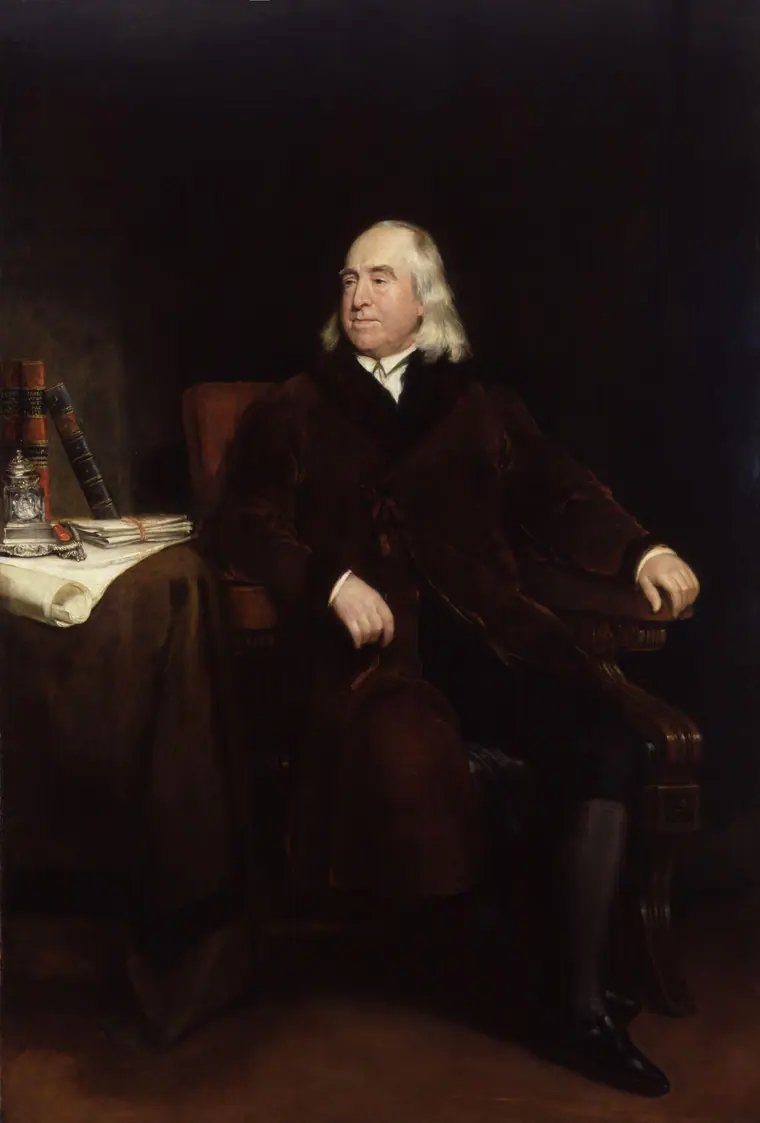
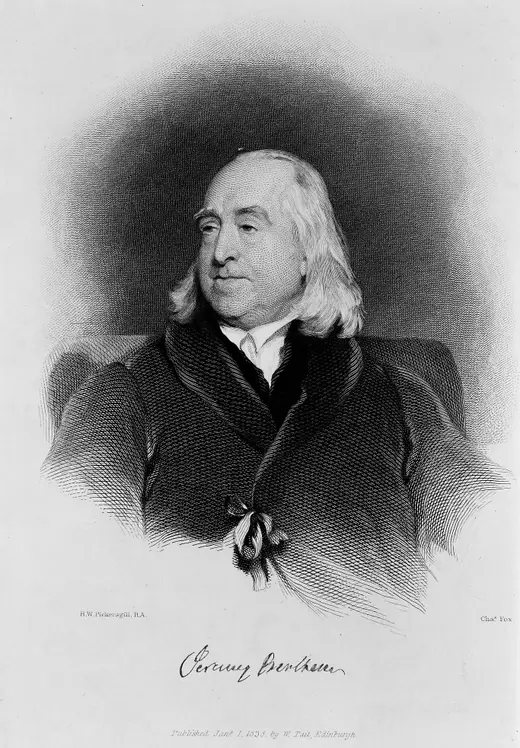
Jeremy Bentham — the founder of utilitarianism, the man who designed the panopticon and coined the phrase about the greatest happiness of the greatest number — died in London on June 6, 1832, aged 84.
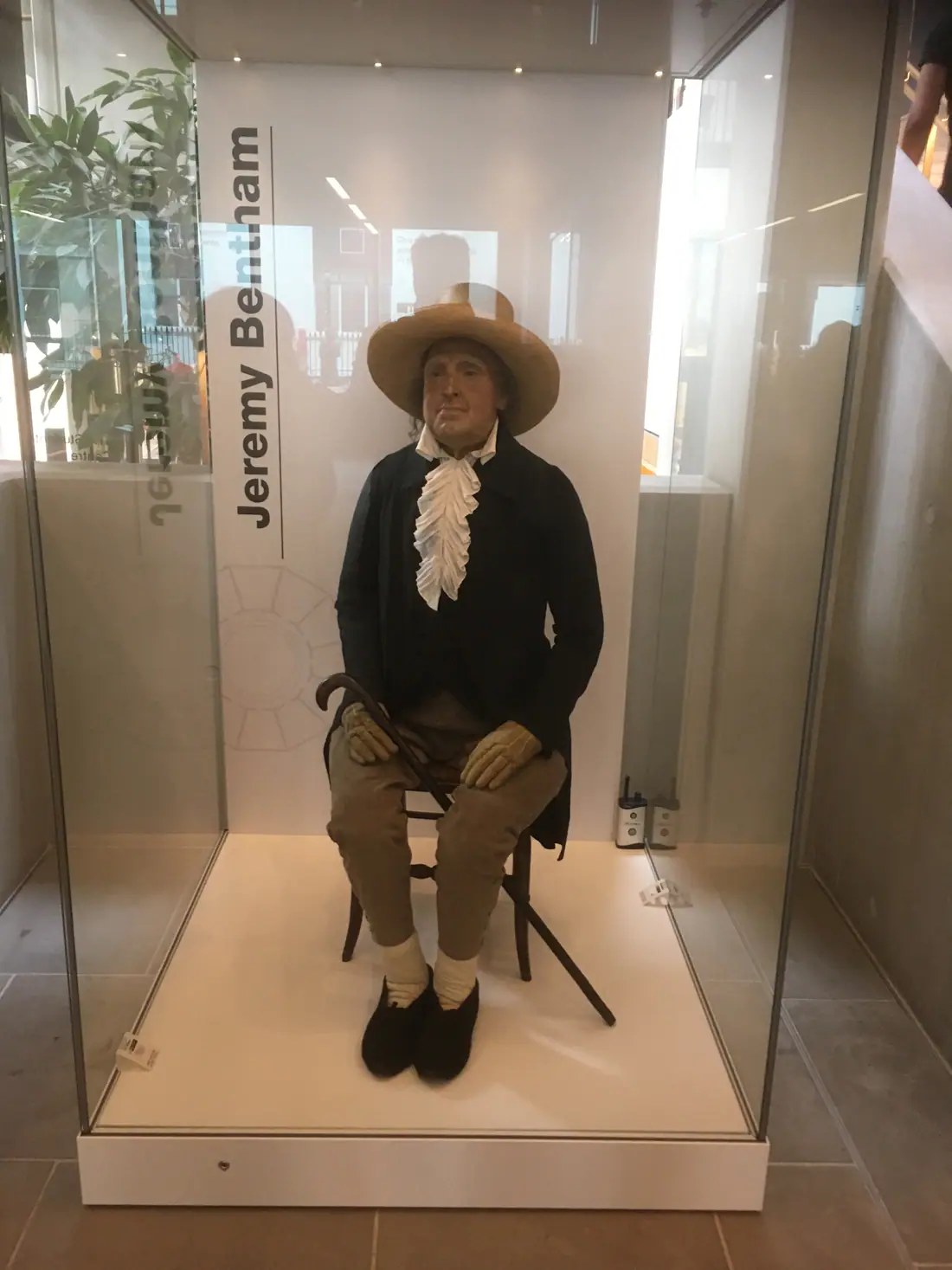
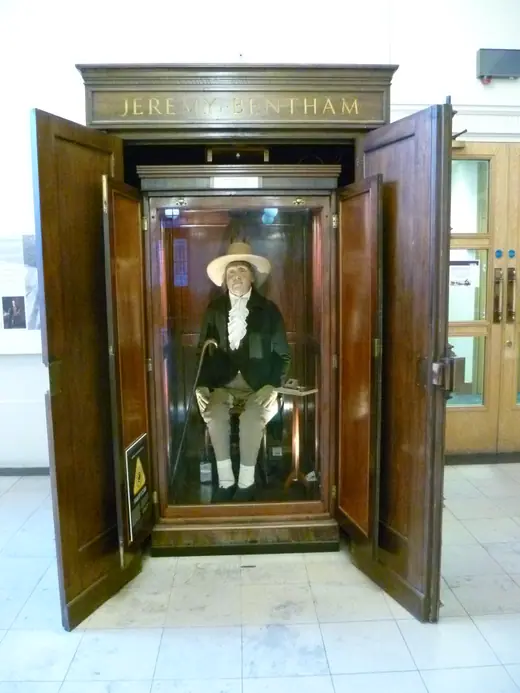
His will, dated May 30, 1832, seven days earlier, gave his body to his friend Dr. Thomas Southwood Smith. It directed that the body be dissected for the instruction of medical science, and then that the skeleton be reassembled, clad in one of his own black suits, seated in his own chair with his own walking stick, and placed in a case — arranged, in his words, in the attitude in which he sat when engaged in thought. He called the result an Auto-Icon.
Southwood Smith did it. He kept the finished object in his house on New Broad Street for eighteen years, and in 1850, moving to smaller premises, gave it to University College London.
It is still there. Since February 20, 2020 it has stood in a glass case on the ground floor of UCL's Student Centre, having spent the previous several decades in the South Cloisters of the Wilkins Building.
A directive he worked on for sixty-three years
The comfortable assumption is that this was the last eccentricity of a very old man. UCL's own Bentham Project has published the wills, and it was not.
His first will, in 1769, was made at 21. It already gave his body away — to the Scottish physician George Fordyce — on the stated hope that mankind might reap some small benefit from his decease. Later wills, in 1785 and 1792, dealt with other things. A codicil in 1824 is where the Auto-Icon itself first appears by name. Dr Tim Causer of the Bentham Project has put the point plainly: this was not a final whim but something Bentham had thought seriously about for a very long time.
That matters legally, and not just biographically. The most common attack on an unusual testamentary instruction is that it reflects a mind that had recently changed — undue influence, insane delusion, a late and out-of-character amendment. A directive that appears in draft after draft across sixty-three years is close to immune to that argument. Consistency over time is evidence.
There was a purpose behind it too. Britain in 1832 had a severe shortage of legally available cadavers for anatomical teaching, and an associated trade in stolen ones. Bentham's dissection was a public argument. Parliament passed the Anatomy Act 1832 later that same year.
A public dissection and a wax head
On June 9, 1832, three days after the death, Southwood Smith carried out the dissection at the Webb Street School of Anatomy and Medicine, before an invited audience of doctors, scholars and writers. He delivered a lecture over the body on the usefulness of such knowledge to the community, and then proceeded. Contemporary accounts note that a thunderstorm broke during it.
The skeleton was preserved and articulated. The head was another matter. Southwood Smith attempted to dry it over sulphuric acid using an air pump, following a preservation method Bentham had admired. It did not work — the result was discoloured and distorted — so a wax head was made instead, and that is what sits on the figure today.
The actual head has been kept separately. It has been in secure storage since 1975, and is not on general display.
Everything else was executed exactly as written: the black suit, the chair, the stick, the case.
One hundred and ninety-four years of compliance, and no litigation
Here is the interesting part for anyone drafting one of these.
Nothing about this arrangement was legally enforceable in any strong sense. In 1832 there was no property in a corpse to give away, and there still isn't. Southwood Smith was not a trustee holding an asset. UCL did not buy anything and does not, in the ordinary sense, own a person. No court has ever been asked to order anyone to keep the Auto-Icon on display, and if one were asked, the remedy would be awkward at best.
It has been performed for 194 years for three reasons that have nothing to do with enforcement mechanisms. The instruction was specific — a suit, a chair, a stick, a case, an attitude — so nobody ever had to interpret it. It was given to a named individual who had agreed in advance and cared about the outcome. And it was given to that person along with a reason that the recipient institution then adopted as its own.
That is the general lesson of unusual final instructions, and it holds in Sarasota as firmly as in Bloomsbury. The documents that get followed are not the ones with the strongest clauses. They are the ones handed, before death, to a specific person who has already said yes.
Timeline
- 1769Bentham, aged 21, makes a will leaving his body to the physician George Fordyce so that mankind may reap some benefit from his decease.
- 1824A codicil first describes the Auto-Icon itself.
- May 30, 1832The operative will: the body to Dr. Thomas Southwood Smith, for dissection and then for preservation as an Auto-Icon, dressed and seated.
- Jun 6, 1832Bentham dies in London at 84.
- Jun 9, 1832Public dissection at the Webb Street School of Anatomy and Medicine, with a lecture delivered over the body.
- Aug 1832Parliament passes the Anatomy Act 1832, expanding the lawful supply of cadavers for anatomical teaching.
- 1850After eighteen years in Southwood Smith's London house, the completed Auto-Icon — with a wax head substituted for the failed preservation — is given to University College London.
- 1975The preserved head is placed in secure storage, separate from the figure.
- Feb 20, 2020The Auto-Icon moves from the South Cloisters of the Wilkins Building to a glass case in UCL's Student Centre.
What actually went wrong
- Almost nothing — which is the point. This entry is in the archive as a control group. The instruction was written down, repeated across six decades, given to a named person who had agreed, and accompanied by a reason. It has been performed for 194 years without a single court order.
- The one clause that failed was the technical one. The head preservation did not work. Bentham had specified a method; the method was wrong. Instructions that depend on a particular technique succeeding should say what to do if it does not.
- No funding mechanism. Bentham left no endowment for the Auto-Icon's upkeep. It has survived on the goodwill of one man and then one university. That worked. It very often does not.
- No succession plan. The will named Southwood Smith. It did not say who takes custody after him. The 1850 transfer to UCL was a private arrangement, not a directed one — an eighteen-year gap in the chain that nobody had planned for.
Would it have gone that way in Florida?
Florida would honour it, and would do it better — your written directions outrank every relative, an anatomical gift becomes irrevocable at death, and Florida will now fund the upkeep for a thousand years.
Bentham's instruction is the thing Florida law is built to protect, and Florida gives you three separate tools he did not have.
First, the disposition itself. Fla. Stat. §497.005 defines the “legally authorized person” entitled to direct the disposition of remains, and the first entry on that list — above the spouse, above the children, above everyone — is the decedent's own written inter vivos directions. Bentham's Auto-Icon clause is precisely that kind of document. In Florida it would sit at the top of the statutory hierarchy from the moment it was signed and delivered.
Second, the anatomical gift, which is stronger still. The dissection half of Bentham's plan is an anatomical gift in modern terms, and Florida's Uniform Anatomical Gift Act, at Ch. 765, Part X, governs it. Under §765.512, anyone competent to make a will may make an anatomical gift for the purposes listed in §765.513 — including research and education, not only transplantation. And here is the part that matters: once validly made and not revoked, an anatomical gift is irrevocable at the donor's death, and the family cannot override it. That is a materially stronger protection than the §497.005 hierarchy, which merely ranks people who might disagree. The anatomical gift removes the disagreement.
Third, the money — and this is where 2022 changed things. Bentham left nothing to maintain the Auto-Icon. In Florida you could. §736.0409 permits a trust for a noncharitable purpose with no definite beneficiary, enforceable by a person named in the trust instrument or by a court-appointed enforcer, and since the 2022 amendment such a trust may be enforced for up to 1,000 years. It is the same machinery that supports Florida's pet trust under §736.0408, aimed at an object rather than an animal. Excess funds beyond the purpose revert to the settlor's estate, so it cannot be used to warehouse money.
The honest caveat, and it is the same one Bentham ran into. No Florida statute compels a museum, university, or anyone else to accept the object or to keep displaying it. You can direct what happens to your remains; you cannot conscript an institution into curating them. Any plan of this kind still depends on an institution that has agreed in advance and in writing — which is exactly what UCL did in 1850, and why this has lasted.
The instruction: if you want something unusual done, do the three things Bentham did and the one he didn't. Put it in a standalone signed document, not buried in a will. Give it to a named person who has already agreed, plus the funeral provider. Say why, in your own words, because a stated reason is what makes people follow an instruction they find strange. And then fund it, under §736.0409, so the person you named is not paying for your idea out of pocket.
What people ask us about this.
Further reading
Third-party sites. Not ours, not endorsed, not kept current by us — just the places worth going next.
Sources
- Auto-Icon — UCL Faculty of Laws — Bentham Project
- Bentham's wills reveal lifelong plans for auto-icon — UCL News, Feb 2021
- What is Jeremy Bentham's Auto-Icon? — Encyclopaedia Britannica
- Jeremy Bentham auto-icon — Humanist Heritage, Humanists UK
- The 'Auto-Icon' of Jeremy Bentham at University College, London — Medical History (Cambridge University Press)
- Fla. Stat. §765.512 — Persons who may make an anatomical gift — The Florida Senate
- Fla. Stat. §736.0409 — Noncharitable trust without ascertainable beneficiary — The Florida Senate
If this is your situation
Free 30-minute consult. Plain English. No pressure.
Nearly every case in this archive turned on something ordinary — an unwitnessed page, a stale beneficiary line, a document nobody could find. Those are cheap to fix while you're alive and expensive to fix afterward.