John Porter Bowman
Bowman buried a wife and two daughters, built them a $75,000 mausoleum, then left $50,000 in trust to keep his Vermont mansion maintained exactly as he left it — in case the family came back. The money ran out in the 1950s.
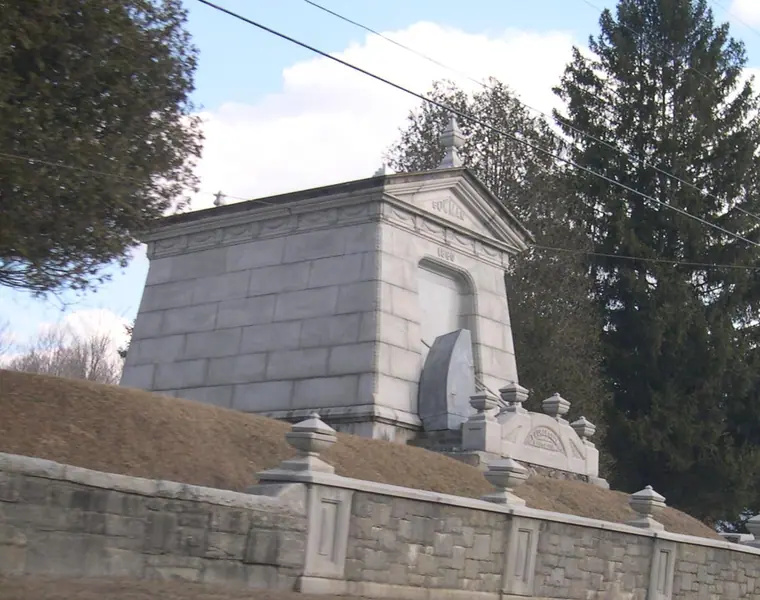
John Porter Bowman was born in 1816 at Clarendon, Vermont, learned the tanning trade in Rutland at fifteen, and built a fortune in leather — tanneries in Cuttingsville and at Stony Creek, New York, and, decisively, government contracts during the Civil War.
Then, in six years, he lost his family. His daughter Addie had died in 1854 at four months old. His daughter Ella died in June 1879. His wife Jennie died in January 1880.
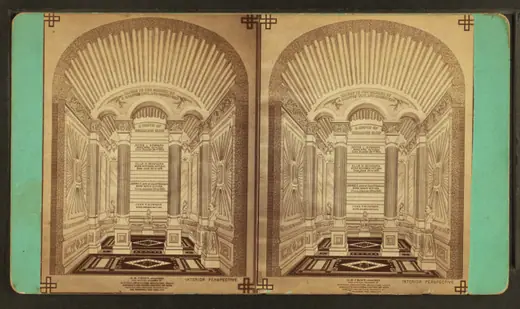
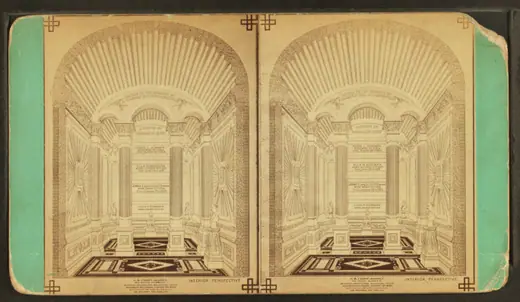
What Bowman did next is documented in extraordinary detail because it required an industrial supply chain. In July 1880 he began construction of the Laurel Glen Mausoleum at Cuttingsville, to a design by the architect G.B. Croff. The reported cost was $75,000. The materials list survives: 750 tons of granite, 50 tons of marble, 20,000 bricks, and 525 barrels of English Portland cement. The Italian sculptor Giovanni Turini executed the interior statuary — busts of the wife and daughters, and, outside on the steps, a life-size marble figure of Bowman himself, kneeling, in mourning coat and top hat, wreath in hand, facing the door.
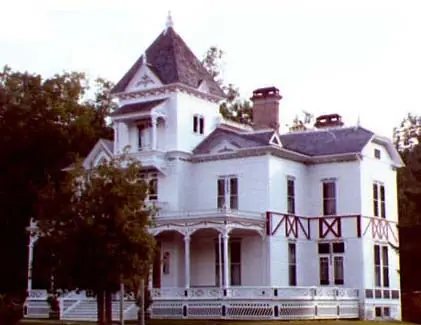
Across the road he built Laurel Hall, also by Croff, with a carriage barn, an icehouse, a caretaker's cottage, and landscaped grounds. He lived there for eleven years and died in the house on September 18, 1891.
Fifty thousand dollars to keep a house ready
Bowman's will left $50,000 to the U.S. Trust Company of New York, in trust, with instructions that the estate be maintained exactly as he left it. A Laurel Glen Cemetery Association was formed in 1894 to administer the arrangement, with friends of Bowman named to run it.
The purpose, as it has been recorded ever since, was that the house should be kept in readiness in case Bowman and his family returned. He was a spiritualist, which was not an unusual thing to be in 1891 Vermont, and he appears to have meant this as a genuine contingency rather than a metaphor.
- What the record supports: a $50,000 trust to maintain the mansion, the mausoleum, and the grounds in perpetuity, in the condition Bowman left them.
- What the record does not support: the most-repeated version of the story, in which servants laid a full dinner in the dining room every single night for the returning dead. The National Register documentation for Laurel Hall notes that no documentary evidence supports the servant-dinner legend.
That distinction is worth keeping straight, and it does not diminish the case. A man directing that his house be maintained indefinitely against the return of his dead wife and daughters is remarkable enough without the nightly place settings.
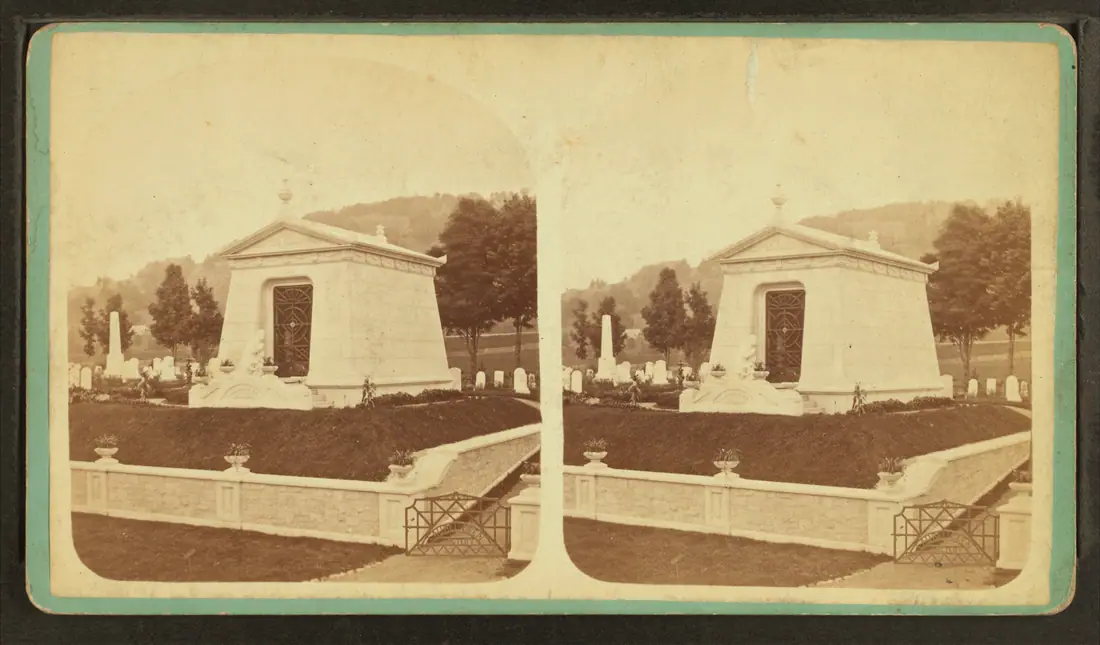
Perpetuity lasted about sixty years
The trust performed for four decades. Then it did what unsupervised long-horizon funds do.
Bad investments in the 1930s and 1940s depleted the fund. By the 1950s the money was gone. The house's furnishings were auctioned in 1953 — the contents of the mansion that had been maintained exactly as Bowman left it, sold to pay for the maintenance of the mansion.
Laurel Hall passed through private hands afterwards. The mausoleum survives, and the marble Bowman is still kneeling on the steps, which is more than most testamentary monuments manage. The instruction that everything be kept exactly as he left it is the one part of the plan that failed completely.
$50,000 in 1891 was a serious endowment — roughly the value of the entire estate of a prosperous family. It was not enough to run a mansion, a mausoleum, and landscaped grounds forever, and nothing in the document allowed anyone to notice that in time and change course.
Timeline
- 1816John Porter Bowman is born at Clarendon, Vermont. He enters the tanning trade at fifteen and later makes a fortune selling leather goods to the United States government during the Civil War.
- 1854His daughter Addie dies at four months old.
- Jun 1879His daughter Ella dies.
- Jan 1880His wife Jennie dies.
- Jul 1880Construction begins on the Laurel Glen Mausoleum at Cuttingsville, designed by G.B. Croff. Reported cost $75,000; 750 tons of granite and 50 tons of marble.
- Sep 18, 1891Bowman dies at Laurel Hall. His will leaves $50,000 in trust to the U.S. Trust Company of New York to maintain the estate exactly as he left it.
- 1894The Laurel Glen Cemetery Association is formed to administer the trust.
- 1930s–1940sBad investments deplete the trust fund.
- 1953The furnishings of Laurel Hall are auctioned. The trust that was to preserve the house exactly as Bowman left it has run out.
What actually went wrong
- A perpetual obligation funded by a fixed sum. $50,000 against a mansion, a mausoleum, outbuildings, and grounds, forever. There was no mechanism to add capital and no authority to reduce the standard of care.
- “Exactly as he left it” with no room to interpret. An instruction that admits no substitution or scaling-back gives a trustee nothing to work with when the money starts running short.
- No investment standard and no oversight. Bad investments across two decades depleted the fund, and the beneficiaries — being deceased — were in no position to object.
- A purpose with no living beneficiary. Nobody had a personal financial stake in the trust performing. Trusts that nobody is waiting on are the ones that quietly fail.
- No termination or gift-over. The document did not say what should happen if the fund became inadequate. So the answer was decided by an auctioneer in 1953.
Would it have gone that way in Florida?
Florida would enforce it — for up to 1,000 years — and would give someone the power to shut it down when the money ran low.
Bowman's trust has no living beneficiary and no charitable purpose. Under the classic rule that made it legally fragile: a trust needs someone with standing to enforce it, and a dead family cannot sue a trustee.
Florida solved that problem by statute. §736.0402 requires a definite beneficiary — and then excepts charitable trusts, pet trusts, and noncharitable trusts without an ascertainable beneficiary. The governing provision is §736.0409, and it fits Bowman's arrangement precisely:
The trust may be created for a noncharitable purpose with no definite beneficiary, so long as the purpose is valid. It may be enforced by a person designated in the trust instrument, or, if none is designated, by a person appointed by the court — this is the enforcer, the thing Bowman's arrangement most needed and did not have. Property may be applied only to the intended purpose, and if the value of the trust property exceeds what the purpose requires, the excess passes back to the settlor or the settlor's estate. And the outer limit: the trust may not be enforced for more than 1,000 years. Florida's perpetuities policy under §689.225 runs to the same horizon.
So a modern Florida Bowman gets more than Vermont gave him: statutory authority, a named enforcer with standing, and a millennium of runway.
What Florida also supplies is the off-switch. §736.0414 permits a trustee to terminate a trust holding less than $50,000 if the trustee concludes the value does not justify the cost of administration — and permits a trustee or qualified beneficiary to petition a court for modification or termination on the same reasoning at any value. When Bowman's fund began failing in the 1930s, a Florida trustee would have had a clean statutory route to wind it down and distribute the remainder consistently with the trust's purposes, rather than administering it into an auction. §736.04113 and §736.04115 offer judicial modification on top of that.
The caveat is that §736.0404 still governs: a trust's purposes must be lawful, not contrary to public policy, and possible to achieve. Maintaining a house against the return of the dead is not unlawful and is not contrary to public policy — it is simply upkeep, and courts do not audit motive. Whether it is possible to achieve is a funding question, not a metaphysical one, and that is exactly where Bowman's failed.
The instruction for anyone who wants a property maintained after they are gone — and this is a common request, usually about a homestead rather than a mausoleum: fund it against a real maintenance budget, not a round number. Get a written estimate of annual upkeep, endow at a multiple that survives a bad decade, name an enforcer in the document under §736.0409, give the trustee explicit discretion to reduce scope or sell, and say plainly who receives the property when the trust ends. A perpetual-care trust without a termination clause does not last forever. It just ends badly.
What people ask us about this.
Further reading
Third-party sites. Not ours, not endorsed, not kept current by us — just the places worth going next.
Sources
- Laurel Hall, Shrewsbury — National Register statement of significance — University of Vermont Historic Preservation Program
- This Place in History: Laurel Hall & Mausoleum — Vermont Historical Society
- Laurel Hall and Laurel Glen Mausoleum (Bowman Estate) — SAH Archipedia
- John Porter Bowman and Laurel Hall / Laurel Glen Mausoleum historical marker — The Historical Marker Database
- Fla. Stat. §736.0409 — Noncharitable trust without ascertainable beneficiary — The Florida Senate
- Fla. Stat. §736.0414 — Modification or termination of uneconomic trust — The Florida Senate
- Fla. Stat. §736.0402 — Requirements for creation — The Florida Senate
If this is your situation
Free 30-minute consult. Plain English. No pressure.
Nearly every case in this archive turned on something ordinary — an unwitnessed page, a stale beneficiary line, a document nobody could find. Those are cheap to fix while you're alive and expensive to fix afterward.