Eva Perón
She was embalmed to last centuries. Three years later a military government took the body from the building where it lay, moved it around Buenos Aires, shipped it to Italy, and buried it in Milan under another woman's name. Her widower got it back in 1971.

María Eva Duarte de Perón died on July 26, 1952, in Buenos Aires. She was 33, and she died of cervical cancer. She had been the wife of the president of Argentina for six years and, by most measures, the most popular person in the country.
Within hours, a Spanish anatomist named Dr. Pedro Ara began an embalming intended to be permanent rather than temporary — a two-stage process, organs left in place, tissues repeatedly infused with preservative. The body was laid out at the headquarters of the CGT, the national labour confederation, to await a monument that was never finished.
Then the monument stopped mattering, because in September 1955 a military coup removed Juan Perón from office and sent him into exile. The new government inherited a problem it had not planned for: an unburied, indefinitely preserved body that functioned as a political object.
November 22, 1955
On November 22, 1955, officers acting under Lieutenant Colonel Carlos Eugenio de Moori Koenig, head of military intelligence, took the body from the CGT building.
The government's options were all bad. Cremation was reportedly foreclosed by the Church's position. A marked public grave anywhere in Argentina would have created a permanent pilgrimage site. So the body was moved, repeatedly, around Buenos Aires — into offices, into a van, into the attic of an intelligence officer's house. The Buenos Aires Herald's account of the period includes an incident in which an officer holding the body shot and killed his own pregnant wife in the dark, having mistaken her for an intruder.
In 1957 the operation passed to Colonel Héctor Cabanillas, and the body left the country.
Fourteen years under a stranger's name
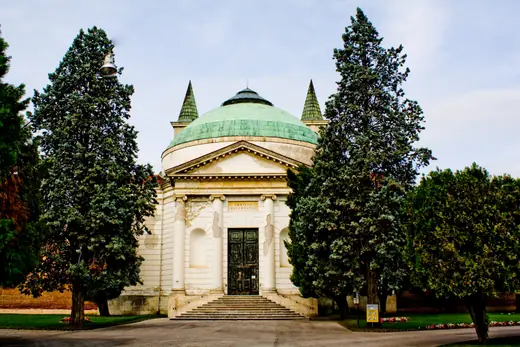
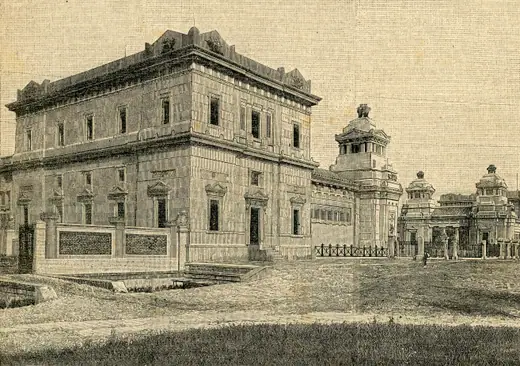
The body was shipped to Italy with paperwork identifying it as María Maggi de Magistris, described as an Italian woman who had died in an accident. In May 1957 it was buried in the Cimitero Maggiore at Musocco, in Milan, in a grave bearing that name.
It stayed there until 1971. For fourteen years the most photographed woman in Argentina lay in a municipal cemetery in Lombardy under a false identity, with the burial record itself the instrument of concealment.
What broke the arrangement was not litigation. In May 1970 the Montoneros abducted and killed Pedro Eugenio Aramburu, the general who had led the 1955 coup, and made the return of the body one of their stated demands. In 1971 Cabanillas retrieved the remains from Milan and delivered them to Juan Perón at his house outside Madrid, where they stayed — reportedly in the house itself — for the next three years.
Meanwhile the property side had been settled by decree rather than by any court. The Fundación Eva Perón, the enormous welfare foundation she had built and run, was dissolved by the military government in 1955 and its assets confiscated the following month.
Recoleta, at last, in 1976
Juan Perón returned to Argentina in 1973, was elected president again, and died on July 1, 1974. His third wife, Isabel Martínez de Perón, succeeded him and on November 17, 1974 had Eva's body flown back to Argentina and placed at the presidential residence at Olivos.
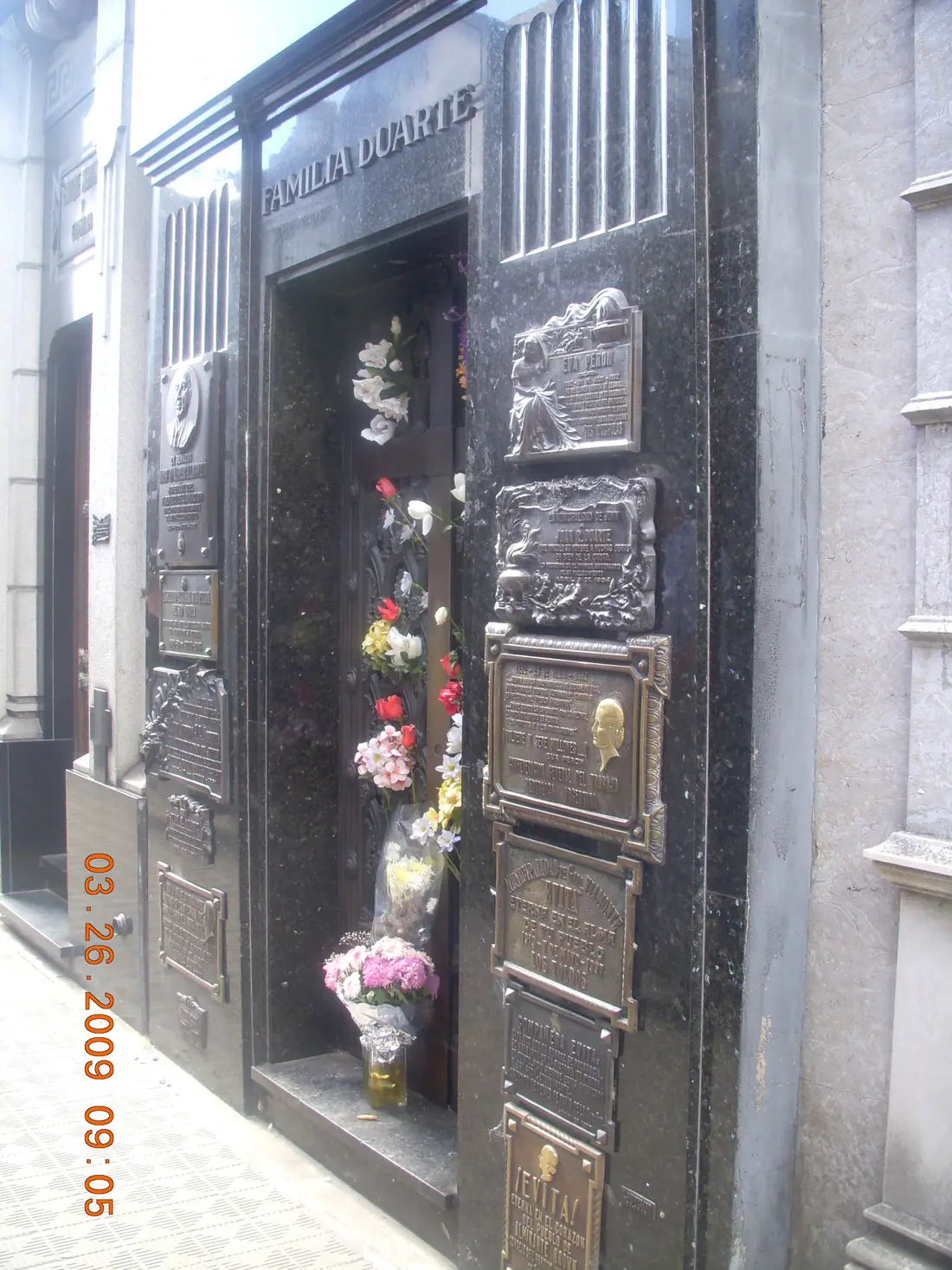
That lasted seventeen months. After the March 1976 coup, the junta removed the body from Olivos and turned it over to the Duarte family, who buried it in the family vault at Recoleta Cemetery in Buenos Aires later that year. It is still there, behind a series of steel plates, and it is the most visited grave in the country.
Twenty-four years elapsed between her death and her burial. In that window the body was seized by one government, concealed by another, buried abroad under a false name, exchanged in a hostage negotiation, kept in a private house in Spain, repatriated by a head of state who was also her successor's widow, and finally handed back to her siblings by a third government.
At no point did anyone establish a legal right to any of it. There was nothing to litigate, because there was nothing anyone owned.
Timeline
- Jul 26, 1952Eva Perón dies in Buenos Aires at 33. Dr. Pedro Ara begins a permanent embalming within hours.
- 1952–1955The body lies at CGT headquarters awaiting a monument that is never completed.
- Sep 1955A military coup removes Juan Perón. The Eva Perón Foundation is dissolved and its assets confiscated.
- Nov 22, 1955Officers under Lt. Col. Carlos Eugenio de Moori Koenig remove the body from the CGT building.
- May 1957After eighteen months of being moved around Buenos Aires, the body is shipped to Italy and buried at the Cimitero Maggiore, Musocco, Milan, under the name María Maggi de Magistris.
- May 1970Montoneros abduct and kill Pedro Eugenio Aramburu, demanding the body's return among their conditions.
- 1971The grave in Milan is opened and the body delivered to Juan Perón in Madrid.
- Nov 17, 1974President Isabel Martínez de Perón returns the body to Argentina, to the residence at Olivos.
- 1976After the March coup the junta gives the body to the Duarte family, who inter it at Recoleta Cemetery.
What actually went wrong
- No burial. Everything that followed was possible because the body had never been interred. An unburied body has no grave to protect it, no cemetery record to fix it, and no custodian with a legal duty.
- Custody in an institution, not a person. The body was held by a labour confederation on behalf of a government. When the government changed, so did the custodian — instantly, and without any legal step.
- A monument instead of a plan. The intended resting place was a building that did not exist yet. Plans that depend on future construction fail when the future changes.
- A falsified burial record. The concealment worked because a cemetery registry can be written in. A grave is only as findable as its paperwork.
- Nothing to sue over. No family member held an enforceable right of possession, and no forum existed to assert one. Where the law provides no cause of action, the outcome is decided entirely by who has the body.
Would it have gone that way in Florida?
In Florida this is three separate felonies, plus a civil claim the family could actually bring — which is the whole difference.
This case is a long way from Sarasota. But it is the clearest possible illustration of what Florida law is for in this area, because it shows what happens without it.
Start with the doctrine. Florida, like the rest of the common-law world, does not recognise ownership of a dead body. What it recognises is a right of possession for burial, held by the person the statute says holds it. Fla. Stat. §497.005 defines that person — the “legally authorized person” — and puts the decedent's own written directions first, then the surviving spouse, then adult children, parents, adult siblings, adult grandchildren, and onward. In 1955 the person holding that right in Florida terms would have been the surviving spouse. Nobody consulted him, because the right did not exist there.
Then the criminal side, which is where Florida is unusually specific. Chapter 872 covers this ground three different ways. §872.01 makes it a crime to deal in dead bodies. §872.02 makes it a second-degree felony to willfully and knowingly excavate, expose, move, remove, or otherwise disturb the contents of a grave or tomb without authority. §872.06 makes it a second-degree felony to mutilate or otherwise grossly abuse a dead human body. Moving a body out of a building at night, transporting it in secret, and burying it under a false name would engage the first two directly, and the removal from the Milan grave in 1971 would engage §872.02 on its own facts.
And then the part that matters most to families, because criminal statutes are enforced by the state and do nothing for the people left behind. Florida has recognised a civil claim here for seventy-five years. In Kirksey v. Jernigan, 45 So. 2d 188 (Fla. 1950), the Florida Supreme Court held that although mental anguish is generally not recoverable absent physical injury in a simple negligence case, that limit does not apply to a tort where the wrongful act implies malice or shows great indifference to the rights of others — and the Court said the rule is especially appropriate to tortious interference with rights involving dead human bodies, where mental anguish to the surviving relatives is frequently the only injury there is. That case involved a funeral home holding a child's body over a fifty-dollar fee. The principle scales.
The honest caveat. These protections only reach conduct in Florida, and they only help if someone with standing brings the claim. A right of possession is not self-executing. If a body is already gone, the practical remedy is a court order and damages, not restoration — the same asymmetry that decided the Ted Williams case, seventy years later and considerably closer to home.
The instruction: bury or cremate on a definite plan, in a definite place, with the arrangements written down and paid for. Chapter 497 preneed contracts exist for exactly this. A body with an intended future resting place and no present one is the single most vulnerable object in estate practice, and the only fix is to not leave one.
What people ask us about this.

Further reading
Third-party sites. Not ours, not endorsed, not kept current by us — just the places worth going next.
Sources
- The post-mortem kidnapping of Eva Perón — Buenos Aires Herald
- Eva Perón — biography and death — Encyclopaedia Britannica
- The kidnapping and 16-year wandering of Eva Perón's body — News.am
- Eva Perón Foundation — dissolution and confiscation of assets, 1955 — Evita Perón Historical Research Foundation
- Kirksey v. Jernigan, 45 So. 2d 188 (Fla. 1950) — Florida Supreme Court, via CourtListener
- Fla. Stat. Chapter 872 — Offenses concerning dead bodies and graves — The Florida Senate
- Fla. Stat. §497.005 — Definitions — The Florida Senate
If this is your situation
Free 30-minute consult. Plain English. No pressure.
Nearly every case in this archive turned on something ordinary — an unwitnessed page, a stale beneficiary line, a document nobody could find. Those are cheap to fix while you're alive and expensive to fix afterward.