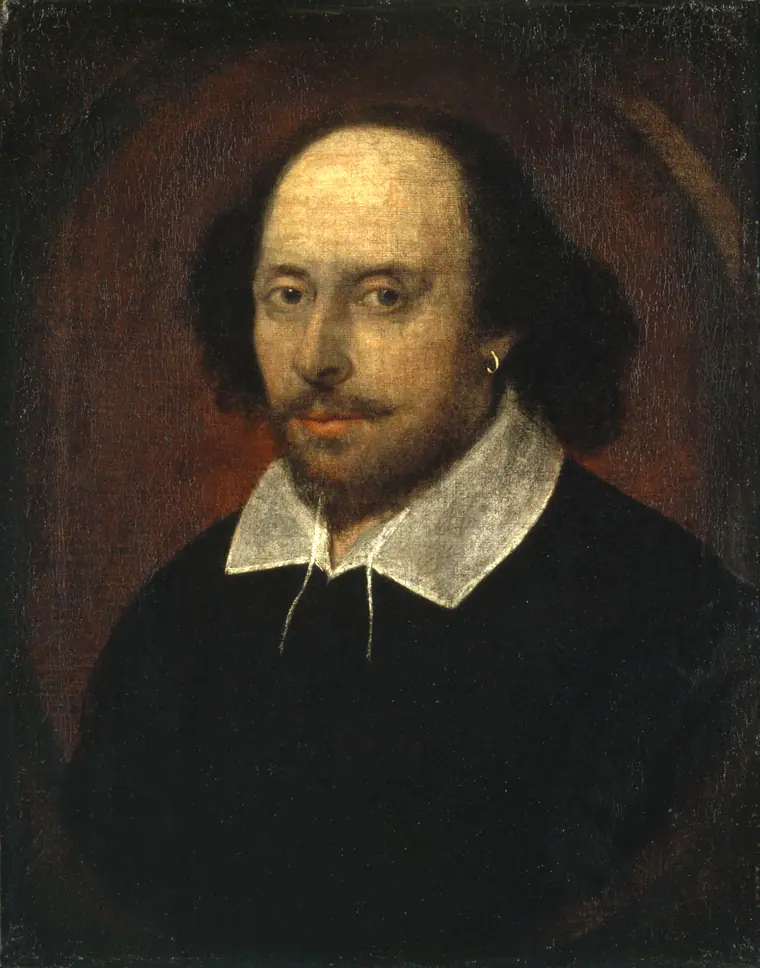
William Shakespeare
Shakespeare left his wife of thirty-four years one item: the second-best bed. Four centuries of readers have taken that as a parting insult. The period law of dower, and the going price of a bed in 1616, suggest they have it backwards.
In January 1616 William Shakespeare called in a Stratford lawyer, Francis Collins, and had a will drafted. He did not sign it. Two things then happened in quick succession that made the January draft unusable, and in March 1616 he had it substantially revised and signed the revision on the twenty-fifth. He died four weeks later, on April 23.
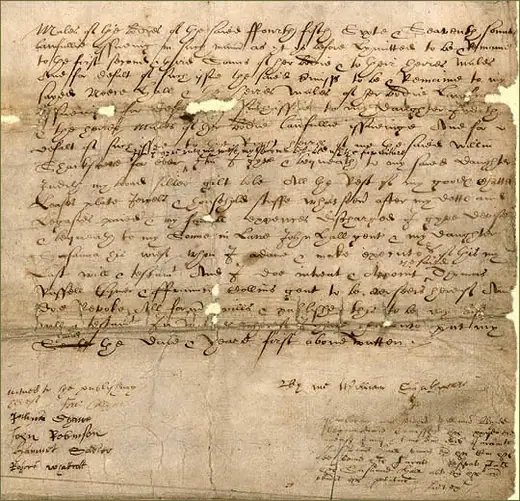
The document that survives is three sheets of paper in a scrivener's secretary hand, with Shakespeare's signature at the foot of each sheet — three of the six surviving examples of his handwriting. It is not a clean copy. It is a working draft that was amended and then executed as amended, with words struck through and new words squeezed between the lines.
One of those squeezed-in lines is the most quoted sentence in the history of probate: “Item I gyve unto my wief my second best bed with the furniture.”
That is the entirety of what Anne Hathaway is named to receive in the will of a husband she had been married to since 1582. The reading that follows almost automatically — that this was a slight, a shrug, a last word in a long cold marriage — has been repeated for three hundred years. It is probably wrong, and the reasons are legal rather than romantic.
Why the bed is not an insult
Three facts about 1616 dismantle the romantic-slight theory.
- Anne did not need the will. Under the law of the period a widow took dower — a life interest in a third of her husband's real property — automatically, by operation of law, whether or not she was mentioned. Leaving her out of the will did not leave her out of the estate. A will that named her share would have been the redundant document.
- The best bed was not the marital bed. In a well-off Elizabethan household the best bed was the guest bed, kept for visitors and display. The second-best bed was the one the couple actually slept in. Reading the bequest as the marriage bed rather than the leftovers reverses the sentiment entirely.
- Beds were property, and were bequeathed by name. Naming a specific bed in a will was ordinary practice, not a coded message. What is unusual about Shakespeare's clause is not the bed; it is that it is the only thing his wife is named for — and dower explains that.
The honest position is that we do not know what he meant. Accounts differ, and serious scholars still take opposite views. But the case for the insult reading rests on applying twenty-first-century assumptions about spousal inheritance to a legal system that gave the widow her third before the will was even opened.
There is a smaller point that gets lost. The bed clause was interlineated — added between existing lines, in a hand shaky enough that it took editors well over a century to agree on what it said. Whatever it was, it was an afterthought added during the March revision. Which raises the question of what the March revision was actually about.
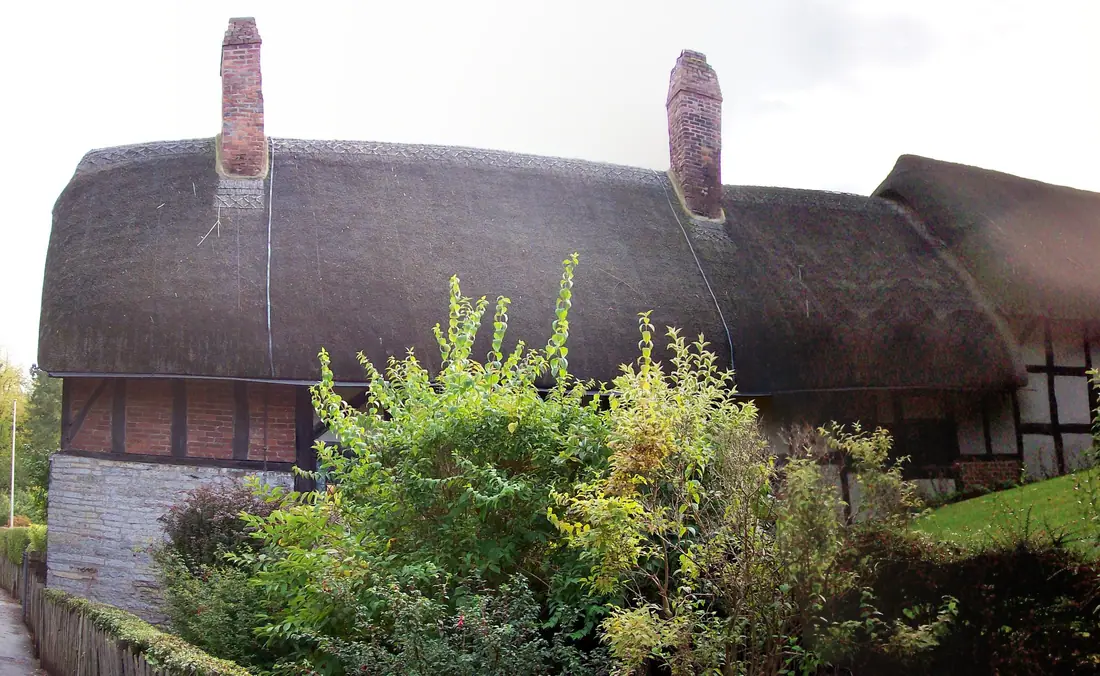
It was never about Anne. It was about Judith's husband
On February 10, 1616, Shakespeare's younger daughter Judith married Thomas Quiney, a Stratford vintner. On March 15, a woman named Margaret Wheeler died in childbirth; Quiney was named as the father and did public penance for it. Ten days later Shakespeare signed a will that had been rewritten around exactly that problem.
The revised document does something precise and unmistakable. References to Shakespeare's “sonne in lawe” are struck out and Judith's own name substituted. Her legacy — £100 as a marriage portion, with a further £150 tied up on conditions — is arranged so that her husband gets at it only if he settles land of equivalent value on her. The money was fenced off from Thomas Quiney by the terms of the instrument.
The bulk of the estate went the other direction. Susanna Hall, the elder daughter, and her husband Dr John Hall, took New Place, the Henley Street property, and the land, held under an entail that ran to Susanna's male heirs — an attempt to keep the estate intact down a line that, as it turned out, ended within two generations. The Halls were also named executors, and John Hall was sworn as executor when the will was proved.
The rest of the will is a portrait of the man's actual world: 26 shillings and eightpence each to John Heminges, Richard Burbage, and Henry Condell to buy mourning rings; a sword to Thomas Combe; £10 to the poor of Stratford. Seven years later, two of the three ring-holders — Heminges and Condell — assembled the First Folio.
A will revised under time pressure, which is the normal kind
Strip away the authorship and what remains is a completely recognisable file. A client starts a will in January. A family emergency lands in February and March. The lawyer is called back, the draft is amended in the margins rather than retyped, the client signs each sheet, and dies four weeks later.
Because Shakespeare held property in more than one county — the Blackfriars gatehouse in London as well as the Warwickshire holdings — the will was proved not locally but in the Prerogative Court of Canterbury in London, on June 22, 1616. The original three sheets, the probate entry, and the registered copy made at probate all survive at The National Archives.
It is worth noticing what the document does not contain. No literary property. No manuscripts, no plays, no instruction about the works. The most valuable thing Shakespeare owned is not in his will at all, because in 1616 it was not property that a person could own or leave.
Timeline
- 1582William Shakespeare marries Anne Hathaway of Shottery.
- Jan 1616Shakespeare instructs the Stratford lawyer Francis Collins. A will is drafted but not signed.
- Feb 10, 1616Judith Shakespeare marries Thomas Quiney.
- Mar 15, 1616Margaret Wheeler dies in childbirth. Quiney is named as the father and does public penance.
- Mar 25, 1616Shakespeare signs a substantially revised will. References to his son-in-law are struck out and Judith's name substituted. The bequest of the second-best bed is interlineated.
- Apr 23, 1616Shakespeare dies at Stratford-upon-Avon.
- Jun 22, 1616The will is proved in the Prerogative Court of Canterbury in London. John Hall is sworn as executor.
- 1623Anne Hathaway dies. In the same year Heminges and Condell — two of the three men left money for mourning rings — publish the First Folio.
What actually went wrong
- Nothing failed. The document worked. The estate passed, the executors were sworn, the entail held. Shakespeare's will is famous for being misread, not for being defective.
- Amendments made in the margins. The clause that has caused four centuries of argument is an interlineation in shaky handwriting. Interlineated changes invite exactly one question — was that there when he signed? — and the answer is usually expensive.
- Silence relying on background law. Anne's position depended entirely on dower operating automatically. When the legal default changes, a will that quietly relies on the default stops saying what its author meant it to say. Dower no longer exists in Florida.
- A dynastic entail with no fallback. The estate was tied to Susanna's male heirs. The male line ran out within two generations, and the structure did nothing it was built to do.
Would it have gone that way in Florida?
In Florida the bed would be the least of it — a surviving spouse cannot be left with one item.
The whole Shakespeare argument turns on a doctrine Florida no longer has. Fla. Stat. §732.111 abolishes dower and curtesy outright. A Florida widow gets nothing automatically by virtue of an ancient life interest in a third of the land, so the 1616 logic — she is not in the will because she does not need to be — has no Florida equivalent.
What Florida substituted is considerably stronger. Under §732.201 and §732.2035, a surviving spouse may elect to take 30% of the elective estate, and the elective estate is defined broadly enough to reach revocable trust assets, pay-on-death accounts, and jointly held property — not just what passes under the will. A Florida testator who left his spouse a bed would find the spouse electing against the will and taking 30% of nearly everything he owned. The deadline is real: §732.2135 requires the election within six months of service of the notice of administration, or two years after death, whichever comes first.
Three more protections stack on top, and none of them can be written out of a will. §732.4015 restricts the devise of homestead where there is a surviving spouse or a minor child — the constitutional homestead rules in Art. X, §4 mean the house is frequently not the testator's to give away in the first place. §732.402 gives the surviving spouse exempt property, including household furniture and furnishings up to a net value of $20,000, which as it happens would cover a bed. §732.403 allows a family allowance during administration.
The honest caveat is the one that decides most real cases: all of that can be waived. Under §732.702, a spouse may waive elective share, homestead rights, exempt property, and family allowance by written contract signed by both parties — and if the agreement is signed before the marriage, no financial disclosure is required for it to be effective. A prenuptial agreement is the reason a Florida spouse sometimes does end up with the equivalent of a bed, and it is enforceable.
On the document itself, Florida is stricter than 1616 England. §732.502 requires the will to be signed at the end by the testator, in the presence of two attesting witnesses, who sign in the presence of the testator and of each other. Shakespeare's three-sheet, signed-on-every-page, witnessed document would satisfy that. What would not survive is the habit of fixing a will by writing between the lines: an interlineation added after execution has no effect unless the will is re-executed or a codicil is properly executed. Changes made on the face of a signed will are the single most common way a Florida estate ends up litigating what the testator actually intended.
The practical instruction is short. If your plan is to leave your spouse less than 30% of everything you own, that plan does not work in Florida without a signed marital agreement, and the time to sign it is before the wedding. And when you change a will, do not write on it. Sign a new one, or a properly executed codicil, and destroy the old copies.
What people ask us about this.

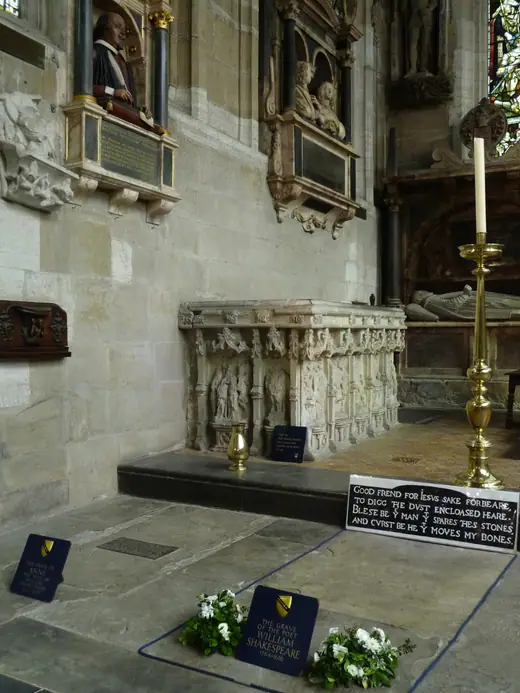
Further reading
Third-party sites. Not ours, not endorsed, not kept current by us — just the places worth going next.
Sources
- Shakespeare's will — Wikipedia
- William Shakespeare's last will and testament: original copy including three signatures — Shakespeare Documented, Folger Shakespeare Library
- William Shakespeare's last will and testament: entry for probate — Shakespeare Documented, Folger Shakespeare Library
- The Second-Best Bed — Shakespeare Birthplace Trust
- Fla. Stat. §732.111 — Dower and curtesy abolished — The Florida Senate
- Fla. Stat. §732.2035 — Property entering into elective estate — The Florida Senate
- Fla. Stat. §732.402 — Exempt property — The Florida Senate
- Fla. Stat. §732.502 — Execution of wills — The Florida Senate
If this is your situation
Free 30-minute consult. Plain English. No pressure.
Nearly every case in this archive turned on something ordinary — an unwitnessed page, a stale beneficiary line, a document nobody could find. Those are cheap to fix while you're alive and expensive to fix afterward.