Jackson Pollock & Lee Krasner
He died at 44 in a car crash with a reputation and not much money. His widow took the entire estate, controlled the supply of paintings for twenty-eight years, commissioned the catalogue, and then left the whole thing to a foundation that gives money to living artists. No litigation. No family war.
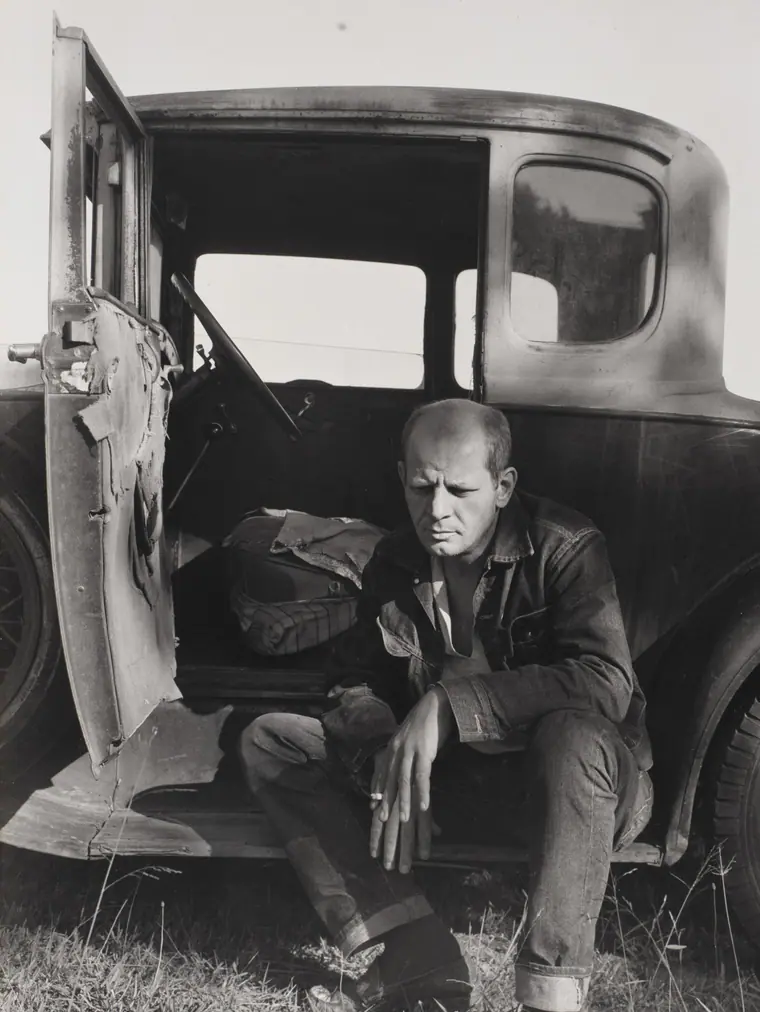
Jackson Pollock died on August 11, 1956, in a single-car crash near his house at Springs, on the eastern end of Long Island. He was 44 and had been drinking. That is the whole of what this page will say about it.
He left a reputation that was already enormous and an estate that was not. Abstract Expressionism had made him famous; it had not yet made anyone rich. What he did leave was an inventory of unsold paintings and drawings — which is the single most difficult asset class in estate practice, because its value depends entirely on how it is released.
His widow, the painter Lee Krasner, took the estate and administered it for the next twenty-eight years. When she died in 1984 she left almost all of it to a foundation that gives money to working artists who need it.
There is no litigation to report. This entry is in the archive as the counterexample.
One person, the whole thing, immediately
Accounts differ on the paperwork. Some biographers record that in 1950 Pollock asked a lawyer who lived across the road at Springs to draft a will making Krasner his sole heir; the estate is also widely described as having passed to her on intestacy. We have not seen the Surrogate's file and will not pretend otherwise.
The outcome is not in dispute. Everything went to Lee Krasner, undivided, and she was the one administering it. There were no children. There was no second household, no minority interest, no committee.
That fact is doing more work than it looks. Split the same inventory three ways among a widow, a sibling, and a parent — a perfectly ordinary intestacy result in a great many states — and you get three people with different time horizons and different cash needs holding fractions of an indivisible thing. Someone wants to sell now. Someone wants to wait. Nobody can control supply, because nobody controls the supply.
Krasner controlled all of it. That is the precondition for everything she did next.
Supply, price, and a catalogue
She ran it like an operator, not a custodian.
Works went out slowly and deliberately, through dealers, into collections and museums she chose. In the 1960s the estate was handled through the Marlborough gallery. In the early 1970s she withdrew the estate from Marlborough, after which it was handled privately by the dealer Eugene Victor Thaw — a decision worth noting, because Marlborough is the gallery at the centre of the Rothko self-dealing scandal that would break open in the same years.
In 1978 she backed the publication of the Pollock catalogue raisonné, by Francis V. O'Connor and Eugene V. Thaw — the definitive four-volume record of the work, produced with a committee that included Krasner, Marlborough's New York president Donald McKinney, and the Museum of Modern Art curator William S. Lieberman. Scholars have treated it as the authority ever since.
That is the part most heirs skip, and it is the part that compounds. A catalogue raisonné is not a vanity project. It is the title register. Every future sale, insurance valuation, museum loan, and forgery dispute runs through it. Krasner spent estate money on the infrastructure of the estate rather than on the estate's output, and it is the reason the market for the work is orderly.
She was criticised for high-handedness — she was the sole decision-maker for nearly three decades, and sole decision-makers usually are. The results are not seriously disputed.
She left it to people she had never met
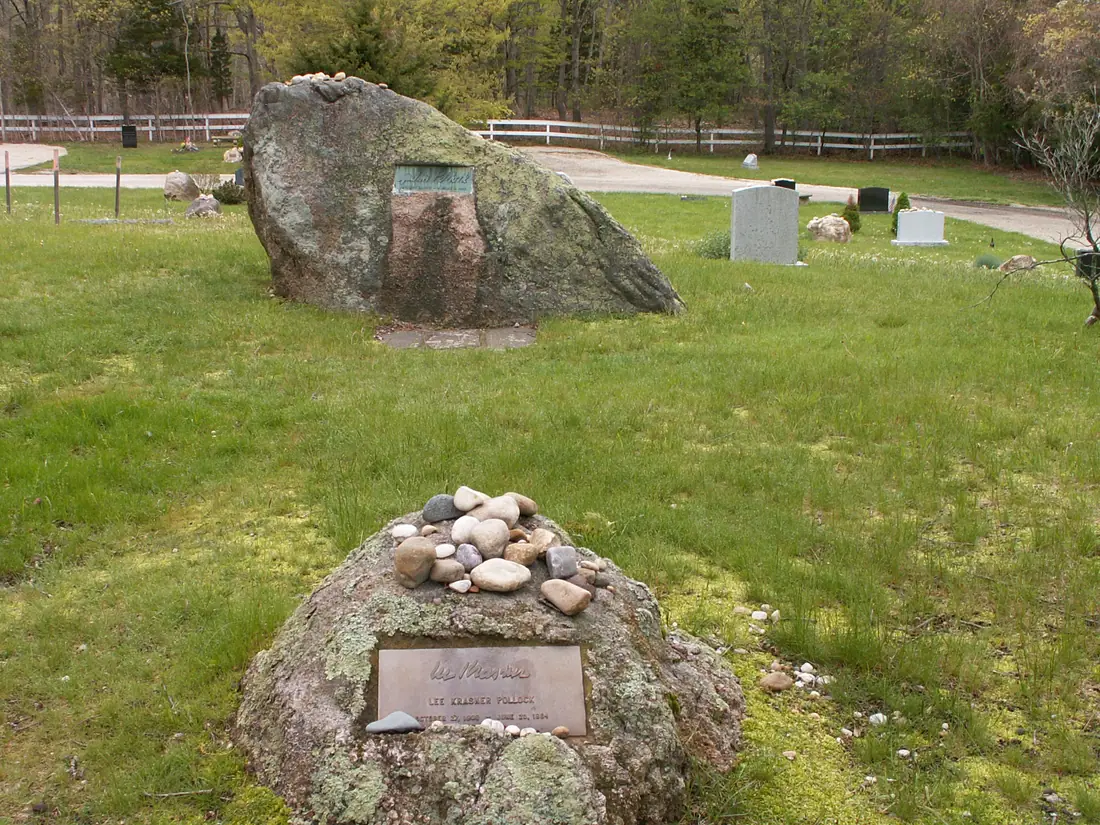
Lee Krasner died on June 19, 1984, at 75. Her will left the bulk of her estate — her own work, what remained of Pollock's, and the proceeds of both, reported at around $20–23 million at the time — to establish the Pollock-Krasner Foundation.
The Foundation was incorporated in 1985. Its purpose is not to promote Pollock, or Krasner, or Abstract Expressionism. It is to give money directly to individual working artists of merit and financial need — painters, sculptors, printmakers, artists working on paper — anywhere in the world. By its own count it has now made more than 5,200 grants in 80 countries, totalling over $95 million.
She also provided for the house and studio at Springs, which became the Pollock-Krasner House and Study Center, and for the archive that goes with it.
One later decision is worth recording because it is the kind of thing every artist's estate eventually faces. The Foundation operated an authentication board from around 1990, and wound it up in the mid-1990s — reported as 1995 — after being sued by collectors whose works it had declined to include. Its chairman said at the time that the Foundation preferred to operate according to its charitable mission rather than deal with litigation and legal fees. Authentication is the one function in an art estate that generates lawsuits no matter how careful you are, and the modern answer is usually to stop doing it.
The last thing worth saying is the simplest. Krasner had no children. She could have left the money to her family, or to a museum with her name on the wing. She left it, in effect, to strangers who would be in the same position she and Pollock had been in in 1945 — good, broke, and working.
Timeline
- 1945Pollock and Krasner marry and buy the house and barn at Springs, East Hampton.
- Aug 11, 1956Pollock dies in a single-car crash near Springs at 44. Accounts of whether he left a will differ; the estate — largely unsold work — passes entirely to Lee Krasner.
- 1960sKrasner places the estate with the Marlborough gallery and releases work slowly and selectively.
- Early 1970sShe withdraws the estate from Marlborough. It is handled privately thereafter by Eugene Victor Thaw.
- 1978The Pollock catalogue raisonné is published, by Francis V. O'Connor and Eugene V. Thaw — the definitive record of the work.
- Jun 19, 1984Krasner dies at 75. Her will directs the bulk of the estate, reported at around $20–23 million, to a new foundation.
- 1985The Pollock-Krasner Foundation is incorporated to make grants to individual working artists internationally.
- c. 1995The Foundation winds up its authentication board after litigation from collectors, citing its charitable mission.
- 2026The Foundation reports more than 5,200 grants in 80 countries, totalling over $95 million.
What actually went wrong
- Very little — and the reason is concentration. One person inherited the entire indivisible asset and had authority to act on it immediately. Almost every failure in this archive begins with the opposite.
- The one real exposure was authentication. Saying which works are genuine is a service the market demands and the law punishes. The Foundation absorbed the lawsuits for several years and then stopped, which is now the standard advice.
- It depended entirely on one person being extremely good at it. Krasner was a professional artist with a deep understanding of the market. Had the same estate passed to someone without that, the identical legal structure would have produced a very different result. Structure does not substitute for the right fiduciary.
- No documented succession for the management function. For twenty-eight years the plan was Lee Krasner. The Foundation exists because she built it at the end, not because anyone had designed a handover in 1956.
Would it have gone that way in Florida?
In Florida the outcome would have been the same, and for a better reason: §732.102(1) gives a childless surviving spouse the entire intestate estate.
This case turns on a single, unglamorous statutory fact, and Florida's version of it is unusually clean.
First, who inherits. Under Fla. Stat. §732.102(1), where a decedent leaves no surviving descendant, the surviving spouse takes the entire intestate estate. Not a share alongside a parent. Not a fixed sum plus half the residue. All of it. Pollock had no children; a Florida Krasner would have taken the whole inventory outright, whether or not there was a will, and would have had undivided authority over it from day one.
That is worth sitting with, because it is the opposite of the usual lesson here. Intestacy happened to point the right way. Change one fact — a child from an earlier relationship — and §732.102(3) cuts the spouse to one-half, with §732.103 distributing the rest to descendants. An indivisible inventory of paintings, owned half by a widow and half by a stepchild, is the setup for a decade of litigation. Pollock got the right answer from a statute he had no control over. That is luck, not planning.
Second, running it. A Florida personal representative has broad authority under §733.612 without needing a court order every time: to retain assets pending distribution, to sell or dispose of property, to invest, to continue a business, to employ appraisers, attorneys, accountants, and other professionals, and to insure the assets — all subject to the overriding requirement to act reasonably for the benefit of the interested persons. Commissioning a catalogue raisonné, paying a conservator, and choosing a dealer are ordinary exercises of that power. They also cost money out of the estate before anyone is paid, which is exactly why heirs who are not professionals so often refuse to do them.
Third, the fiduciary problem Krasner did not have. She was the sole beneficiary as well as the fiduciary, so there was nobody to be disloyal to. Where the two roles are split, §736.0802 imposes the duty of loyalty and §736.0813 the duty to inform and account — the provisions that decide art-estate cases, because the temptation in a slow-release strategy is always to sell to yourself, to a friendly gallery, or to an entity you have an interest in. That is precisely what happened in the Rothko estate, with the same gallery Krasner walked away from.
Fourth, the foundation. §736.0405 confirms that “the advancement of arts” is an express charitable purpose in Florida, and that a charitable trust may be enforced — by the settlor among others, and in practice by the Attorney General. A Florida Krasner could have created exactly the Pollock-Krasner Foundation, and if she had specified no beneficiary or purpose with sufficient precision, the court could have selected one consistent with her intent rather than letting the gift fail.
The instruction, and it is aimed at the surviving spouse rather than the artist. If you inherit a body of creative work, you have inherited a business. Do the three things Krasner did in her first years and most heirs never do: get everything photographed, catalogued, and physically secured; pick one decision-maker and give them written authority; and do not sell in the first eighteen months unless the estate needs cash, because the price of an artist's work in the two years after death tells you almost nothing about what it is worth.
What people ask us about this.
Further reading
Third-party sites. Not ours, not endorsed, not kept current by us — just the places worth going next.
Sources
- Pollock-Krasner Foundation — foundation overview — The Pollock-Krasner Foundation
- The Pollock-Krasner Foundation — Philanthropy Roundtable
- Lee Krasner — Pollock-Krasner House and Study Center — Stony Brook University
- Jackson Pollock and Lee Krasner papers, circa 1914–1984 — Archives of American Art, Smithsonian Institution
- A matter of opinion — art authentication boards and litigation — ARTnews
- The true cost of authentication litigation — Herrick, Feinstein LLP
- Fla. Stat. §732.102 — Spouse's share of intestate estate — The Florida Senate
- Fla. Stat. §736.0405 — Charitable purposes; enforcement — The Florida Senate
If this is your situation
Free 30-minute consult. Plain English. No pressure.
Nearly every case in this archive turned on something ordinary — an unwitnessed page, a stale beneficiary line, a document nobody could find. Those are cheap to fix while you're alive and expensive to fix afterward.