Franklin D. Roosevelt
He gave his house to the United States and kept the right to live in it. He gave away his own papers and had to invent an institution to receive them. He died on April 12, 1945; seven months later his family gave up their rights early, and the government moved in.
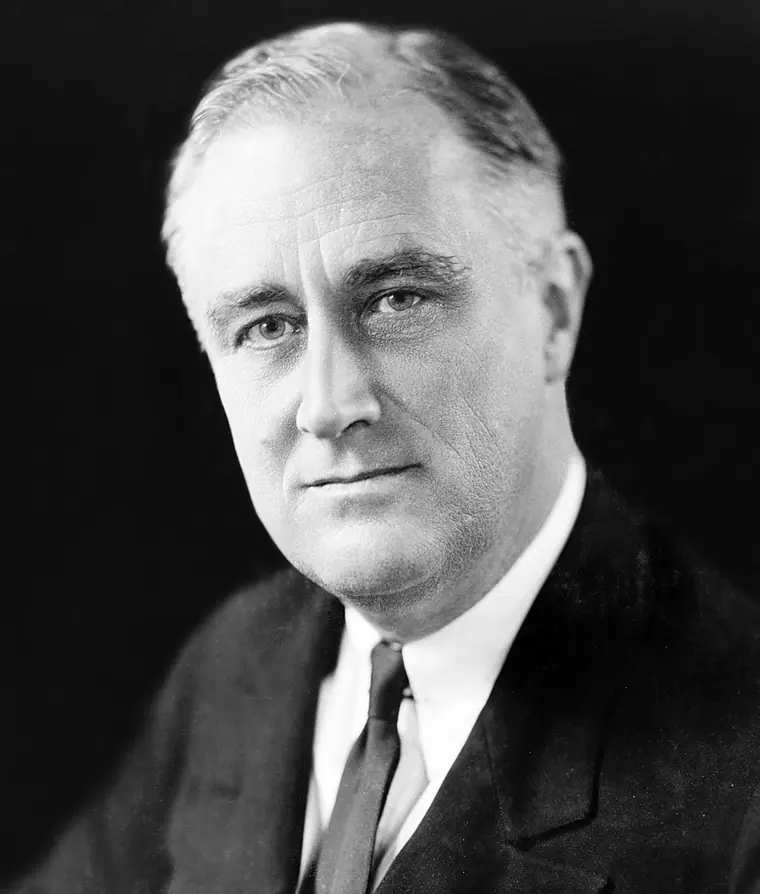
Until 1938, a president's papers were his own property. He took them home when he left office. What happened to them next depended entirely on his heirs, his executors, and their judgment — and the historical record is full of the consequences.
Franklin Roosevelt decided to fix this for himself, and in doing so built the template every president since has followed. At a press conference on December 10, 1938, he described what he wanted: his papers kept together, in one place, open to the public, and not divided among a dozen repositories.
The structure he chose is the interesting part, because it is an estate-planning structure and not a political one. He and his mother Sara donated sixteen acres of the Hyde Park land. Private donors raised $376,000 to build the building — no appropriation, no public money. Roosevelt sketched the design himself. On July 4, 1940 the completed building was turned over to the federal government, to be operated by the National Archives. It was dedicated on June 30, 1941.
So: private land, given away. Private money, spent on a public building. Public institution, running it in perpetuity. Nobody had done this before, and Congress had to be brought along at every step.
A gift, and a right to keep living there
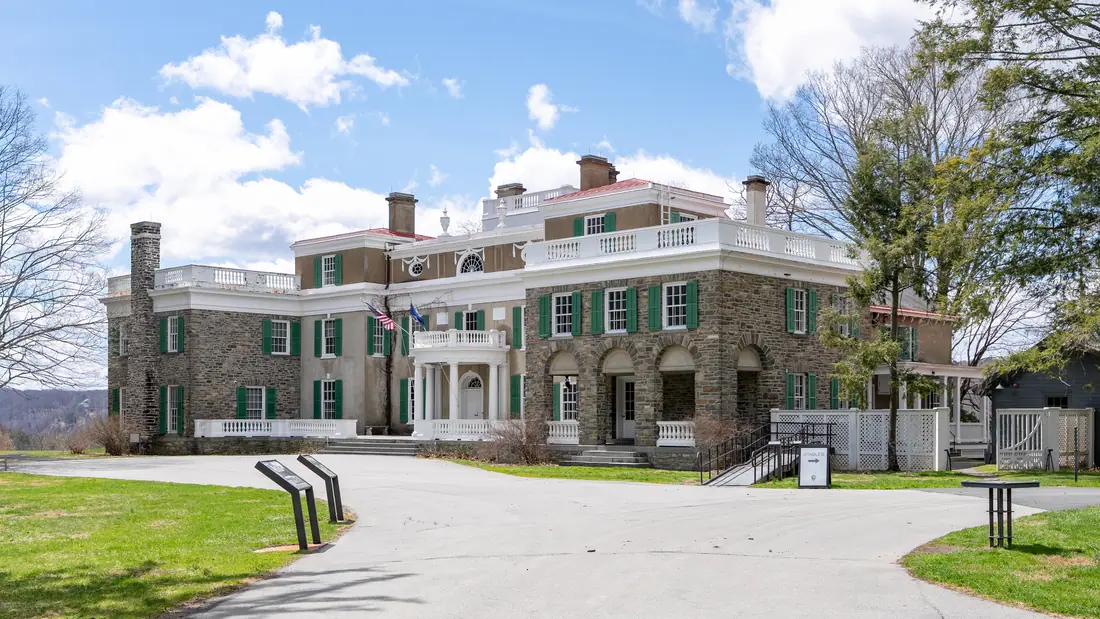
In 1943 Roosevelt gave the Springwood estate at Hyde Park to the American people — the whole of it, except Val-Kill, which had already been given to Eleanor.
He attached the condition that makes the whole thing work: the family retained a lifetime right to use the property. Title moved. Possession did not. Roosevelt continued to live in his own house, on land the United States now owned, exactly as he had before.
That is a reserved life estate, and it is one of the oldest and most useful tools in property law. You separate the ownership from the right to occupy, give away the first, and keep the second. The gift is complete and irrevocable on the day of the deed; the occupancy ends only when the reserved interest ends.
Roosevelt died at Warm Springs, Georgia, on April 12, 1945, and was buried at Springwood. The life rights, however, did not die with him — Eleanor and the children still held them, and by the terms of the gift the government would have had to wait.
They did not make it wait. On November 21, 1945, having relinquished their rights, the family saw the estate transferred to the Department of the Interior. The site had already been designated a National Historic Site on January 15, 1944.
The asset nobody had a form for
The house was straightforward. The papers were not.
Roosevelt's presidential papers were, in law, his personal property. He was the first president to donate them intact to the government, and there was no existing mechanism for doing it. The Roosevelt Library's own history records that because the papers were his property, legal proceedings were required to establish them as government property — a process that took roughly three years after his death.
Read that again. A man spends seven years building an institution specifically to receive his papers, hands over the building and the land while still alive, dies — and it still takes three years of legal process to settle who owns the documents inside it.
That is not incompetence. That is what happens when an asset class has no established form of transfer. The same problem now appears with digital property: a lifetime of email, photographs, domain names, cloud accounts, cryptocurrency, and social media, all of it valuable, none of it fitting neatly into a form that says and to my daughter, my chest of drawers.
In 1955 Congress passed the Presidential Libraries Act, which regularized the arrangement Roosevelt had improvised: privately built, federally maintained, administered by the National Archives. Every president since has used it.
- Give it away while you are alive. No probate, no delay, no contest window.
- Reserve what you actually need. Occupancy, income, or control — not title.
- Name the recipient institution precisely, and make sure it can accept. Roosevelt had to build one.
- Say who owns the intangible thing. The building was settled in a day. The papers took three years.
What the family did in November 1945
The step that closed the matter is the least dramatic and the most instructive. Eleanor Roosevelt and the children gave up an interest they were entitled to keep.
They had every legal right to occupy Springwood for the rest of their lives. They chose not to, and the accelerated transfer to the Interior Department followed within months rather than decades.
Voluntarily surrendering an inherited or reserved interest has a name and a statutory procedure. It is called a disclaimer, and it is one of the few genuinely elegant tools in estate law: a beneficiary can decline property so that it passes to whoever would have taken it next, without a sale, a gift tax, or a transfer. Florida has a whole chapter for it.
Timeline
- Dec 10, 1938At a press conference Roosevelt describes a library to hold his papers in one place, publicly accessible — an institution that does not yet exist.
- 1939FDR and his mother Sara donate 16 acres at Hyde Park. Construction begins with $376,000 in privately raised funds.
- July 4, 1940The completed library building is turned over to the federal government, to be operated by the National Archives.
- June 30, 1941The Franklin D. Roosevelt Presidential Library is dedicated — the first presidential library.
- 1943Roosevelt gives the Springwood estate to the American people, excepting Val-Kill, with the family retaining a lifetime right of use.
- Jan 15, 1944The property is designated a National Historic Site.
- Apr 12, 1945Roosevelt dies at Warm Springs, Georgia, at 63. He is buried at Springwood.
- Nov 21, 1945The family having relinquished its rights, the estate is transferred to the Department of the Interior.
- 1948Roughly three years of legal proceedings establish that Roosevelt's personal papers are government property.
- 1955The Presidential Libraries Act regularizes the model: privately built, federally maintained, administered by the National Archives.
What actually went wrong
- Almost nothing — which is why it is worth reading. Roosevelt made lifetime gifts, reserved what he needed, named a recipient, and funded the recipient. That is a well-built plan.
- Except the papers. The one asset he could not transfer cleanly was the one the whole project existed to preserve, because no legal form for it existed yet. Three years of litigation followed his death.
- A recipient that had to be invented. A charitable or public gift only works if the recipient can legally accept and administer it. Roosevelt had to build the institution and get Congress to accept it before the gift could function.
- A reserved interest held by several people. The life rights ran to the family, not just to FDR. Had they chosen to keep them, the public transfer would have waited decades. A gift whose completion depends on other people's cooperation is not fully done.
Would it have gone that way in Florida?
This is Florida's favourite structure — and Florida has a better version of it, plus a statute for what the family did in 1945.
Roosevelt used two devices. Florida has an improved form of the first and a full statutory chapter for the second.
The reserved life estate. A traditional life estate deed does what Roosevelt's 1943 gift did: title passes now, occupancy is retained for life. It works, and Florida recognises it. But the traditional version has a real cost — once the deed is signed, the life tenant cannot sell, mortgage, or change course without the consent of the remainder owners. You have given away the thing and kept only the right to sit in it.
Florida's answer is the enhanced life estate deed, universally called the lady bird deed. It is a life estate deed with the retained power to sell, mortgage, lease, or revoke, exercisable by the life tenant alone. The property passes automatically to the named remainder beneficiary at death, outside probate, and — because the transfer is not complete until death — it is generally treated as a non-countable transfer for Medicaid purposes, and the beneficiary receives a stepped-up income tax basis. It gives you Roosevelt's structure without Roosevelt's loss of control. Florida is one of a small handful of states where it is well established.
The honest caveat: a lady bird deed is a poor fit where the property has multiple intended beneficiaries who need to be coordinated, where the beneficiary is a minor or has creditor or benefits problems, or where the homestead devise restrictions in §732.4015 apply because there is a surviving spouse or a minor child. It is a scalpel, not a plan.
The disclaimer. What Eleanor Roosevelt and the children did in November 1945 — giving up an interest they were entitled to keep — is governed in Florida by the Florida Uniform Disclaimer of Property Interests Act, Chapter 739. Under §739.104 a person may disclaim any interest in or power over property, in whole or in part, even if the person who created the interest tried to forbid it. The disclaimer must be in writing, must declare itself to be a disclaimer, must describe the interest, and must be signed, witnessed, and acknowledged in the manner required for a deed of real estate, then delivered or filed under §739.301.
The effect is the elegant part. Under §739.201 the disclaimed interest passes as though the disclaimant had died immediately before the interest was created. It is not a gift and not a transfer, so it does not come out of the disclaimant's own estate, and it does not create a taxable gift. Beneficiaries use it constantly and for entirely ordinary reasons: to push an inheritance down to their own children, to protect a beneficiary who is on needs-based benefits, or to redirect an asset a will got wrong.
Two traps. §739.402 bars a disclaimer once the person has accepted the interest or its benefits, waived the right in writing, sold or encumbered the interest, or is insolvent at the moment the disclaimer would become irrevocable. Cash one distribution cheque and the right is gone. And while Florida imposes no general deadline of its own, a disclaimer intended to be a qualified disclaimer for federal transfer-tax purposes must generally be made within nine months.
The instruction: if you want a specific person or institution to receive a specific piece of property, do it with a deed or a beneficiary designation rather than a paragraph in a will — and if you are a beneficiary about to inherit something you would rather your children had, talk to a lawyer before you touch it. After acceptance the disclaimer is unavailable, and the only remaining route is a gift, with all the tax and Medicaid consequences a gift carries.
What people ask us about this.

Further reading
Third-party sites. Not ours, not endorsed, not kept current by us — just the places worth going next.
Sources
- Library History — the first presidential library, its funding, and the ownership of FDR's papers — Franklin D. Roosevelt Presidential Library and Museum
- Franklin D. Roosevelt Presidential Library and Museum — Wikipedia
- Home of Franklin D. Roosevelt National Historic Site — the 1943 gift and the 1945 transfer — Wikipedia
- Home of Franklin D. Roosevelt National Historic Site — National Park Service
- Fla. Stat. §739.104 — Power to disclaim; general requirements — The Florida Senate
- Fla. Stat. §739.201 — Disclaimer of interest in property — The Florida Senate
- Fla. Stat. §739.402 — When disclaimer barred or limited — The Florida Senate
If this is your situation
Free 30-minute consult. Plain English. No pressure.
Nearly every case in this archive turned on something ordinary — an unwitnessed page, a stale beneficiary line, a document nobody could find. Those are cheap to fix while you're alive and expensive to fix afterward.