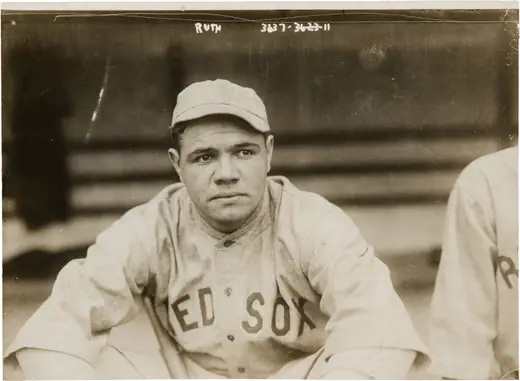
Babe Ruth
He died in 1948 having built the most valuable name in American sport. Forty-two years later his two daughters sued a publisher for using his photograph and lost outright — New York gave the dead no right of publicity at all. In 2024 one of his shirts sold for $24.12 million.
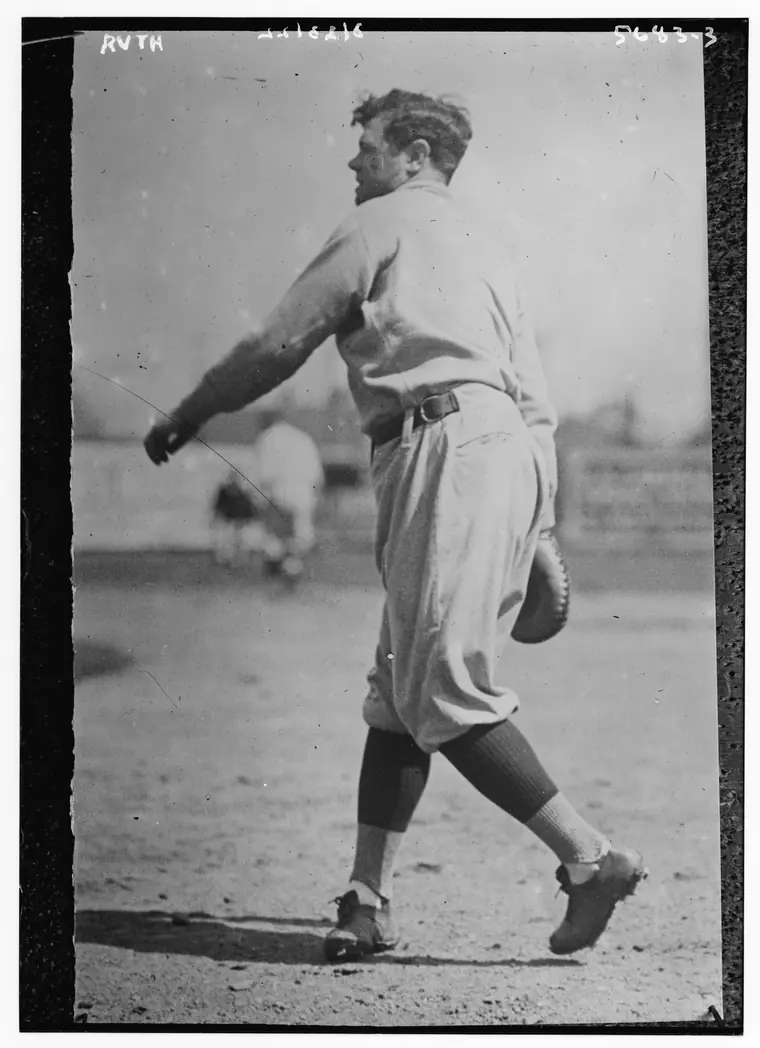
George Herman Ruth died on the evening of August 16, 1948, at 53, of nasopharyngeal cancer diagnosed two years earlier. His body lay in state at Yankee Stadium; the funeral was at St. Patrick's Cathedral; the crowd was reported above 100,000. He is buried at Gate of Heaven Cemetery in Valhalla, New York, beside his second wife Claire, who died in 1976.
The year before he died he had put his name to a charity — the Babe Ruth Foundation, formed in 1947 for underprivileged children, and directed by Shelby M. Harrison of the Russell Sage Foundation. The Yankees created Old-Timers' Day at the stadium that same year to raise money for it. When Ruth died the Foundation named 57 honorary pallbearers.
So the charitable structure was in place, and the personal estate was administered, and none of that is why this case is in the archive.
The interesting question is what happened to the name — and the answer, for forty-two years, was that nobody owned it.
Pirone v. MacMillan, 894 F.2d 579 (2d Cir. 1990)
In the late 1980s the publisher MacMillan produced a baseball calendar using photographs of Ruth. His two daughters, Dorothy Ruth Pirone and Julia Ruth Stevens, sued — together with the Babe Ruth League, Inc. and Curtis Management Group, the licensing agency that represented the family's interest in the name.
They lost, and then lost again. On January 29, 1990, the United States Court of Appeals for the Second Circuit affirmed summary judgment for MacMillan on every claim.
The reasoning is worth stating precisely, because it is still the law in a great many places.
- On publicity rights: New York's statutory privacy law occupied the field and did not survive death. There was no common-law right of publicity in New York to inherit. Forty-two years after Ruth died, his daughters simply had nothing to assert.
- On trademark: the court held that a photograph of a human being, unlike a drawing of a cartoon character, is not inherently distinctive. Ruth's name and image were being used descriptively — to identify the historical subject of a baseball calendar — rather than as an indication of who produced or sponsored it.
Note who was in the caption. The family, the youth-baseball organisation that carried his name, and a professional licensing agency, all on the same side, all unsuccessful. This was not a failure of representation. It was the absence of an asset.
New York eventually changed its mind. In November 2020 the state enacted a postmortem right of publicity — Civil Rights Law §50-f, protecting a deceased personality for 40 years after death. It arrived 72 years after Ruth died and it is not retroactive to him.
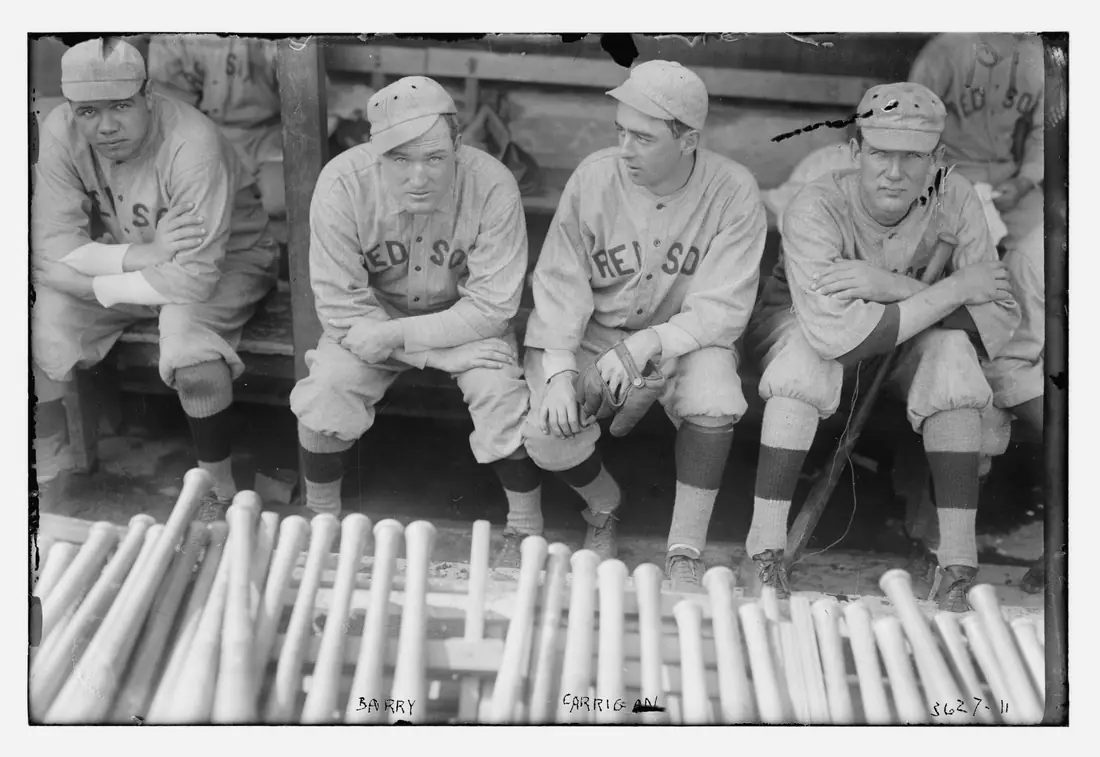
A shirt, at $24.12 million
On August 25, 2024, Heritage Auctions sold the jersey Ruth wore in the 1932 World Series — the “called shot” game — for $24.12 million. It is the most expensive sports collectible ever sold, ahead of the $12.6 million paid for a 1952 Mickey Mantle card in 2022.
The same jersey had sold in 2005 for $1,056,630.
Set the two halves of this case side by side. The right to control the Babe Ruth name was, in 1990, legally worth nothing to his family. A shirt he wore for three hours in 1932 was worth twenty-four million dollars in 2024.
That is not a paradox. It is the distinction between intangible rights, which exist only where a legislature says they exist, and tangible personal property, which is an object somebody owns and can leave to somebody else. The jersey passed through hands the ordinary way, by sale and by inheritance, because a shirt is a chattel and chattels have always been inheritable.
The estate-planning point is not romantic and it is not about baseball. The most valuable single item in a great many estates is a physical object nobody thought to name — a watch, a ring, a car, a first edition, a signed photograph in a drawer. Those items generate more family litigation per dollar than any brokerage account ever has, and there is a one-page fix for it.
Timeline
- 1946Ruth is diagnosed with nasopharyngeal cancer.
- 1947The Babe Ruth Foundation is formed for underprivileged children; Old-Timers' Day is created at Yankee Stadium to raise money for it.
- Aug 16, 1948Ruth dies in New York at 53. The Foundation names 57 honorary pallbearers; the funeral is at St. Patrick's Cathedral.
- 1976Claire Ruth dies and is buried beside him at Gate of Heaven Cemetery, Valhalla, New York.
- Late 1980sMacMillan publishes a baseball calendar using photographs of Ruth. His daughters, the Babe Ruth League, and Curtis Management Group sue.
- Jan 29, 1990The Second Circuit affirms summary judgment for MacMillan. New York's privacy statute does not survive death; a photograph is not inherently distinctive as a trademark.
- 2005Ruth's 1932 World Series jersey sells at auction for $1,056,630.
- Nov 2020New York enacts a postmortem right of publicity, Civil Rights Law §50-f, lasting 40 years after death. It does not reach back to 1948.
- Aug 25, 2024The same 1932 jersey sells at Heritage Auctions for $24.12 million — the most expensive sports collectible ever.
What actually went wrong
- The most valuable thing he built was not property. A famous name is only an asset where a statute makes it one. In New York in 1948, and until 2020, it was not — so there was nothing for the estate to hold, licence, or defend.
- Enforcement was attempted decades too late and in the wrong state. By 1990 the family was litigating a right that had never existed, against a use the court found descriptive. No amount of drafting in 1948 could have created what the legislature had not.
- The real inheritance was in objects, and objects are where families fight. Memorabilia, jewellery, instruments, and vehicles routinely outrun their appraised value and almost always outrun their sentimental accounting.
- Trusts written for a long life have to survive a long time. Any structure meant to hold value for descendants across generations runs into perpetuities rules, changing tax law, and successor trustees nobody living has met. Longevity is a design requirement, not an afterthought.
Would it have gone that way in Florida?
Better than New York — but not by enough. Florida's postmortem right of publicity runs 40 years, so a 1948 death would have run out in 1988, two years before the daughters filed.
Florida had a right of publicity long before New York did. Fla. Stat. §540.08 prohibits using a person's name, portrait, photograph, or other likeness for trade, commercial, or advertising purposes without express consent, and it gives the injured party an injunction, damages, a reasonable royalty, and punitive damages in a proper case.
It also has a hard stop. No action may be brought for a use occurring more than 40 years after the person's death. Ruth died in 1948. A Florida statutory publicity right would have expired in 1988 — before MacMillan's calendar and before the 1990 appeal. A Florida-domiciled Babe Ruth would have lost the same case, two years earlier, for a different reason.
There is one more Florida limit that matters here even inside the 40 years. Section 540.08 does not reach bona fide news reporting, and the Second Circuit's actual point about the MacMillan calendar — that Ruth's image was used descriptively, to identify the historical subject rather than to indicate sponsorship — maps closely onto the kind of editorial and historical use Florida also declines to police. Publicity statutes protect against being sold; they do not create ownership of one's own history.
The half of this case Florida law can genuinely fix is the other half — the shirt. Fla. Stat. §732.515 lets a Florida testator dispose of tangible personal property by a separate written statement referred to in the will. The writing must be signed by the testator and must describe the items and the devisees with reasonable certainty. It may be made before or after the will is signed, it may be changed at any time without re-executing the will, and where two writings conflict, the most recent one controls. It does not cover money or property used in a trade or business.
That single provision is the cheapest thing in Florida estate planning and the most under-used. You do not need a lawyer, a witness, or a notary to update it — you need a pen. The ring goes to the person you write down. So does the watch, the shotgun, the quilt, the signed ball in the closet that turns out to be worth more than the car.
The practical instruction: write the list. Today, on one page, signed and dated, referred to in your will, kept with it. Put a value estimate beside anything you suspect is worth real money, and get an appraisal for anything that might be worth more than a car — because an heir who does not know what something is worth is an heir who either gives away a fortune or fights over a trinket. Then update it whenever the answer changes, which is the whole point of the statute.
What people ask us about this.
Further reading
Third-party sites. Not ours, not endorsed, not kept current by us — just the places worth going next.
Sources
- Pirone v. MacMillan, Inc., 894 F.2d 579 (2d Cir. Jan. 29, 1990) — Caselaw Access Project / CourtListener
- New York right of publicity — statutory history and the 2020 postmortem statute — Rothman's Roadmap to the Right of Publicity
- Babe Ruth — biography, illness, and death — Society for American Baseball Research
- Babe Ruth — official biography — baberuth.com
- Babe Ruth's called shot — the 1932 jersey and its 2024 sale for $24.12 million — Wikipedia, citing Heritage Auctions
- Death and funeral of Babe Ruth — Wikipedia
- Fla. Stat. §540.08 — Unauthorized publication of name or likeness — The Florida Senate
- Fla. Stat. §732.515 — Separate writing identifying devises of tangible property — The Florida Senate
If this is your situation
Free 30-minute consult. Plain English. No pressure.
Nearly every case in this archive turned on something ordinary — an unwitnessed page, a stale beneficiary line, a document nobody could find. Those are cheap to fix while you're alive and expensive to fix afterward.