Alfred Nobel
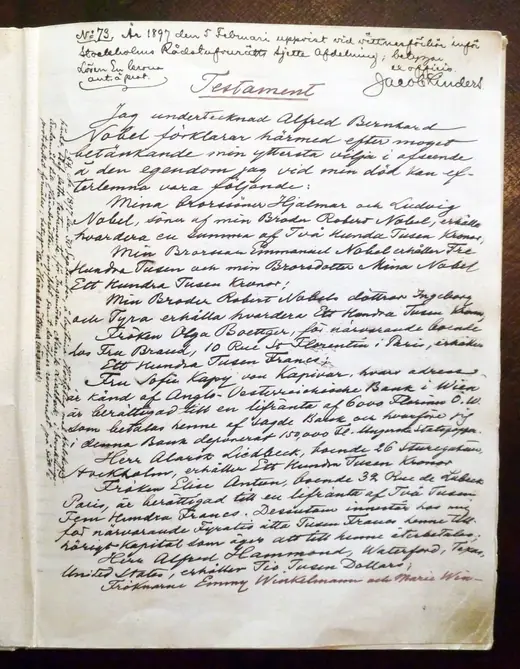
Nobel wrote his own will in four handwritten pages, left 94% of his fortune to an organisation that did not exist, and named no country as his home. It took five years, a family lawsuit, and an executor moving securities out of France to make it work.
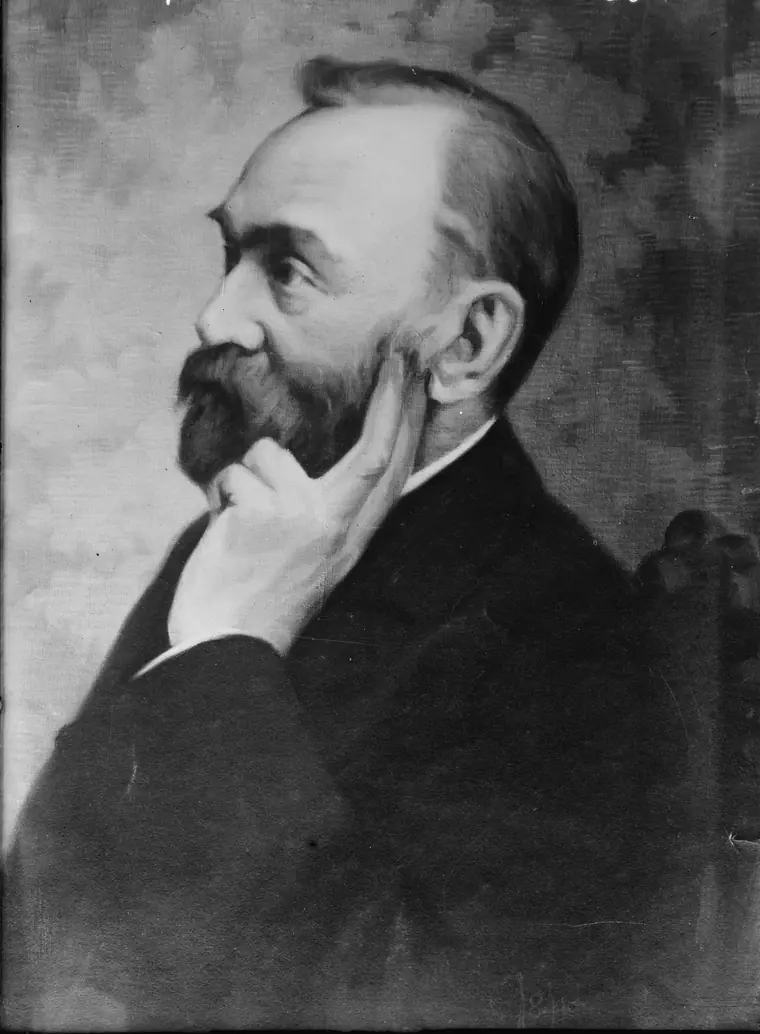
On November 27, 1895, at the Swedish-Norwegian Club in Paris, Alfred Nobel signed a will he had written himself, in his own hand, on four pages, without a lawyer. He told no one in his family what was in it. He died thirteen months later at Sanremo, on December 10, 1896.
The operative instruction is one of the most consequential sentences ever written in a private document. The bulk of the estate — 94% of his assets, some 31.2 million Swedish kronor — was to be converted to safe securities and constituted as a fund, the interest on which would be distributed annually in five prizes: physics, chemistry, physiology or medicine, literature, and the promotion of peace between nations.
It is a magnificent instruction and a terrible legal document. Nobel had invented dynamite, held 355 patents, and run an industrial empire across half of Europe. He drafted his own will the way people who are very good at one thing often do — precisely about the outcome, and silent about every mechanism required to reach it.
Three problems, all of them structural
The will was opened and read after Nobel's death, and the objections arrived almost at once.
- No legatee. The money was left to a fund that had never been created. There was no foundation, no charter, no board — nothing that could take title. A gift needs a recipient capable of receiving it.
- No domicile. Nobel had lived in Sweden, Russia, France, and Italy. He had homes across Europe, an industrial base in Sweden at Bofors and Björkborn, his principal residence for years in Paris, and he died in San Remo. France regarded him as a resident. Where a person is domiciled at death decides which country probates the estate, which law governs the will, and which tax authority collects — and nobody could say where Nobel was domiciled.
- No consent from the institutions. The will assigned prize-awarding duties to Swedish and Norwegian bodies that had not been asked and were not, at first, uniformly enthusiastic about being volunteered.
Then came the family. The heirs of Nobel's eldest brother, Robert, brought legal action to invalidate the will, on the straightforward ground that the great bulk of their uncle's estate had been directed away from his relatives to an institution that did not exist. The Norwegian Storting approved the will's arrangement for the peace prize on April 26, 1897, and the prize-awarding institutions were appointed in June of that year — but the estate itself remained contested.
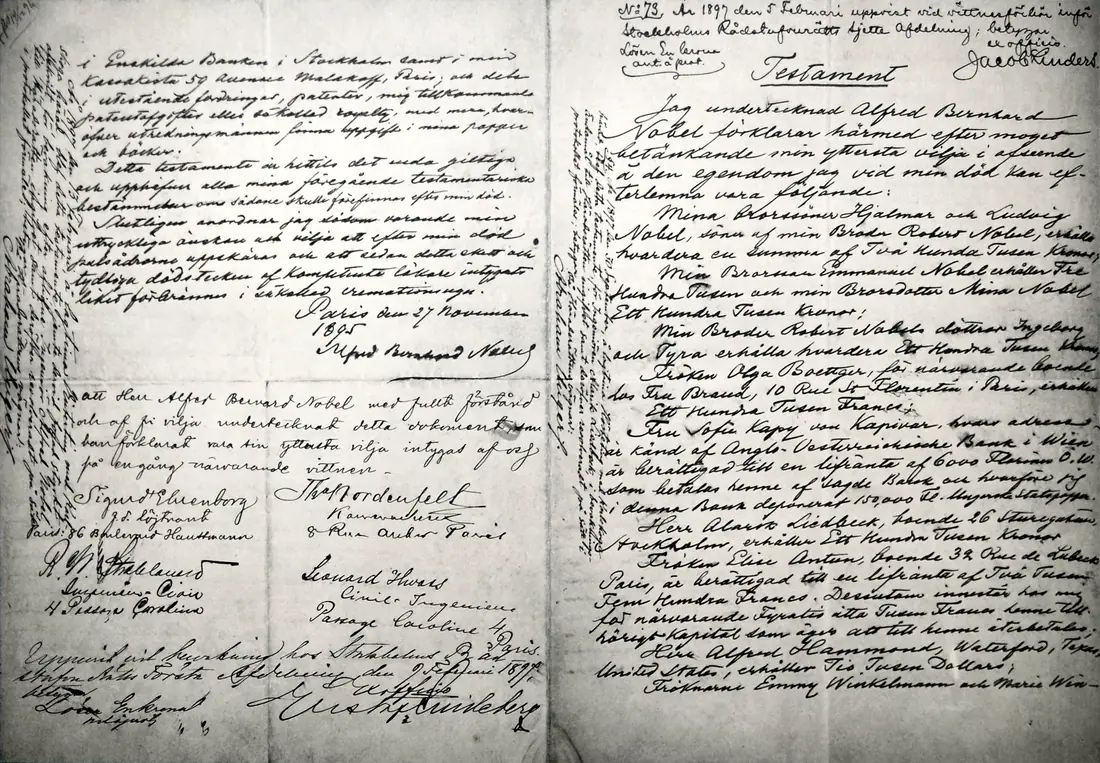
Sohlman, Lilljequist, and a race to move the assets
Nobel had named two executors: Ragnar Sohlman, his young assistant, then in his twenties, and the engineer Rudolf Lilljequist. Neither was a lawyer. Between them they spent years untangling a document written by a man who assumed clarity of purpose would substitute for legal machinery.
The domicile fight was the immediate emergency, and Sohlman's response to it is the most-told story in the whole affair: rather than wait for a French court to decide that Nobel had been domiciled in Paris, he arranged for Nobel's securities to be removed from France and taken to Sweden, so that the estate would be administered under Swedish law. It is the sort of manoeuvre that reads as dashing at a century's distance and as an enormous professional risk at the time.
The negotiation with the family was resolved in the ordinary way that estate fights are resolved. Emanuel Nobel, head of the Russian branch of the family, backed his uncle's intentions, and an agreement with Robert Nobel's heirs was reached in 1898 — a settlement, not a judgment. The Swedish government was involved in the wider negotiations.
On June 29, 1900, King Oscar II approved the statutes of the newly created Nobel Foundation. The first prizes were awarded on December 10, 1901 — five years to the day after Nobel died.
A five-year gap between intention and effect
It worked. That is the first thing to say. The Nobel Foundation exists, the prizes have run for more than a century, and the will's purpose was carried out substantially as written. Nobel's instinct about what he wanted was sound.
But the five-year gap was entirely avoidable, and every element of it traces to the same decision: a man who could afford any lawyer in Europe drafted his own will. The result was a document that stated a goal without building the vehicle to reach it.
The modern equivalent is common and rarely this glamorous. Someone writes a will leaving money to a charity that has changed its name, merged, or dissolved. Someone leaves money to a foundation they intended to create and never did. Someone with houses in three states leaves no evidence of which one was home. Each of those is Nobel's problem in miniature, and each of them is a probate fight.
Timeline
- Nov 27, 1895Nobel signs a four-page handwritten will at the Swedish-Norwegian Club in Paris, without a lawyer. He does not tell his family its contents.
- Dec 10, 1896Nobel dies at Sanremo, Italy. The will directs 94% of the estate — some 31.2 million kronor — to a fund endowing five annual prizes.
- Early 1897The will is read. Objections follow: no legal entity to receive the money, no settled domicile, and no consent from the institutions named to award the prizes.
- Apr 26, 1897The Norwegian Storting approves the arrangement for the peace prize. Prize-awarding institutions are appointed in June.
- 1897–1898Executors Ragnar Sohlman and Rudolf Lilljequist contest French claims to Nobel's domicile and move his securities to Sweden so the estate is administered under Swedish law.
- 1898An agreement is reached with the heirs of Nobel's brother Robert, who had brought action to invalidate the will. Emanuel Nobel supports his uncle's intentions.
- Jun 29, 1900King Oscar II approves the statutes of the Nobel Foundation.
- Dec 10, 1901The first Nobel Prizes are awarded, five years after Nobel's death.
What actually went wrong
- A gift to an entity that did not exist. The will left the residue to a fund with no charter, no trustees, and no legal capacity to take title. Somebody had to build the recipient before the gift could land.
- No stated domicile. Nobel had homes in several countries and died in a fourth. Domicile decides which court probates the estate and whose law governs. Leaving it ambiguous handed the estate a jurisdictional fight before anyone reached the merits.
- Institutions volunteered without being asked. The will assigned duties to bodies that had given no consent and had no funding mechanism for the work.
- Self-drafted, in secret. No lawyer reviewed it and no family member knew what was coming. The first was why the mechanics failed; the second is why the litigation started.
Would it have gone that way in Florida?
Florida would get there faster — charitable trusts are the one place a vague beneficiary is allowed.
Nobel's central defect — a gift to a fund that did not yet exist — is the one problem Florida law is specifically designed to absorb. Fla. Stat. §736.0402 requires a trust to have a definite beneficiary, and then carves out three exceptions. The first is a charitable trust. A Florida instrument that says “establish a fund and pay the income annually to whoever has conferred the greatest benefit on humankind in physics” does not fail for want of an identifiable beneficiary, because charity is the exception to the rule.
§736.0404 supplies the outer limit: a trust may be created only to the extent its purposes are lawful, not contrary to public policy, and possible to achieve. Nobel's purposes were all three. A Florida court would appoint a trustee, approve a governing instrument, and get on with it.
The more interesting Florida provision is §736.0413 — cy pres. When a charitable trust's particular purpose becomes unlawful, impracticable, impossible to achieve, or wasteful, the court may modify or terminate the trust and apply the property to a charitable purpose consistent with the settlor's broader intention. That is the statute you reach for when the named charity has dissolved, merged, changed its name, or — as here — never existed in the first place. A settlor, a trustee, or a qualified beneficiary can bring the proceeding. Cy pres is the reason a well-intentioned charitable gift in Florida almost never simply evaporates.
On the family contest, Florida is unhelpful to anyone hoping to prevent one. Nobel's relatives sued; a modern testator's instinct is to insert an in-terrorem clause disinheriting anyone who challenges the will. Fla. Stat. §732.517 makes no-contest clauses in wills unenforceable in Florida, and §736.1108 does the same for trusts. You cannot buy peace that way here. What you can do is document capacity and independence at signing so that a contest, if it comes, is short.
The domicile problem is genuinely a Florida specialty, because Florida is full of people who own homes in two states and have never decided which one is home. §222.17 lets a person file a sworn declaration of domicile with the clerk of the circuit court, stating that a Florida residence is their predominant and principal home — or, in the other direction, that they remain domiciled elsewhere despite owning property here. It is a short form. It is not conclusive on its own, but combined with voter registration, driver licence, tax filings, and where you actually spend your nights, it is the cheapest evidence you will ever buy. Given that Florida imposes no state estate tax under Art. VII, §5 of the state constitution, the stakes of that question are not academic.
Practical instruction, in two parts. If you are leaving money to a charity, name it precisely — legal name, address, tax ID — and add a clause telling the trustee what to do if that organisation no longer exists, so a court is applying your instruction rather than reconstructing your intention under cy pres. If you live in more than one state, pick one. File the declaration under §222.17, and make the rest of your paperwork agree with it.
What people ask us about this.
Further reading
Third-party sites. Not ours, not endorsed, not kept current by us — just the places worth going next.
Sources
- Alfred Nobel — Wikipedia
- Nobel Foundation — Wikipedia
- Ragnar Sohlman — Wikipedia
- Alfred Nobel's will — The Norwegian Nobel Institute
- Emanuel Nobel — Wikipedia
- Fla. Stat. §736.0402 — Requirements for creation — The Florida Senate
- Fla. Stat. §736.0413 — Cy pres — The Florida Senate
- Fla. Stat. §222.17 — Manifesting and evidencing domicile in Florida — The Florida Senate
If this is your situation
Free 30-minute consult. Plain English. No pressure.
Nearly every case in this archive turned on something ordinary — an unwitnessed page, a stale beneficiary line, a document nobody could find. Those are cheap to fix while you're alive and expensive to fix afterward.