Pablo Escobar
There was no probate. Colombia did not administer the estate — it extinguished the title, under an action that runs against the property and does not require a conviction. Thirty years on, the ranch is a theme park, part of the land has gone to victims of the armed conflict, and the hippopotamuses are a federal problem.
Pablo Escobar led the Medellín cartel, was indicted in Colombia and the United States on drug-trafficking charges, surrendered in 1991 to a prison he had built for himself, escaped in 1992, and was killed by a Colombian National Police unit on a Medellín rooftop on December 2, 1993, the day after his forty-fourth birthday. That is the crime part, and it is the part everyone knows.
The interesting part, for anyone who thinks about estates, is what happened next: nothing that resembled a probate. There was no inventory, no notice to creditors, no personal representative, no distribution to heirs. Colombia did not administer the fortune. It took title.
Forbes had listed him in every billionaires issue from 1987 to 1993, first at an estimated $3 billion. Wildly larger figures circulate; none of them is a court finding, and this page will not repeat them as though they were. What is documented is what the state actually seized, what it did with it, and what it is still doing with it in 2026.
Extinción de dominio: the state takes title, not the estate
Article 34 of Colombia's 1991 Constitution provides for the extinction of ownership, by judicial decision, over property acquired through illicit enrichment or to the detriment of the public treasury or social morality. Congress built the procedure out over three statutes — Law 333 of 1996, Law 793 of 2002, and finally Law 1708 of 2014, the Código de Extinción de Dominio, which is the code in force.
The features that matter here are the ones a common-law reader finds strange. The action is autonomous: it does not depend on a criminal prosecution and does not wait for one. It is imprescriptible: no limitation period runs against it. It is real, meaning it runs against the asset. And it produces a declaration of ownership in favour of the State without compensation.
Put those four features together and the estate question answers itself. If title is extinguished, there is nothing to inherit, because ownership is declared never to have lawfully existed. Heirs do not lose an inheritance in the ordinary sense. They are told there was no inheritance.
Assets that go through the process are administered by the Sociedad de Activos Especiales (SAE), a state company attached to the Ministry of Finance whose job is to hold, manage, and dispose of forfeited property. Most systems that seize a great deal of property eventually build one of these, because the hard problem is not taking a ranch. It is running one.
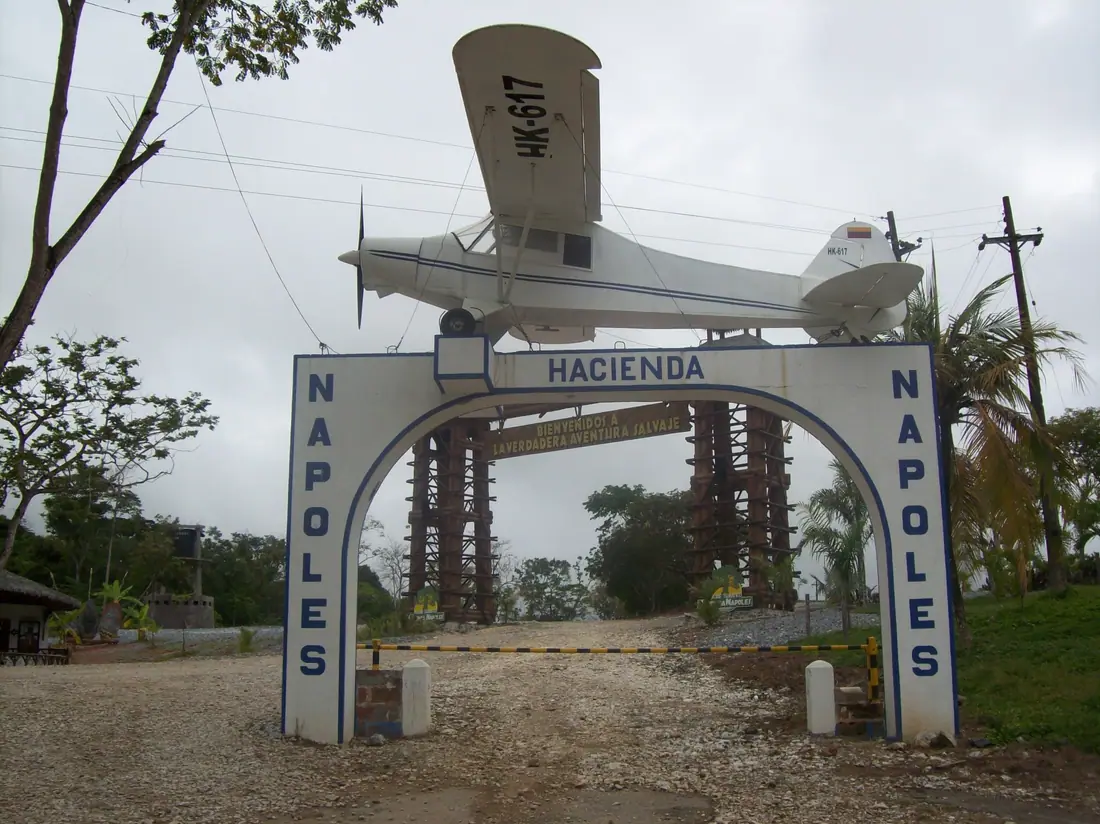
Hacienda Nápoles, and thirty years of deciding what it is for
Escobar bought the land near Puerto Triunfo, Antioquia, in 1978 and built out an estate usually given as about 20 square kilometres: a mansion, an airstrip, artificial lakes, a bullring, and a private zoo stocked with elephants, giraffes, rhinoceroses, ostriches and hippopotamuses, most of them imported without permission.
After 1993 it sat in litigation and decay for years while the extinción de dominio process ran. The property passed into state hands; the government at one stage placed families on parts of it; the extinction of ownership over the land was declared in 2004. In December 2007 a theme park opened on the site, its administration given to the municipality of Puerto Triunfo and its operation let to private investors. It is now one of the more visited parks in the region — water attractions, a wildlife park, museums, and concrete dinosaurs where the zoo used to be.
The disposition is still going. On October 2, 2025, Colombia's National Land Agency handed over 120 hectares of the property to rural women who are victims of the armed conflict, as part of the government's agrarian reform programme. The recipients had been given use of land there under a loan arrangement in 2017 and, according to the government's own account, were removed from it.
Which is the honest version of what a state does with a criminal fortune: it argues about it for thirty years. Seizure is a court order. Disposition is politics, and it takes far longer than anyone plans for.
Four hippopotamuses, and the arithmetic nobody did in 1981
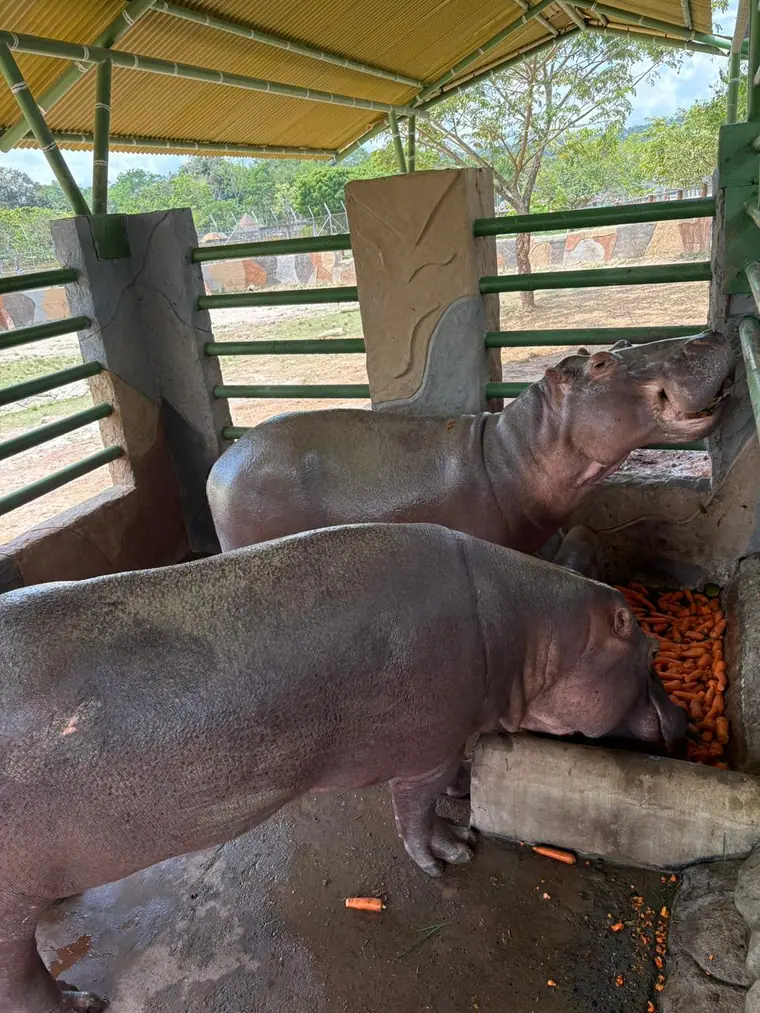
The zoo's other animals were dispersed after the seizure. The hippopotamuses — four of them, imported illegally — were not, because moving a hippopotamus is difficult and expensive and nobody wanted to. They stayed, they bred, and they moved into the Magdalena River basin.
The official count in 2023 was 169, with authorities projecting growth toward a thousand by 2035. In 2022 Colombia's Ministry of Environment declared them an invasive species by resolution; the legality of that resolution was itself challenged before Colombia's Council of State, on the argument that Law 1774 of 2016 classifies animals as sentient beings rather than property. Management options — sterilisation at roughly $9,800 per animal, relocation abroad, and culling — have all been announced, contested, and partly attempted.
In October 2021 a United States federal court in the Southern District of Ohio granted an application for discovery under 28 U.S.C. §1782 in which the applicants were described as the community of hippopotamuses living in the Magdalena River. It was widely reported as the first US recognition of animals as legal persons. Legal commentators pointed out promptly that the order contained no such finding — it granted a routine discovery application in aid of a foreign proceeding, in the form the applicants' lawyers drafted. Both things are true: the caption is real, and the holding is not what the headlines said.
The estate-planning point is unglamorous and completely general. Living property does not stop. A collection of animals is the one asset class that grows, escapes, incurs costs, and creates liability while a court decides who owns it, and every year of delay makes the problem larger. Four became one hundred and sixty-nine while the paperwork was pending.
The son's public accounting
Escobar's son, Juan Pablo Escobar, was sixteen when his father died. The family left for Argentina in the mid-1990s and he has lived since under the name Sebastián Marroquín. He trained as an architect and, in 2014, published a memoir — Pablo Escobar: My Father — followed by an English edition in 2016.
His account, given repeatedly in the book and in interviews, is that the family received none of the money, and that they did not know where any liquid fortune was. That is his statement, not a court finding, and no court has adjudicated it. It is worth recording for the same reason the Lansky family's account is worth recording: it describes an ordinary failure mode, at an extraordinary scale.
A fortune held in cash, in other people's names, and in places nobody wrote down is a fortune that disappears at the moment of death — from heirs and from the state alike. The property Colombia actually recovered was the property that could not be hidden: land, buildings, aircraft, vehicles, animals. The rest is a story.
Timeline
- 1978Escobar buys the land near Puerto Triunfo that becomes Hacienda Nápoles, later built out to roughly 20 square kilometres with an airstrip and a private zoo.
- 1987Forbes includes him in its first international billionaires issue at an estimated $3 billion. He appears in every issue through 1993.
- 1991Colombia's new Constitution, at Article 34, provides for judicial extinction of ownership over property acquired through illicit enrichment.
- Dec 2, 1993Escobar is killed by a Colombian National Police unit in Medellín, aged 44. No probate follows; the state proceeds against the property instead.
- 1996 – 2014Colombia builds out the forfeiture procedure through Law 333 of 1996, Law 793 of 2002, and finally Law 1708 of 2014, the Código de Extinción de Dominio.
- 2004Extinction of ownership over the Hacienda Nápoles land is declared.
- Dec 2007A theme park opens on the site, administered by the municipality of Puerto Triunfo and operated under private concession.
- Oct 2021A US federal court in Ohio grants a 28 U.S.C. §1782 discovery application brought in the name of the Magdalena River hippopotamuses. Commentators note the order makes no finding on legal personhood.
- 2022 – 2023Colombia declares the hippopotamuses an invasive species by resolution; the resolution is challenged. The 2023 count is 169 animals.
- Oct 2, 2025The National Land Agency transfers 120 hectares of Hacienda Nápoles to rural women who are victims of the armed conflict.
What actually went wrong
- Forfeiture is not inheritance with a different name. Extinción de dominio declares that ownership never lawfully existed. There is no estate to administer, no claims process, and nothing for heirs to contest.
- An action against property is not stopped by a death. Colombia's action is autonomous, imprescriptible and real. The one event that ends a criminal prosecution — the defendant dying — does nothing to it at all.
- Undocumented wealth is lost to everyone. By the family's account they never located the liquid fortune; the state recovered the assets that had addresses. Cash with no paper trail protects nobody after the person who knew about it dies.
- Seizing an asset is the easy half. Thirty years after the death the same property has been a ruin, a settlement scheme, a theme park and an agrarian-reform parcel. Somebody has to pay to hold it during all of that.
- Living assets get worse while you litigate. Four hippopotamuses became a hundred and sixty-nine, an invasive-species designation, a foreign discovery application, and a nine-figure management problem.
Would it have gone that way in Florida?
In the United States a criminal forfeiture would have died with him. A civil forfeiture would not — and Florida's version is unusually hard for the state to win.
American law splits what Colombia keeps in one action. Criminal forfeiture — under 21 U.S.C. §853 for drug offences — is part of a defendant's sentence. It requires a conviction. A defendant who dies before judgment gets the whole prosecution abated, and the forfeiture count goes with it. Civil forfeiture — 21 U.S.C. §881, 18 U.S.C. §981 — is an in rem action against the property itself, filed in the property's name, and it does not require anyone to be convicted of anything. That is the branch that behaves like extinción de dominio, and it is the branch that survives a death.
Florida's own statute is the Florida Contraband Forfeiture Act, §932.701–932.7062. It is civil and in rem, and it says out loud what most statutes leave to inference: under §932.703(1)(a), seizure is permitted where the owner of the property is arrested, cannot be identified, is a fugitive — or is deceased. A dead owner is an express category in the statute.
Florida then makes the state work harder than most jurisdictions do. After the 2016 amendments, §932.704 requires the seizing agency to prove beyond a reasonable doubt that the article was used in violation of the Act — a criminal standard, in a civil case, which is rare. §932.703(2) requires the agency to apply within 10 business days for a court order determining whether probable cause existed for the seizure. §932.703(7) is the innocent-owner provision: property may not be forfeited unless the agency establishes by a preponderance that the owner knew, or should have known after reasonable inquiry, that the property was being used unlawfully. A lienholder's interest survives unless the agency proves actual knowledge when the lien was made. And §932.703(9) gives an owner an affirmative defence that the connection between the property and the offence was incidental or accidental.
Where does that leave a personal representative? In an awkward but manageable position. Seized property is not estate property to be inventoried and distributed; it is the subject of a separate civil case in which the estate is a claimant. The representative's job is to appear in the forfeiture, assert the estate's interest or the innocent-owner defence on behalf of heirs whose interest is genuinely innocent, and preserve the claim. Doing nothing forfeits by default.
Meanwhile the ordinary probate clocks keep running on everyone else. §733.702 bars a claim not filed by the later of 3 months after first publication of the notice to creditors or 30 days after service, and §733.710 bars any claim against the decedent 2 years after the date of death, without extension. A creditor waiting to see how a forfeiture turns out before filing a claim is a creditor who will be too late for both.
The uncomfortable Florida point, stated straight. Fla. Const. Art. X §4 protects a Florida homestead from forced sale by creditors with no value cap — the limits are acreage only — and the protection descends to the heirs. It does not, however, defeat a forfeiture. Homestead is an exemption from creditors' process; forfeiture is a claim that the property itself is contraband, and the Florida Supreme Court has treated the two as different questions. The honest summary is that Florida's homestead is one of the strongest debtor protections in the country and is regularly used as one, and that it is not a defence to a properly proven forfeiture.
What to actually do. If you are administering an estate and any asset has been seized, calendar two dates before anything else: the forfeiture deadlines in the seizure paperwork, and the §733.702 claims window in the probate. Then file an answer in the forfeiture case asserting the estate's interest. An estate that treats a seizure as somebody else's problem loses the asset without a hearing.
What people ask us about this.
Further reading
Third-party sites. Not ours, not endorsed, not kept current by us — just the places worth going next.
Sources
- Pablo Escobar in Forbes' first-ever billionaire issue in 1987 — Forbes, Sep 2015
- Ley 1708 de 2014 — Código de Extinción de Dominio — Departamento Administrativo de la Función Pública, Colombia
- Víctimas del conflicto recibieron las primeras hectáreas de la Hacienda Nápoles — El Colombiano, Oct 2025
- Tras Pablo Escobar, la Hacienda Nápoles se convirtió en uno de los parques más visitados de Latinoamérica — Infobae, Jun 2025
- Locals fret as Colombia to declare hippos invasive species — The Washington Post / AP, Feb 2022
- Pablo Escobar's multiplying 'cocaine hippos' will be sterilized in Colombia — Smithsonian Magazine, Nov 2023
- Hippos are legally people? Actually, not so much — Duane Morris Animal Law Developments, Oct 2021
- Pablo Escobar: My Father — Juan Pablo Escobar (Sebastián Marroquín), 2014 / 2016
- Fla. Stat. §932.703 — Forfeiture of contraband article; exceptions — The Florida Senate
If this is your situation
Free 30-minute consult. Plain English. No pressure.
Nearly every case in this archive turned on something ordinary — an unwitnessed page, a stale beneficiary line, a document nobody could find. Those are cheap to fix while you're alive and expensive to fix afterward.