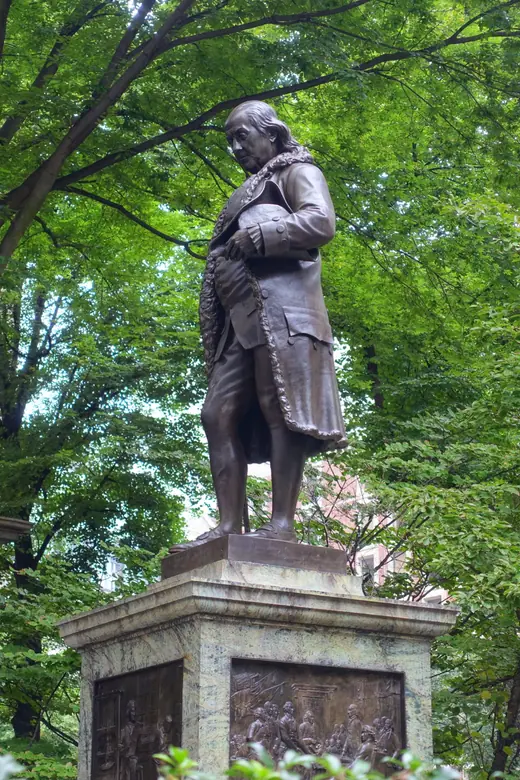
Benjamin Franklin
Franklin left £1,000 each to Boston and Philadelphia with instructions to lend it to young tradesmen at 5% and let it compound for two centuries. The cities did roughly that. The money came out in 1990, and Boston still had to litigate who got it.
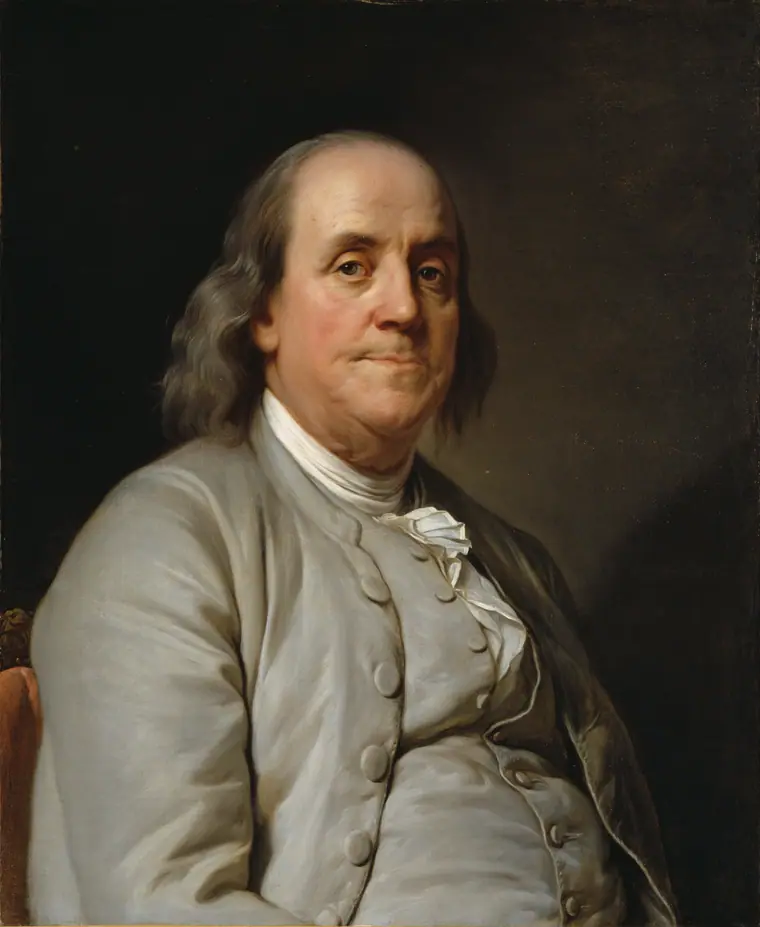
Benjamin Franklin died on April 17, 1790. Ten months earlier he had added a codicil to his will, and it is the single most interesting paragraph any American has ever put in an estate document.
He left £1,000 sterling to the town of Boston and £1,000 to the city of Philadelphia — roughly $4,000 each at the time. The money was not to be spent. It was to be lent out in small sums at 5% interest to young married tradesmen who had completed their apprenticeships, exactly as Franklin himself had been helped as a young printer. The repayments would go back into the fund and be lent again.
Then the timetable. After 100 years, the cities could spend a large portion of the accumulated fund on public works, with the remainder left to keep compounding. After 200 years, the whole thing would be wound up and divided between each city and its state.
Franklin had done the arithmetic in the codicil itself, and he was explicit that he was making a bet on compound interest running for longer than anyone alive would see it resolved. He was, characteristically, also making a point: that a small sum plus patience plus a working credit market is a public institution.
The terms stopped matching the world
The funds ran roughly as designed for the first several decades. Then the American economy changed underneath them. The apprenticeship system that defined Franklin's eligible borrower shrank. Banks arrived. A young tradesman with two sureties had other places to go for credit, and the pool of applicants who fit the codicil's description thinned out.
By 1884 the Boston Globe was describing the trusts as inflexible, noting that the loan programme had drawn only a handful of takers. The money kept compounding — but partly because there was nobody left to lend it to on Franklin's terms.
At the 100-year mark in 1890 the funds had grown unevenly. Reported figures put Boston's fund at about $328,000 and Philadelphia's at roughly $71,000 — a fivefold divergence produced not by market returns but by administration. Boston had lent and collected carefully. Philadelphia had not.
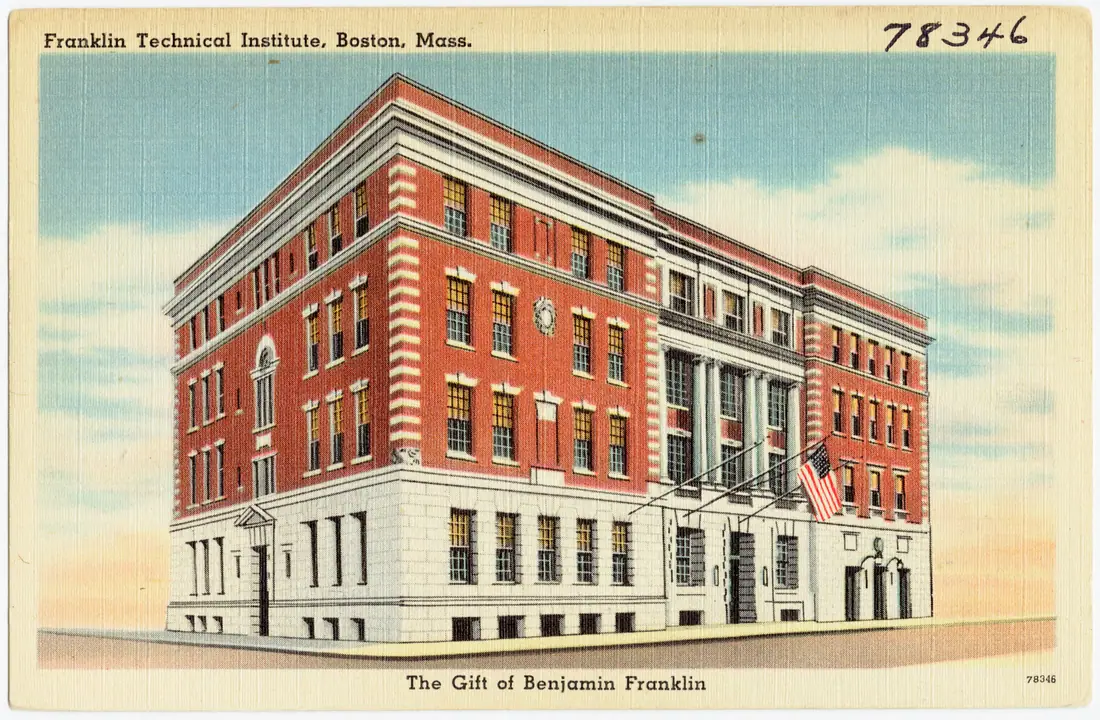
The first distribution was not smooth either. Philadelphia put its share toward the Franklin Institute. Boston spent nearly two decades arguing about what to do — the debate included allegations of misappropriation by city aldermen — before a gift from Andrew Carnegie helped establish the Franklin Union, later the Benjamin Franklin Institute of Technology, in 1908. That outcome, a school teaching skilled trades, is about as close to Franklin's stated purpose as a public works project could get.
The trust learned to bend
The remaining quarter of each fund compounded for another hundred years, and over that century the rules loosened. The married-under-25-apprentice requirement quietly gave way. By the mid-twentieth century Boston's fund was making loans to medical students — a category Franklin never contemplated and would probably have approved of — and reportedly supported more than 7,000 students between 1960 and 1990.
That is the part of the story estate lawyers should notice. The trust survived two hundred years because the people administering it were permitted to change what it did. A rigid reading of the codicil would have left a growing pile of money with no eligible borrower and no lawful use.
The 200-year mark arrived in 1990. The reported totals: about $4.5 million in Boston and roughly $2 million in Philadelphia.
Two centuries of compounding, and one more lawsuit
Philadelphia handled the wind-up administratively. Mayor W. Wilson Goode convened advisers to work out what Franklin would have wanted; the city's portion — reported at about $520,000 — went to trade-education grants for high school students, and the Commonwealth's larger share went to the Franklin Institute.
Boston went to court. The Benjamin Franklin Institute of Technology claimed the entire $4.5 million, relying on a 1958 Massachusetts statute concerning the trust. Litigation ran past the 200-year deadline, and in 1994 the school prevailed, taking the full fund.
So the final scorecard on Franklin's experiment: the money compounded almost exactly as he predicted it would, the purpose had to be rewritten twice to stay usable, and the last act was a four-year fight over who got the cheque. Two hundred years is a long time for a document to keep making sense.
Timeline
- June 1789Franklin executes a codicil leaving £1,000 sterling each to Boston and Philadelphia, to be lent at 5% to young married tradesmen who have completed apprenticeships, with milestones at 100 and 200 years. Accounts differ on the exact day in June.
- Apr 17, 1790Franklin dies in Philadelphia at 84.
- 1884The Boston Globe describes the trusts as inflexible, reporting that only a handful of borrowers in Boston have used the loan programme.
- 1890The 100-year mark. Reported balances: about $328,000 in Boston, roughly $71,000 in Philadelphia. Philadelphia directs its share toward the Franklin Institute.
- 1890s–1908Boston's distribution is contested for nearly two decades, including allegations of misappropriation by city aldermen.
- 1908With a contribution from Andrew Carnegie, Boston's share helps establish the Franklin Union — later the Benjamin Franklin Institute of Technology.
- 1960–1990Boston's remaining fund lends to students, reportedly supporting more than 7,000 of them. The original eligibility terms are no longer applied.
- 1990The 200-year term ends. Reported totals: about $4.5 million in Boston, roughly $2 million in Philadelphia. Philadelphia's city share funds trade education; the Commonwealth's share goes to the Franklin Institute.
- 1994After litigation, the Benjamin Franklin Institute of Technology is awarded the full Boston fund.
What actually went wrong
- Eligibility written for one decade, applied across twenty. Married, under 25, apprenticeship completed, two sureties. Within fifty years that described a shrinking population; within a hundred it described almost nobody. The purpose survived only because administrators stopped enforcing the terms.
- No stated fallback if the class of beneficiaries disappeared. Franklin said what to do with the money and who should get it, but not what to do if no one qualified. That gap is what forced a century of improvisation.
- Two cities, two administrations, five times the difference. Same gift, same terms, same start date. Boston ended the first century with roughly $328,000 and Philadelphia with about $71,000. A long trust is only as good as whoever is minding it.
- A wind-up with no distribution mechanic. The codicil said the fund would be divided between city and state at 200 years, but not how, or by whom, or on what dispute-resolution procedure. Boston spent four years in court answering a question the document should have answered.
Would it have gone that way in Florida?
Entirely legal in Florida — and you now get 1,000 years instead of 200.
Franklin's codicil is a charitable trust with a fixed term, and nothing about it offends modern Florida law. Fla. Stat. §689.225 codifies Florida's statutory rule against perpetuities, and for trusts created on or after July 1, 2022, the permissible period is 1,000 years — up from 360 years for trusts created after December 31, 2000, through June 30, 2022. Franklin's two-hundred-year fuse would be comfortably inside it. Charitable trusts, in any event, sit largely outside the perpetuities problem altogether: a gift that runs from one charity to another can last indefinitely.
§736.0404 is the substantive gate — a trust may be created only to the extent its purposes are lawful, not contrary to public policy, and possible to achieve. Lending money to young tradesmen is all three. Note the last clause, though, because it is exactly where Franklin's trust ran into difficulty by 1884: a purpose that was possible to achieve in 1790 had become close to impossible to achieve on the stated terms a century later.
That is what cy pres is for. §736.0413 lets a court modify a charitable trust when its particular purpose becomes unlawful, impracticable, impossible to achieve, or wasteful, and direct the property to a purpose consistent with the settlor's broader charitable intention. A settlor, a trustee, or a qualified beneficiary can bring the proceeding. In Florida, the informal loosening that Boston and Philadelphia did over 200 years would be done formally, on the record, with a judge signing off — which is slower, but leaves the trustee protected instead of exposed.
Florida also supplies two tools Franklin's trustees did not have. §736.04113 permits judicial modification where circumstances not anticipated by the settlor mean that compliance with the terms would defeat or substantially impair a material purpose. And §736.04117 permits decanting — a trustee with power to invade principal may pour the assets into a new trust with updated terms. Between them, a modern Florida trustee facing an eligibility clause nobody can satisfy has a clean path forward rather than a hundred years of quiet non-enforcement.
The caveat worth stating plainly: none of these tools recover value the trust already lost. Cy pres fixes the future. It does not refund the decades a fund spent unable to perform its function. Boston's trust compounded for a century while the loan programme it existed to run had almost no participants.
Practical instruction, and it is the same one every long trust needs. Write the purpose broadly and the mechanics narrowly, not the other way round. Say to help young people entering skilled trades — then describe your preferred method as a preference, not a condition. Add a clause telling the trustee what to do if the method becomes impracticable, name a trust protector with power to amend administrative terms, and say explicitly how the trust ends and who divides what. Franklin got the economics right and the drafting backwards, and it still worked. Most people do not have two centuries of margin for error.
What people ask us about this.
Further reading
Third-party sites. Not ours, not endorsed, not kept current by us — just the places worth going next.
Sources
- How a 200-year-old gift from Benjamin Franklin made Boston and Philadelphia a fortune — Mental Floss, August 2020
- Ben Franklin's gift that keeps on giving — HistoryNet
- The unusual codicil in Benjamin Franklin's will — Unsung History
- Governor's Commission on the Benjamin Franklin Trust Fund, Executive Order No. 294 — Commonwealth of Massachusetts
- Fla. Stat. §689.225 — Statutory rule against perpetuities — The Florida Senate
- Fla. Stat. §736.0413 — Cy pres — The Florida Senate
- Fla. Stat. §736.04113 — Judicial modification of irrevocable trust — The Florida Senate
If this is your situation
Free 30-minute consult. Plain English. No pressure.
Nearly every case in this archive turned on something ordinary — an unwitnessed page, a stale beneficiary line, a document nobody could find. Those are cheap to fix while you're alive and expensive to fix afterward.