Alistair Cooke
He broadcast Letter from America for 58 years and died in New York in 2004. A year later the family learned that a tissue-recovery company had taken bone from his body before cremation, on paperwork nobody had signed. Its principal went to prison for 18 to 54 years.
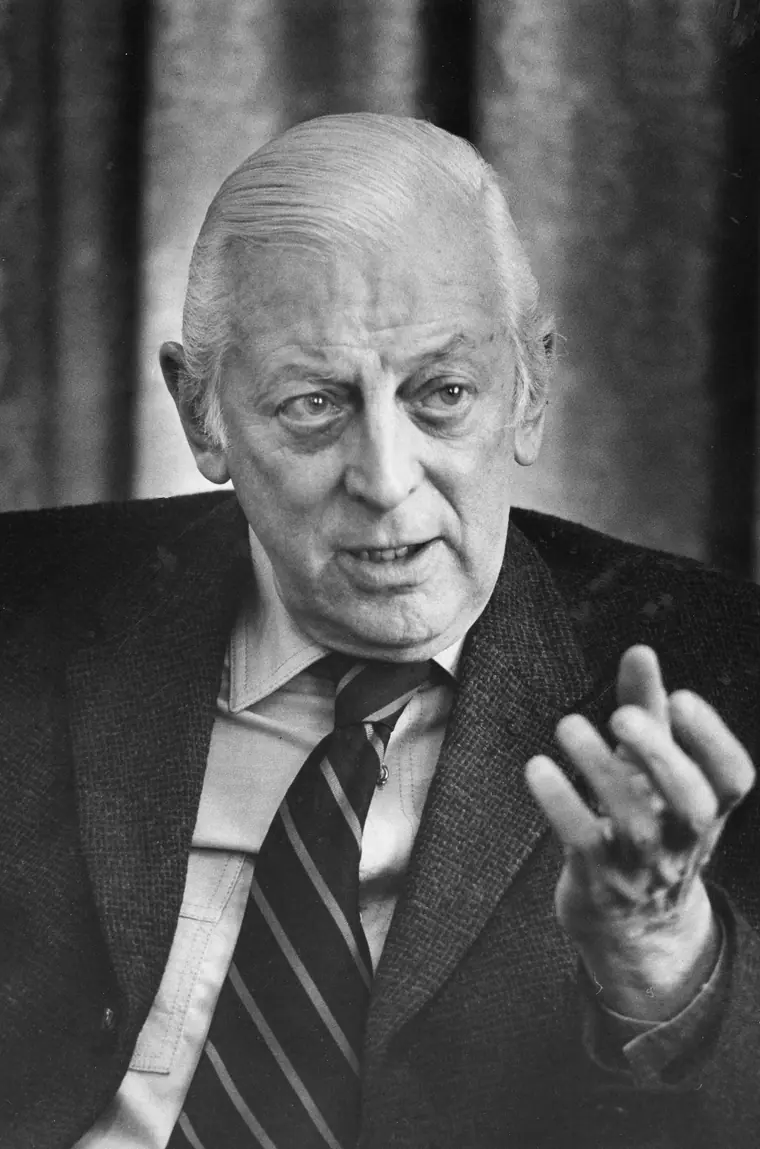
Alistair Cooke was born in Salford in 1908 and spent most of his life explaining America to Britain. He wrote and recorded Letter from America for the BBC from 1946 until March 2004 — 2,869 episodes, the longest-running speech radio programme in the world — and introduced Masterpiece Theatre on American public television for twenty-two years. He announced his retirement on March 2, 2004, and died on March 30, 2004, in New York, at 95. The cause was lung cancer that had spread to his bones.
His body went to a funeral home for cremation. His ashes were later scattered by his family in Central Park.
On December 22, 2005, the New York Daily News reported that bone had been removed from his body before the cremation and sold on for use in surgical grafts, and that the paperwork authorising it had been fabricated. The consent form was forged. The death certificate had been altered — among other changes, his age was recorded as 85 rather than 95, and the recorded cause of death did not match. His family had signed nothing and been told nothing.
The bone was, in any event, unusable. The cancer that killed him was in it.
A tissue-recovery company and a supply of paperwork
The company was Biomedical Tissue Services, of Fort Lee, New Jersey. Its principal was Michael Mastromarino, a former oral surgeon. BTS recovered tissue from bodies held at funeral homes and sold it on to processors, which turned it into grafts for orthopaedic, dental, and reconstructive surgery — a legitimate industry with a real and constant shortage of supply.
The recovery is lawful when there is consent, when the donor is screened, and when the paperwork is genuine. Investigators alleged that at BTS none of those three reliably held: consent forms were forged, and donor screening records were falsified.
The FDA ordered BTS to cease operations on October 8, 2005 and ordered a recall of the tissue it had distributed. By then roughly 10,000 patients in the United States and Canada had received grafts traceable to the company. Some recipients later reported serious infections. The recall was the largest of its kind.
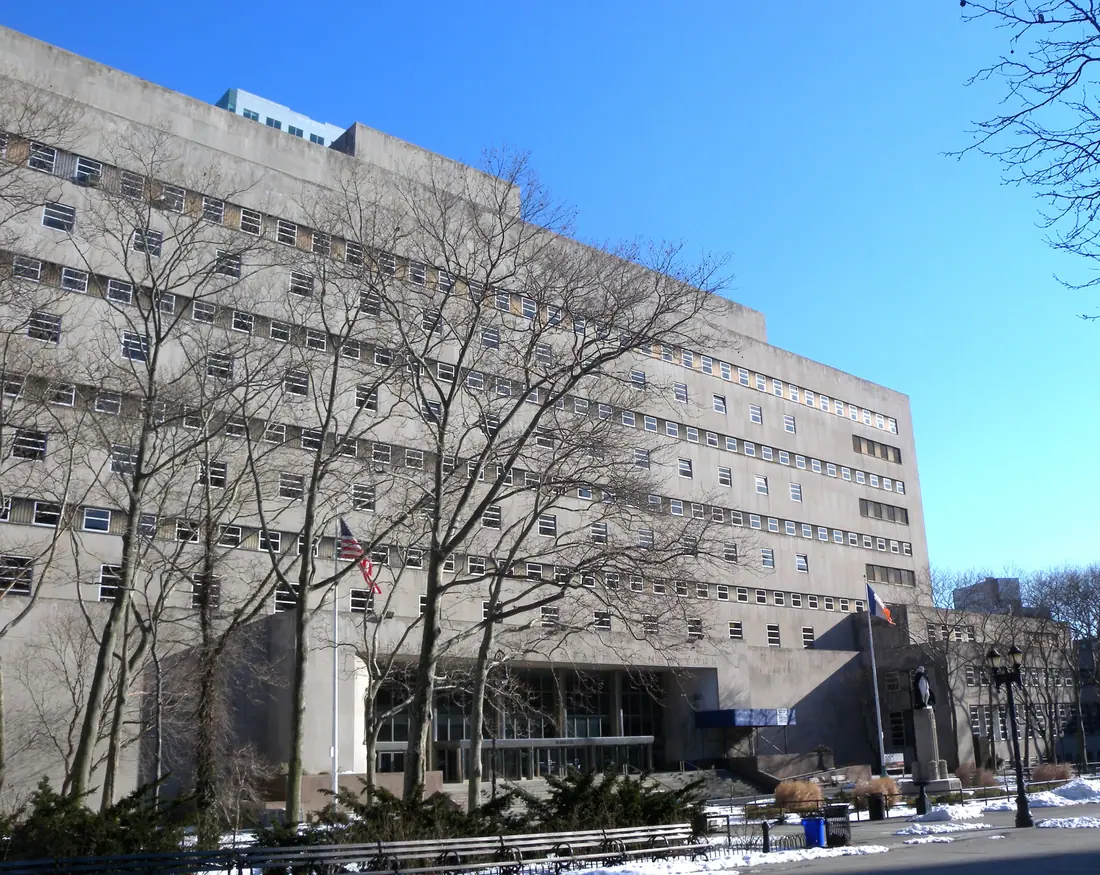
Mastromarino and three others were charged in Brooklyn. He pleaded guilty in 2008 to charges including enterprise corruption and body stealing, and on June 27, 2008 was sentenced in Kings County to 18 to 54 years. He died in prison on July 7, 2013.
Two sets of victims, two entirely different lawsuits
This is the part worth understanding, because it explains why the outcome felt incomplete to almost everyone involved. The scheme produced two groups of injured people, and the law routes them to different courts with different claims.
- The recipients — patients who received grafts made from unscreened tissue — had product-liability claims against the processors and distributors. Those were consolidated as multidistrict litigation in the District of New Jersey, In re Human Tissue Products Liability Litigation, before Judge William J. Martini. A 2007 ruling in that MDL is a fair snapshot of the difficulty: the plaintiffs asked the court to order the defendants to send standardised warning letters to unidentified recipients, and the court declined on primary-jurisdiction grounds, holding that recall communications sat with the FDA and directing them to petition the agency instead.
- The families had no product claim at all. Their injury was interference with the body itself, which in most American states is a distinct common-law tort. In New York it is the right of sepulcher — the next of kin's absolute right to immediate possession of the body for burial or other disposition — and its remedy is damages for emotional suffering and mental anguish.
The families' obstacle was the same document that made the scheme work. New York's Public Health Law §4201 protects a funeral home or crematory that acts reasonably and in good faith in reliance on facially valid authorisation from someone with apparent authority. The Appellate Division applied exactly that protection in Mack v. Brown (2d Dep't 2011), holding a funeral home and cemetery were entitled to rely on an authorisation without independent investigation.
That is the structural point. Good-faith reliance on paperwork is what keeps funeral homes functioning — nobody wants a director second-guessing a grieving widow's signature. It is also, precisely, what a forger is exploiting. The criminal law reached the forger. The civil law mostly did not reach the institutions that believed him.
Why donated tissue is regulated differently from donated organs
Transplant organs move through a federally contracted allocation network with tracking at every step. Tissue — bone, skin, tendon, cornea — does not. It is processed into products, held on shelves, and shipped like inventory, and much of it is handled by for-profit companies.
The legal architecture around it is thin by comparison. Sale is prohibited, but the reimbursement of recovery, processing, storage, and transport costs is permitted, and that permitted category is elastic enough to fund an entire industry. Consent is required, but the consent is a piece of paper obtained at a funeral home in the first hours after a death, from people who are not reading carefully.
The BTS case did not change that architecture. It produced a prison sentence, a national recall, and tightened donor-screening rules. The place where the system remains only as strong as a signature is still the funeral home, in the first forty-eight hours, before anyone has thought to ask.
Timeline
- Mar 2, 2004Cooke announces his retirement after 58 years of Letter from America.
- Mar 30, 2004He dies in New York at 95. His body is taken to a funeral home for cremation; his ashes are later scattered in Central Park.
- Oct 2005The New York Daily News reports a police investigation into Biomedical Tissue Services over tissue taken from bodies at funeral homes.
- Oct 8, 2005The FDA orders BTS to cease operations and to retain and recall its distributed tissue.
- Dec 22, 2005The Daily News reports that Cooke's remains were among those handled by BTS, on forged consent and an altered death certificate.
- Feb 2006Mastromarino and three others are charged in Brooklyn on counts including enterprise corruption and body stealing.
- May 21, 2007In the New Jersey multidistrict litigation, Judge Martini declines to order court-supervised notice to tissue recipients, deferring to the FDA's primary jurisdiction.
- Jun 27, 2008Mastromarino, having pleaded guilty, is sentenced in Kings County to 18 to 54 years.
- Jul 7, 2013Mastromarino dies in prison.
What actually went wrong
- The consent document was the only safeguard, and it was forged. Every institution downstream — processor, distributor, surgeon — behaved correctly in reliance on it.
- Nobody in the family was asked, because nobody had to be asked twice. A single facially valid form ends the enquiry. There is no second check, and no notification to next of kin that recovery occurred.
- The two groups of victims had nothing in common legally. Recipients had product claims in federal MDL; families had a dignitary tort in state court. Neither route produced a remedy against everyone responsible.
- Good-faith reliance protects the funeral home. New York's §4201 shields a provider acting reasonably on facially valid authorisation — sensible policy that, in this case, insulated the last party positioned to notice.
- Nothing in the process happens after the family has time to think. Recovery must occur within hours. The document is signed in the worst part of the worst week of someone's life.
Would it have gone that way in Florida?
Florida criminalises both halves of this — the handling and the sale — and both are second-degree felonies. The civil side is harder, and the fix is a document you sign yourself.
Florida law reaches this conduct from two directions, and it is worth seeing them as a pair. Section 872.06 makes it a second-degree felony to mutilate or otherwise grossly abuse a dead human body, with an express exception for any act done for a bona fide medical purpose or other lawful purpose. That exception is the whole game: recovery performed on valid consent is lawful, and the identical act performed on a forged one is a felony. The paperwork is the line.
Section 873.01 attacks the money. It is a second-degree felony to offer to buy or sell, to buy or sell, or to transfer for valuable consideration any human organ or tissue — bone and skin are named — and no for-profit corporation or employee may transfer or arrange the transfer of a body part for valuable consideration. The statute then carves out the reasonable costs of removal, storage, and transportation. That carve-out is not a loophole so much as a necessity, because tissue banking cannot function without it. It is also the space the industry lives in.
The lawful route into that industry is Chapter 765, Part V, the Florida Uniform Anatomical Gift Act. Section 765.512 says who may make a gift: the donor may make it in life, and if the donor has not, an ordered list of others may — spouse, then adult child, then parent, then adult sibling, adult grandchild, grandparent, a close personal friend, a guardian, a representative ad litem. The provision that matters most is the one at the end: where the donor has made the gift, a family member, guardian, representative ad litem, or health care surrogate may not modify, deny, or prevent it, and the gift is irrevocable after death. Florida also gives the decedent's own written directions first place in the disposition hierarchy under §497.005.
The honest civil caveat. Florida recognises a claim by next of kin for the wrongful handling of a decedent's remains, and mental-anguish damages are the recognised measure — but a funeral establishment that acted reasonably on documentation that appeared valid is in a materially better position than one that did not, in Florida as in New York. Against a forger, the practical remedy is usually the prosecution, not the lawsuit, because a person facing an 18-to-54-year sentence rarely has assets worth collecting.
The practical instruction, and it is genuinely useful here. Make the decision yourself, in advance, rather than leaving it to a form your family signs in a funeral home at 11pm. If you want to donate, register the gift — the donor designation on a Florida driver licence or in the state donor registry is a gift under Chapter 765 that your family cannot undo. If you do not want tissue recovery, put that in the same standalone written disposition directions that name your funeral provider and your health care surrogate. And when a funeral director presents an authorisation for anything beyond the disposition you arranged, read the top line and ask who the recovering organisation is. That question, asked once, is the check the system does not otherwise perform.
What people ask us about this.
Further reading
Third-party sites. Not ours, not endorsed, not kept current by us — just the places worth going next.
Sources
- Alistair Cooke — life, death, and the 2005 disclosure — Wikipedia
- Michael Mastromarino — charges, plea, and sentence — Wikipedia
- Biomedical Tissue Services — FDA order and case timeline — Wikipedia
- In re Human Tissue Products Liability Litigation, 488 F. Supp. 2d 430 (D.N.J. 2007) — Caselaw Access Project, Harvard Law School
- Mack v. Brown, 82 A.D.3d 133 (N.Y. App. Div. 2d Dep't 2011) — Caselaw Access Project, Harvard Law School
- Fla. Stat. §872.06 — Abuse of a dead human body — The Florida Senate
- Fla. Stat. §873.01 — Purchase or sale of human organs and tissue prohibited — The Florida Senate
- Fla. Stat. §765.512 — Persons who may make an anatomical gift — The Florida Senate
If this is your situation
Free 30-minute consult. Plain English. No pressure.
Nearly every case in this archive turned on something ordinary — an unwitnessed page, a stale beneficiary line, a document nobody could find. Those are cheap to fix while you're alive and expensive to fix afterward.