Aimee Semple McPherson
The most famous preacher in America died in 1944 with a personal estate of about $10,000. The organisation she founded was valued at $2.8 million. Her son took over the day she died — not by inheritance, but because the corporate bylaws said so.
This page is about estate mechanics — what a founder personally owned, what the institution owned, and which of those two things a will can move. Nothing here evaluates anyone's beliefs.
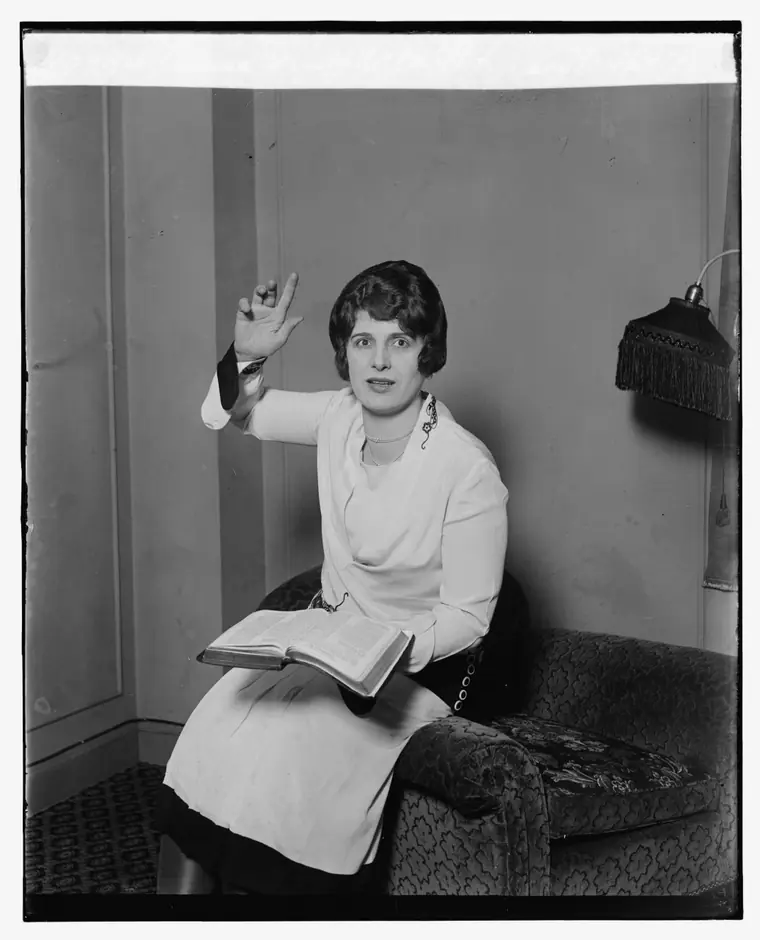
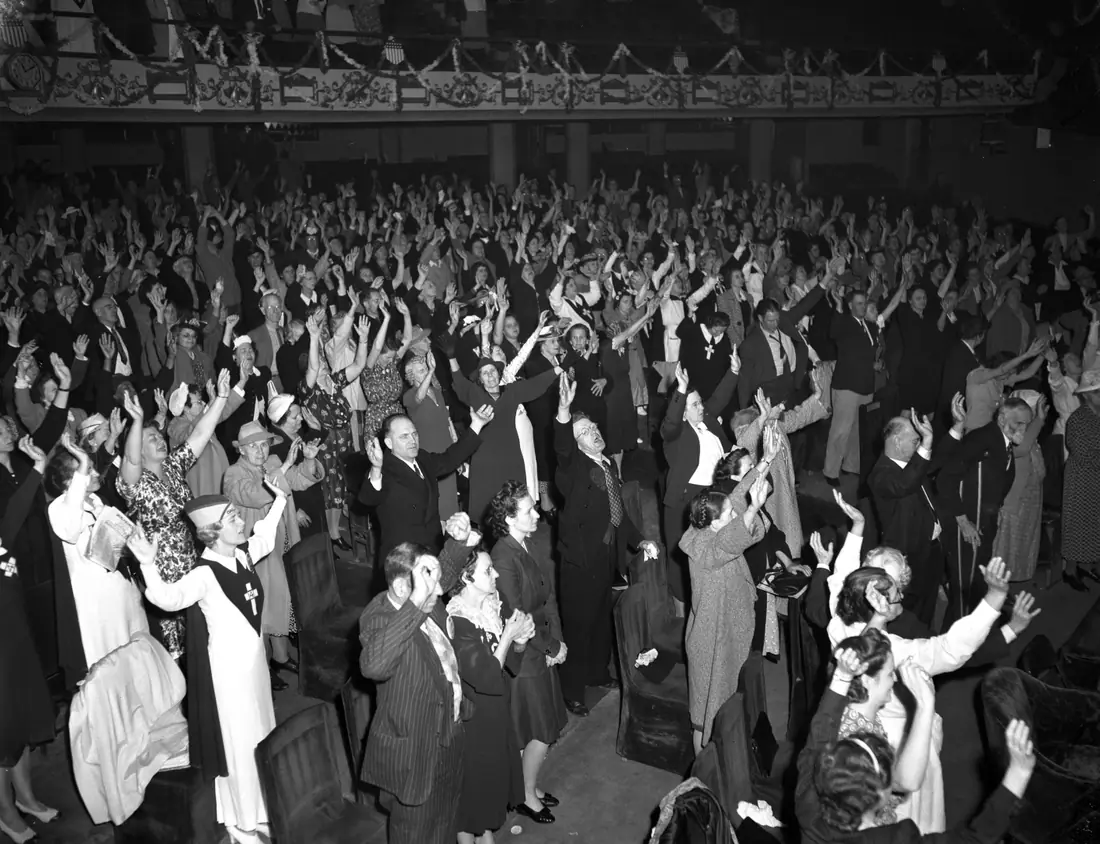
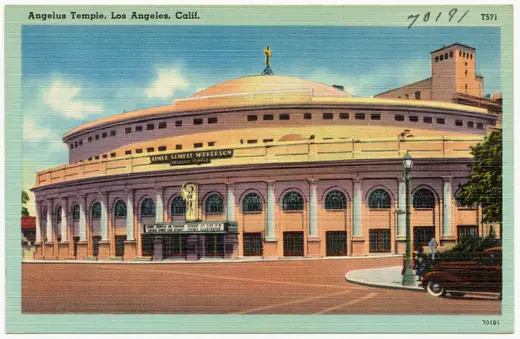
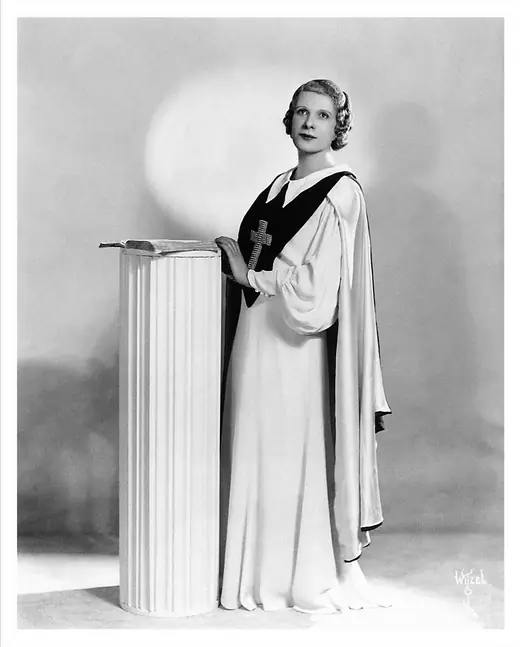
Aimee Semple McPherson was, through the 1920s and 1930s, one of the most recognisable public figures in the United States. She opened Angelus Temple in Los Angeles in January 1923, a 5,300-seat auditorium she filled several times a week. She was among the first women in America granted a broadcast licence. Her sermons, her legal troubles, and her disappearance in 1926 were front-page news for two decades.
She died on September 27, 1944, in an Oakland hotel room, at 53. An autopsy found heart failure associated with an overdose of sleeping pills; the death was generally treated as accidental. That is the whole of it, and the rest of this page is about paperwork.
The paperwork is the surprise. Millions of dollars had moved through her ministry. Her personal estate came to roughly $10,000. She left $2,000 to her daughter, Roberta, and the remainder to her son, Rolf. The International Church of the Foursquare Gospel — the organisation — was valued at about $2.8 million.
Incorporated in 1927, and that changed the question
The organisation was incorporated in California in December 1927, after the movement reached roughly 100 congregations. Incorporation is a plain, unglamorous step that has enormous consequences for what happens seventeen years later.
Before incorporation, assets accumulated by a movement are held by whoever holds title — a founder, a group of trustees, a loose association. Those assets are personal property, they pass at death, and they can be fought over in probate. After incorporation, the corporation owns them. The founder becomes an officer of an entity, and officers do not inherit; they are elected or appointed.
The governance McPherson operated under gave the president extensive powers — appointment of officers, hiring, salaries, and a veto. That is a governance question, not an ownership question. She had authority over the corporation's property. She did not own it.
Rolf McPherson became president in 1944 and held the office for 44 years, retiring in 1988. In that period the denomination grew from roughly 29,000 members in 410 congregations to over a million members in more than 19,000 congregations across 63 countries. Not one dollar of that transition depended on his mother's will.
- Angelus Temple and the denomination's charter properties — corporate assets. Not in the estate. Not devisable by will.
- Her personal savings and effects — roughly $10,000. The whole of what probate had to distribute.
- The presidency — a corporate office. Passed by governance, effective immediately, with no court involved.
- Her daughter's $2,000 — a devise, not a share. Which is how the family half of this story ends.
The daughter who sued and won and left
The $2,000 line has a history behind it. In 1937, McPherson's daughter Roberta Semple sued her mother's lawyer, Willedd Andrews, for slander, after he stated publicly that she had attempted to intimidate her mother. The trial was national news. Roberta won.
She then left the organisation, resigning the vice-presidency, and moved to New York. Her brother was groomed for the succession. Seven years later, the will reflected exactly that arrangement: $2,000 to Roberta, the remainder to Rolf.
It is worth being precise about what that number means. In an estate of $10,000, a $2,000 devise is one-fifth. It is a small figure because the estate was small, not because the estate was the fortune. The fortune was never hers to divide. Any family member hoping to inherit a share of the temple was hoping for something no will could deliver.
McPherson's mother, Mildred Kennedy, had taken a different route years earlier — a 1927 settlement reported at roughly $200,000 in cash and property, negotiated during life. Whatever else can be said about that arrangement, it was the only one of the three that produced a definite number at a definite time.
Founders own less than everyone assumes
This pattern recurs constantly, and almost never with a temple attached. A person builds a business, a foundation, a practice, a congregation. Everyone — including the founder — speaks of it as theirs. Then they die, and someone reads the actual documents.
The documents say the entity owns the building, the accounts, the marks, and the goodwill. The founder owned shares, or a membership interest, or in a nonprofit corporation frequently nothing at all — because a nonprofit has no owners. What the founder had was control, and control is a creature of bylaws.
Two consequences follow, and they run in opposite directions. The good one: institutional assets are insulated from a family fight. No relative can put Angelus Temple into probate. The uncomfortable one: a founder's family has no claim on any of it, however much of the family's labour went into building it.
Timeline
- Jan 1923Angelus Temple opens in Los Angeles, a 5,300-seat auditorium and the movement's headquarters.
- 1927McPherson's mother, Mildred Kennedy, takes a settlement reported at roughly $200,000 in cash and property and leaves the organisation.
- Dec 1927The International Church of the Foursquare Gospel is incorporated in California, after the movement reaches roughly 100 congregations. From this point the corporation owns the property.
- 1937Roberta Semple sues her mother's lawyer, Willedd Andrews, for slander. She wins, then resigns the vice-presidency and moves to New York.
- Sep 27, 1944McPherson dies in Oakland at 53. An autopsy finds heart failure associated with an overdose of sleeping pills; the death is treated as accidental.
- 1944Her personal estate is reported at roughly $10,000 — $2,000 to Roberta, the remainder to Rolf. The organisation is valued at about $2.8 million.
- 1944Rolf McPherson becomes president. The office passes by corporate governance, not by will, and takes effect without a probate proceeding.
- 1988Rolf McPherson retires after 44 years, by which time the denomination reports over a million members in more than 19,000 congregations.
What actually went wrong
- Nothing went wrong — and that is the point. The succession was clean precisely because the valuable assets had been put inside a corporation seventeen years earlier. The lesson is the structure, not a failure.
- The family may not have understood the arithmetic. A daughter who spent years as vice-president of an organisation worth $2.8 million received a $2,000 devise, because the $2.8 million was never in the estate. That is a conversation to have in life.
- Personal and institutional finances that look the same from outside. When a founder's public identity and the organisation's identity are indistinguishable, everyone — donors, relatives, the founder — loses track of which entity owns what. Only the deeds and the account signature cards answer it.
- No public record of a succession plan beyond the bylaws. The bylaws worked. But a governing document that concentrates appointment, hiring, salary, and veto power in one office is a document that depends entirely on who holds that office next.
Would it have gone that way in Florida?
Same result, and the Florida statutes make the dividing line explicit: a personal representative reaches the decedent's property, and only the decedent's property.
Run this estate through a Florida probate and almost nothing changes, because the outcome turns on title, and title is title everywhere.
Fla. Stat. §733.607(1) gives the personal representative the right to take possession or control of the decedent's property — that phrase is the whole answer. A Florida personal representative appointed for an estate like this one would be entitled to the $10,000 and nothing else. Corporate real estate, corporate bank accounts, and corporate trademarks are outside the inventory because they are outside the estate.
The organisation itself would live under Chapter 617, the Florida Not For Profit Corporation Act. A Florida nonprofit has no shareholders and no owners. It has members, or it has a self-perpetuating board, and §617.0803 requires a board of at least three directors, elected or appointed in the manner set out in the articles or the bylaws. That sentence is the succession plan. Whoever the bylaws say picks the next officer, picks the next officer — on the day of the death, without a court, without an inventory, and without any input from the founder's heirs.
If the assets had instead been held in a charitable trust rather than a corporation, §736.0405 would govern. Subsection (1) confirms that the advancement of religion is a charitable purpose. Subsection (3) gives the settlor standing to enforce the trust. And §736.0110(3) gives the Florida Attorney General the right to assert the rights of a qualified beneficiary — with standing in any judicial proceeding — for a charitable trust whose principal place of administration is in Florida. That is the supervision mechanism for charitable assets that no private person is positioned to police.
The honest caveat runs the other way. Putting assets into an entity is not a magic wall. If a founder transferred personal property into the organisation while insolvent, or in a manner that defeated a spouse's rights, the transfer can be attacked — Florida's elective share under §732.2035 reaches a wide range of lifetime transfers, including revocable trusts and property over which the decedent held certain powers. Incorporation protects institutional assets. It does not launder a transfer made to defeat a claim.
Practical instruction, for founders and for their families. Make a one-page schedule of title. Two columns: what the organisation owns, what you own. Deeds, accounts, vehicles, insurance, intellectual property, the domain name, the mailing list. Give a copy to your family and a copy to your board. The single most common surprise in a founder's estate is a relative discovering, at the reading, that the thing everyone called “Dad's company” has belonged to a corporation since 1993.
What people ask us about this.
Further reading
Third-party sites. Not ours, not endorsed, not kept current by us — just the places worth going next.
Sources
- Aimee Semple McPherson — Wikipedia
- Rolf McPherson — Wikipedia
- Foursquare Church — Wikipedia
- Aimee Semple McPherson — history — The Foursquare Church
- Roberta Semple Salter — Wikipedia
- Aimee Semple McPherson — Encyclopaedia Britannica
- Fla. Stat. §733.607 — Possession of estate — The Florida Senate
- Fla. Stat. §617.0803 — Number of directors — The Florida Senate
- Fla. Stat. §736.0110 — Others treated as qualified beneficiaries — The Florida Senate
If this is your situation
Free 30-minute consult. Plain English. No pressure.
Nearly every case in this archive turned on something ordinary — an unwitnessed page, a stale beneficiary line, a document nobody could find. Those are cheap to fix while you're alive and expensive to fix afterward.