Sam Walton
In 1953 a variety-store operator in Arkansas put everything he had into a family partnership and gave his four children 20% each. Nine years later he opened the first Wal-Mart. By the time he died the fortune was measured in tens of billions — and most of it had never been his to tax.
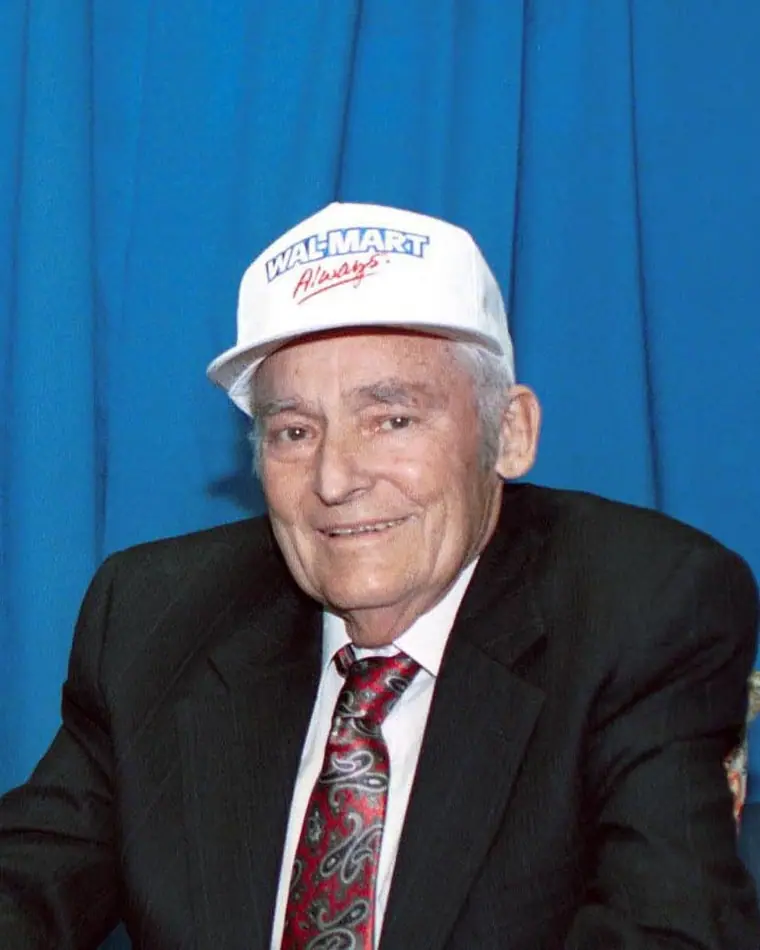
In 1953, Sam and Helen Walton owned some variety stores in Arkansas and Missouri and not much else. That year they put what they had into a family partnership and included their four children — Rob, John, Jim, and Alice — in the ownership. Each child took 20%. Sam and Helen kept 20% between them.
The entity became Walton Enterprises. In 1962 the first Wal-Mart Discount City opened in Rogers, Arkansas. In 1970 the company went public. Every dollar of that growth happened inside a structure the children already owned.
Sam Walton died on April 5, 1992, at 74, of multiple myeloma. He was the richest man in America, and he personally held roughly 10% of Walton Enterprises.
That sentence is the entire case. You do not transfer a fortune. You transfer the thing that later becomes one.
Why the partnership matters more than the gift
Giving children stock outright would have moved the appreciation too. What the partnership added was control without ownership, and it added three things at once.
- The senior generation keeps the wheel. A general partner runs the business regardless of how small a percentage of the economics they hold. Sam Walton ran the company for four more decades holding a minority interest.
- The interests are hard to value, and that is the point. A minority, non-controlling, non-marketable interest in a closely held family entity is worth less than its proportionate share of the underlying assets, because nobody can sell it, force a distribution, or vote it. Valuation discounts in the 20–30% range are ordinary in this context, and they apply to every gift.
- The shares cannot wander. A partnership agreement can restrict transfers, so an interest cannot be sold to a stranger, seized in a divorce, or fragmented across cousins without the family's consent.
- One voice at the shareholder meeting. Walton Enterprises still holds a large block of Walmart stock and still votes it as a unit. Six separate holdings would have voted six ways within a generation.
Sam Walton described the thinking plainly in his autobiography: the way to reduce estate tax is to give assets away before they appreciate. He wrote that having begun the arrangement forty years earlier, which is the only reason the advice is worth anything.
Walton Enterprises today is reported to hold roughly 37% of Walmart's outstanding shares and to manage in the region of $225 billion — described as the largest family office in the world. It was formed with a variety-store business and four children who were not yet adults.

Helen Walton, GRATs, and the trusts that came after
The 1953 partnership solved the first transfer. The family kept building.
Audrey Walton, Sam's sister-in-law, gave the technique its name. In 1993 she funded trusts with about $200 million of stock that paid her an annuity, with whatever remained at the end passing to her daughters. The IRS challenged the structure and lost in the United States Tax Court in 2000 — Walton v. Commissioner, 115 T.C. 589. The decision invalidated the regulation the government had relied on, and the “Walton GRAT” — a grantor retained annuity trust structured so the taxable gift is close to zero — became standard practice for large estates across the country.
Helen Walton established four charitable lead annuity trusts in 2003, at a moment when the IRS's benchmark interest rate was near historic lows; her estate established twelve more after her death in 2007. A CLAT pays a fixed amount to charity each year and passes the remainder to family. If the assets outperform the IRS rate, the excess reaches the heirs without gift or estate tax. A Bloomberg analysis of IRS filings found the four 2003 trusts had grown from about $1.4 billion in 2007 to roughly $2 billion in 2011, returning about 14% a year over that period.
That is the honest complication in this case and it should not be skipped. The same structures that keep a family business intact also move very large amounts of appreciation outside the transfer-tax system, and reasonable people describe that as sound planning or as a policy failure depending on where they sit. Both descriptions are about the law, not about the family. Everything here was lawful, disclosed on federal returns, and in the Audrey Walton matter litigated to judgment and upheld.
It works at three million as well as at thirty billion
The instinct this case triggers — that's for billionaires — is exactly backwards. The Waltons were not billionaires in 1953. They were a retail family with four kids and a decent business, doing the one thing that only works before the value arrives.
The equivalent today is a Florida contractor, a marina, a medical practice, a group of rental properties, or a family farm — any asset a person expects to be worth substantially more in twenty years than it is worth this morning. The cheapest moment to move it is now, and the moment gets more expensive every year the value climbs.
What makes it work is not the entity. It is the agreement inside the entity: who manages, who votes, what happens when someone dies or divorces or wants out, how an interest is valued when it is bought back, and who is obliged to buy it. An LLC or limited partnership with no such agreement is a filing fee, not a plan.
There is one genuine argument against doing any of this, and it deserves to be stated rather than buried. A lifetime gift gives up the basis step-up. Property held until death is revalued for income-tax purposes to its fair market value on the date of death under IRC §1014, so the heirs can sell it the next morning with no capital gains at all. Property given away during life carries the donor's original basis with it, and the gain is taxed when it is eventually sold. For a family whose whole estate sits comfortably under the federal exemption, the estate tax the Waltons were avoiding is not a live problem — and giving early can cost more in capital gains than it saves.
So the honest version of the lesson is conditional. Move an asset early if you expect the estate to exceed the exemption, or if control and continuity matter more than basis. Hold it if you do not. What is not conditional is the paperwork: the entity, the agreement, the transfer restrictions, and the valuation method are worth having either way, because they decide who runs the business on the morning after — a question the tax code has no opinion about.
Timeline
- 1953Sam and Helen Walton place their assets into a family partnership including their four children — Rob, John, Jim and Alice — with 20% to each child and 20% to the parents. It becomes Walton Enterprises.
- 1962The first Wal-Mart Discount City opens in Rogers, Arkansas.
- 1970Wal-Mart goes public. The family's holding sits inside the 1953 structure.
- Apr 5, 1992Sam Walton dies at 74. He personally holds roughly 10% of Walton Enterprises; what he does leave passes largely to his surviving spouse under the unlimited marital deduction.
- 1993Audrey Walton funds grantor retained annuity trusts with about $200 million of stock.
- 2000The US Tax Court decides Walton v. Commissioner, 115 T.C. 589, rejecting the IRS's position and making the near-zeroed-out “Walton GRAT” standard practice.
- 2003Helen Walton establishes four charitable lead annuity trusts while IRS benchmark rates are near historic lows.
- Apr 2007Helen Walton dies. Her estate establishes twelve further charitable lead annuity trusts.
- 2011Bloomberg's analysis of IRS filings puts the four 2003 trusts at roughly $2 billion, up from about $1.4 billion in 2007.
What actually went wrong
- Nothing — which is why it is here. This is the control case for every disaster elsewhere in the archive. The distinguishing feature is not sophistication. It is that the structure existed in 1953, when there was nothing in it worth arguing about.
- The one real risk is doing it late. A transfer made when an asset is already worth a fortune is valued at that fortune. Every year of delay is priced.
- A family entity with no agreement is worse than none. The partnership works because it says who manages, who may transfer, and what happens on death. Without those terms it is simply a co-ownership arrangement with extra filings.
- Discounts have to be real. Valuation discounts depend on genuine restrictions genuinely observed. An entity that ignores its own agreement, distributes on demand, and is run as the founder's personal account invites the IRS to disregard it.
- Concentration is the standing hazard. A single holding company in a single stock has carried this family for seventy years and would end it in a decade if the underlying business failed. That is the trade, and it should be made consciously.
Would it have gone that way in Florida?
This is a Florida play too — and Florida's limited partnership and LLC statutes give the structure a second job that Arkansas law was never asked to do.
Florida has no estate tax of its own under Fla. Const. Art. VII, §5, so the only transfer-tax question here is the federal one. In 2026 the federal estate and gift tax exemption is $15 million per person, indexed for inflation, with portability between spouses — a married Florida couple can therefore shelter $30 million between them. Above that, the rate is 40%, which is the number that makes the Walton arithmetic worth understanding.
The family entity of choice in Florida is usually a limited liability company under Ch. 605 or a limited partnership under Ch. 620, and either can carry the Walton structure. The mechanics: the senior generation contributes the asset, takes back manager or general-partner authority, and gifts non-managing interests to children or to trusts for them over time, using annual exclusion gifts and lifetime exemption. Management stays put. Appreciation moves.
Fla. Stat. §620.1702 is the provision that makes the discount defensible. A transferee of a limited partnership interest receives the right to distributions the transferor would have received — and nothing else. No management participation, no right to demand information, no historical accounting. It also provides that a transfer made in violation of a restriction in the partnership agreement is ineffective as to a person with notice of the restriction. An interest that cannot vote, cannot compel a distribution, and cannot be freely sold is genuinely worth less than its arithmetical share, and that is why it is valued that way.
Fla. Stat. §620.1703 adds the protective layer. A judgment creditor of a partner may obtain a charging order against that partner's transferable interest — and the statute says in terms that the charging order is the exclusive remedy, that foreclosure on the interest is not available, and that a court may not order an accounting or inquiry into the partnership's affairs on the creditor's behalf. A creditor who charges an interest gets whatever is distributed and cannot force a distribution to be made. The Florida LLC equivalent for a multi-member company sits at §605.0503.
The honest caveats, and there are three. First, discounts must be earned: the entity has to have a real business purpose, real formalities, and an agreement the family actually follows, or the IRS will argue the restrictions should be disregarded under IRC §2704 and the discount collapses. Second, a gift removes basis step-up: property transferred during life carries over the donor's income-tax basis, while property held until death gets a step-up to fair market value under IRC §1014. Below the exemption, holding until death is frequently the better answer, and the calculation is capital-gains rate against estate-tax rate. Third, charging-order protection is weaker for a single-member LLC; Florida law treats those differently, and a family entity intended for asset protection should have more than one genuine member.
The practical instruction. If you own something you expect to be worth much more later — a business, land, a practice, a rental portfolio — get the entity and the agreement in place while the number is still small. Put the buy-sell terms, the transfer restrictions, the valuation method, and the management succession into that agreement on day one. Then have a qualified appraiser value each gift contemporaneously and file the gift tax return, even when no tax is due, because filing starts the three-year statute of limitations on the IRS's ability to revalue it.
What people ask us about this.

Further reading
Third-party sites. Not ours, not endorsed, not kept current by us — just the places worth going next.
Sources
- How Wal-Mart's Waltons maintain their billionaire fortune with estate taxes — Accounting Today / Bloomberg, Sep 2013
- How Wal-Mart's Waltons keep the tax man at bay — The Dallas Morning News / Bloomberg, Sep 14 2013
- How to preserve a family fortune through tax tricks — Bloomberg
- Trusts allow Walton family to safeguard wealth — St. Louis Post-Dispatch
- Walton Enterprises — Wikipedia — formation, ownership split, current Walmart stake
- Sam Walton — Wikipedia — biography and date of death
- Fla. Stat. §620.1702 — Transfer of partner's transferable interest — The Florida Senate
- Fla. Stat. §620.1703 — Rights of creditor of partner or transferee — The Florida Senate
If this is your situation
Free 30-minute consult. Plain English. No pressure.
Nearly every case in this archive turned on something ordinary — an unwitnessed page, a stale beneficiary line, a document nobody could find. Those are cheap to fix while you're alive and expensive to fix afterward.