Muhammad Ali
In 2006 Ali sold 80% of the marketing rights to his own name and likeness for $50 million. When he died ten years later, the most valuable thing he had ever owned was not in his estate — and when a broadcaster used his image the following year, the plaintiff was a brand-management company.
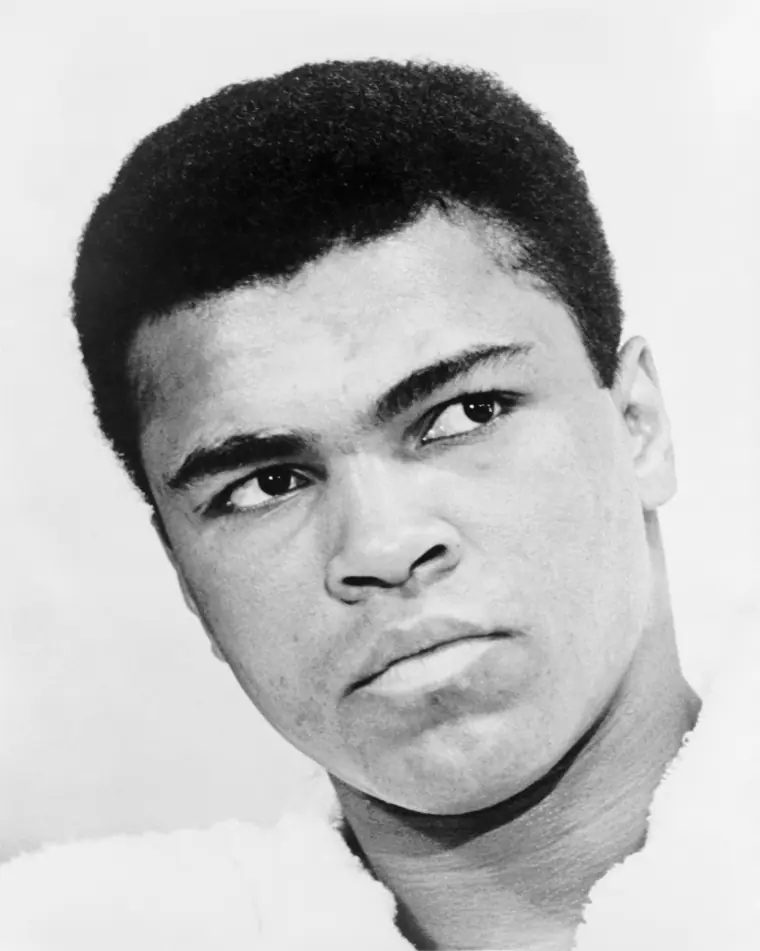
Muhammad Ali died on June 3, 2016, in Scottsdale, Arizona, at 74, after decades with Parkinson's disease.
By then the answer to the question what did he own had already been settled, and it had been settled by him.
In April 2006, Ali sold 80% of the marketing rights to his name, likeness, and trademarks to the entertainment company CKX Inc. for a reported $50 million. The vehicle was called GOAT LLC — Greatest Of All Time. Ali kept a 20% interest and, with his wife Lonnie, a continuing role in how the marks were used.
Ten years later, when nine children and a widow were left to sort out an estate, the single most valuable asset in the world bearing the name Muhammad Ali was not among the things they were sorting out.
From CKX to Authentic Brands Group
The rights then did what corporate assets do: they moved.
CKX was taken private and later reorganized as CORE Media Group. On November 19, 2013 — while Ali was still living — Authentic Brands Group announced it had completed the purchase of Muhammad Ali Enterprises from CORE Media Group. ABG took global rights to the intellectual property: the name and likeness, the trademarked phrases including float like a butterfly, sting like a bee and The Greatest of All Time, and what the announcement described as the world's largest library of photographic images of Ali.
ABG partnered with the Ali family and with collectibles executive Joel Weinshanker. Lonnie Ali said in the announcement that the family felt confident ABG was the right team to protect and progress Ali's core principles.
This is worth stating plainly because it is the whole case: by 2013, three years before Ali's death, the controlling interest in his identity was owned by a New York brand-management company, and it had already changed hands twice.
Who sued Fox
In February 2017, Fox aired a roughly three-minute promotional video before Super Bowl LI built around archival footage of Ali, calling him The Greatest, before turning to NFL figures including Joe Montana, Joe Namath, Vince Lombardi, and Tom Brady.
In October 2017, a $30 million federal lawsuit followed, alleging false endorsement under the Lanham Act and violation of the Illinois Right of Publicity Act. The complaint argued that Fox could have sold those three minutes to advertisers for the amount claimed.
The plaintiff was Muhammad Ali Enterprises LLC — the ABG-owned entity. Not the estate. Not the widow. Not any of the nine children.
Fox denied the claims and the parties settled. But the caption on the complaint is the most useful document in this entire case. Fourteen months after Ali died, the party with standing to protect his image in court was a company he had sold it to eleven years earlier.
An estate, nine children, and a set of reported tensions
Press reports around the death put the estate in the region of $50 million to $80 million, with the widow Lonnie Ali and Ali's nine children as the intended beneficiaries. The figures circulated widely and were not confirmed by the estate.
Coverage in 2016 and 2017 described friction — over access to Ali in his final years, over the arrangements for the funeral and who served as pallbearers, over the plan itself. Ali's daughter Maryum Ali publicly disputed the reports of a family feud, saying the children had been raised to love each other and that there was no dispute with their stepmother.
We note the reports and the denial and stop there, because the interesting point is structural rather than personal. Whatever the family did or did not agree about, the argument had a ceiling on it. The most valuable asset was not on the table. It had been sold, twice removed, by the person whose name was on it.
That is not obviously a bad outcome. A $50 million cash sale during life converts an asset that is hard to value, hard to police, and expensive to litigate into money that is none of those things. It funds a family, it settles the valuation question the IRS would otherwise raise, and it removes the most reliable source of post-mortem litigation among heirs. Whether it was the right trade is a judgment about what a family needs. The mistake is not making the trade. The mistake is making it without telling the people who will one day be surprised by it.
Timeline
- Apr 2006Ali sells 80% of the marketing rights to his name, likeness, and trademarks to CKX Inc. for a reported $50 million, through GOAT LLC. He retains 20%.
- 2011CKX is taken private and later reorganized as CORE Media Group. The Ali rights move with the company.
- Nov 19, 2013Authentic Brands Group announces it has completed the purchase of Muhammad Ali Enterprises from CORE Media Group, taking global rights to the name, likeness, trademarks, and image library.
- Jun 3, 2016Ali dies in Scottsdale, Arizona, at 74.
- Jun 10, 2016Funeral and memorial procession in Louisville. Reports describe family disagreement over the arrangements; Maryum Ali later disputes accounts of a feud.
- Feb 5, 2017Fox airs a roughly three-minute promotional video built around Ali footage before Super Bowl LI.
- Oct 2017Muhammad Ali Enterprises LLC — owned by Authentic Brands Group — sues Fox Broadcasting for $30 million under the Lanham Act and the Illinois Right of Publicity Act.
- 2018Fox and Muhammad Ali Enterprises settle. Terms are not disclosed.
What actually went wrong
- Nothing was wrong with the sale — but it emptied the estate of its headline asset. A lifetime transfer of publicity rights is planning, not error. It only becomes a problem when the heirs learn about it afterwards.
- Enforcement follows title, not blood. After a written license or assignment, the party who can sue an infringer is the licensee. Children of a famous person routinely discover they have no standing to protect the name they carry.
- Nine children, several mothers, one widow, and a document nobody outside the room had seen. Concentrated information plus dispersed expectations is the standard recipe for a contested estate, whether or not one actually happens.
- Funeral and burial arrangements were not settled in advance in a form the family could see. Reported disagreements over the funeral are a recurring feature of large blended families and are among the easiest things to prevent in writing.
Would it have gone that way in Florida?
Same result — and Florida's statute says so out loud. Under §540.08 a written licensee outranks the surviving spouse and children, and the right dies 40 years after you do.
Florida protects the right of publicity by statute. Fla. Stat. §540.08 forbids the use of a person's name, portrait, photograph, or other likeness for trade, commercial, or advertising purposes without express written or oral consent, and gives the injured party an injunction plus damages — including what the statute calls a reasonable royalty, and punitive damages where warranted.
Two features of that statute decide the Ali question in Florida, and both cut the same way as the actual outcome.
First, the consent hierarchy. After death, consent may be given by any person, firm, or corporation authorized in writing to license the commercial use of the name or likeness — and only if no such written authorization exists does the right pass to a class made up of the surviving spouse and surviving children. Florida does not merely permit a lifetime assignment of publicity rights. It expressly subordinates the family to it. A written license executed during life is the top of the ladder, and the widow and nine children stand below it.
Second, the clock. No action may be brought under §540.08 for any use occurring more than 40 years after the person's death. That is a materially shorter tail than several comparable states — Kentucky protects 50 years, California 70, Indiana 100 — and it is the single most under-appreciated fact about being a famous Florida decedent. A Florida-domiciled athlete's statutory publicity right runs out in 2066 if they die in 2026. Trademarks and copyrights in specific images can outlive it; the statutory identity right does not.
The honest caveat runs in both directions. Publicity rights are governed by the law of the decedent's domicile at death, so establishing Florida residency shortens the tail while shortening the estate tax bill — a trade very few people are told they are making. And §540.08 does not reach bona fide news reporting or a photograph in which a person appears solely as a member of the public and is not identified, so not every unlicensed use is actionable.
The practical instruction, for anyone whose name earns money: find out, in writing, who currently holds the right to license it. If you have assigned or licensed it, say so in a letter to your family and keep the letter with your will — the surprise, not the sale, is what generates litigation. If you have not assigned it, name in your trust who inherits the right to enforce it, because §540.08 hands it to a class of spouse and children, and a class of eight or nine people with equal authority is a lawsuit waiting for a defendant.
What people ask us about this.
Further reading
Third-party sites. Not ours, not endorsed, not kept current by us — just the places worth going next.
Sources
- Marketing firm buys into Ali's name — Al Jazeera, Apr 2006
- Authentic Brands Group, LLC completes the purchase of Muhammad Ali Enterprises — PR Newswire, Nov 2013
- Muhammad Ali Enterprises files $30M lawsuit against Fox — ESPN, Oct 2017
- Muhammad Ali Enterprises socks Fox with $30 million lawsuit over Super Bowl promo — Variety, Oct 2017
- Fox settles lawsuit for using Muhammad Ali to hype Super Bowl — The Hollywood Reporter, 2018
- Legal battle looms among Muhammad Ali's surviving family members over his fortune — Inside Edition, Jun 2016
- Kentucky — Rothman's Roadmap to the Right of Publicity — Rothman's Roadmap (Ky. Rev. Stat. §391.170)
- Fla. Stat. §540.08 — Unauthorized publication of name or likeness — The Florida Senate
If this is your situation
Free 30-minute consult. Plain English. No pressure.
Nearly every case in this archive turned on something ordinary — an unwitnessed page, a stale beneficiary line, a document nobody could find. Those are cheap to fix while you're alive and expensive to fix afterward.