Ulysses S. Grant
A partner's Ponzi scheme took everything he had in May 1884. That autumn he was diagnosed with throat cancer. He spent the last year of his life writing two volumes at the pace of a man racing a diagnosis, finished on July 18, 1885, and died five days later. His widow received about $450,000.
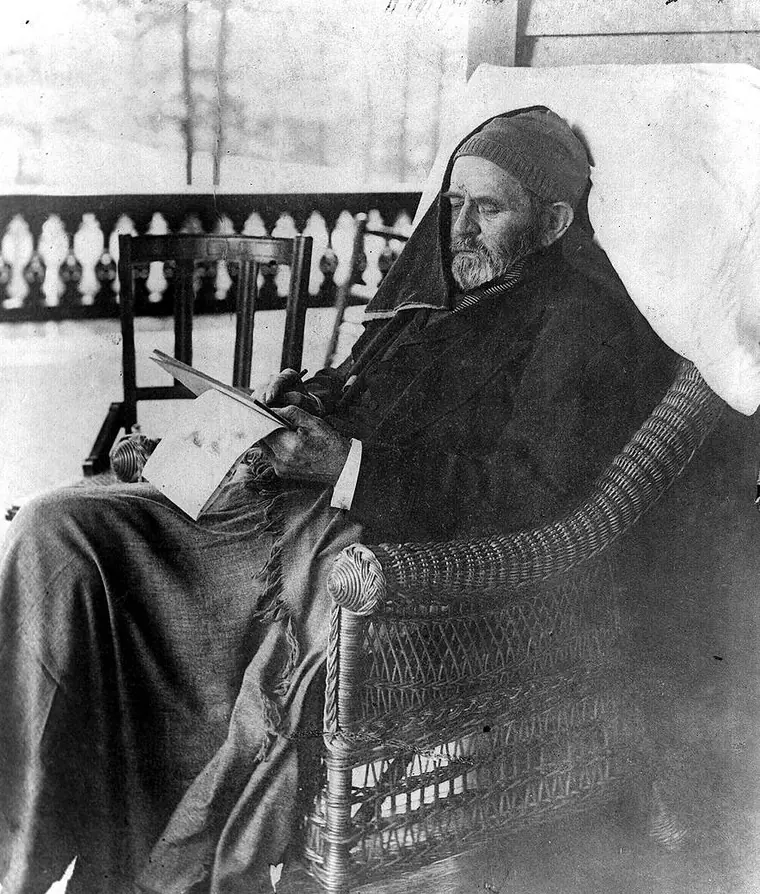
By 1880 Ulysses S. Grant had been a general, a two-term president, and a world traveller, and he had almost no money. What he had, he put into a Wall Street brokerage where his son was a partner: Grant & Ward.
The other partner, Ferdinand Ward, was running a Ponzi scheme. He claimed inside access to government contracts, pledged the same securities repeatedly as collateral, paid old investors with new money, and promised two to three percent a month. Grant himself invested $100,000 and became a full partner, which is precisely what made the scheme work — his name was the collateral.
It collapsed on May 4, 1884, taking the Marine National Bank with it and setting off the Panic of 1884. Grant was left effectively penniless. He borrowed $150,000 from William H. Vanderbilt to try to hold things together, and it was not enough.
That autumn he was diagnosed with throat cancer. He was 62.
Ten percent, and the man who tore it up
Grant began by writing articles about his campaigns for Century Magazine. Century then offered him a book contract at a 10 percent royalty, which was ordinary for the period and, given the circumstances, meaningfully less than the manuscript was worth.
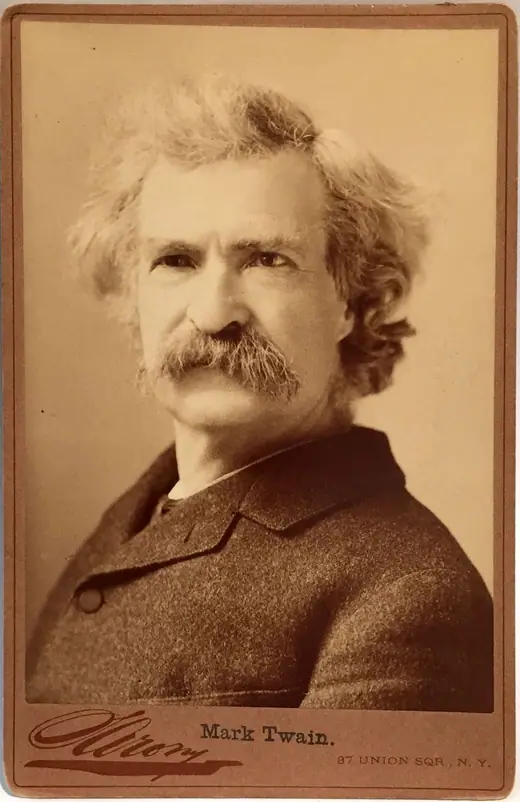
Samuel Clemens — Mark Twain — heard the terms and went to New York. He had by then set up his own publishing house, Charles L. Webster & Company, built around the subscription model: an army of agents selling by advance order, door to door, before a single copy was printed.
The contract Clemens put in front of Grant gave him or his heirs 70 percent of the profits, plus a $25,000 advance paid out of Clemens's own funds.
That is not a publishing anecdote. That is the whole estate plan. Grant had one asset and one chance to price it, and the difference between the two offers was the difference between his widow being comfortable and his widow being dependent.
Five days
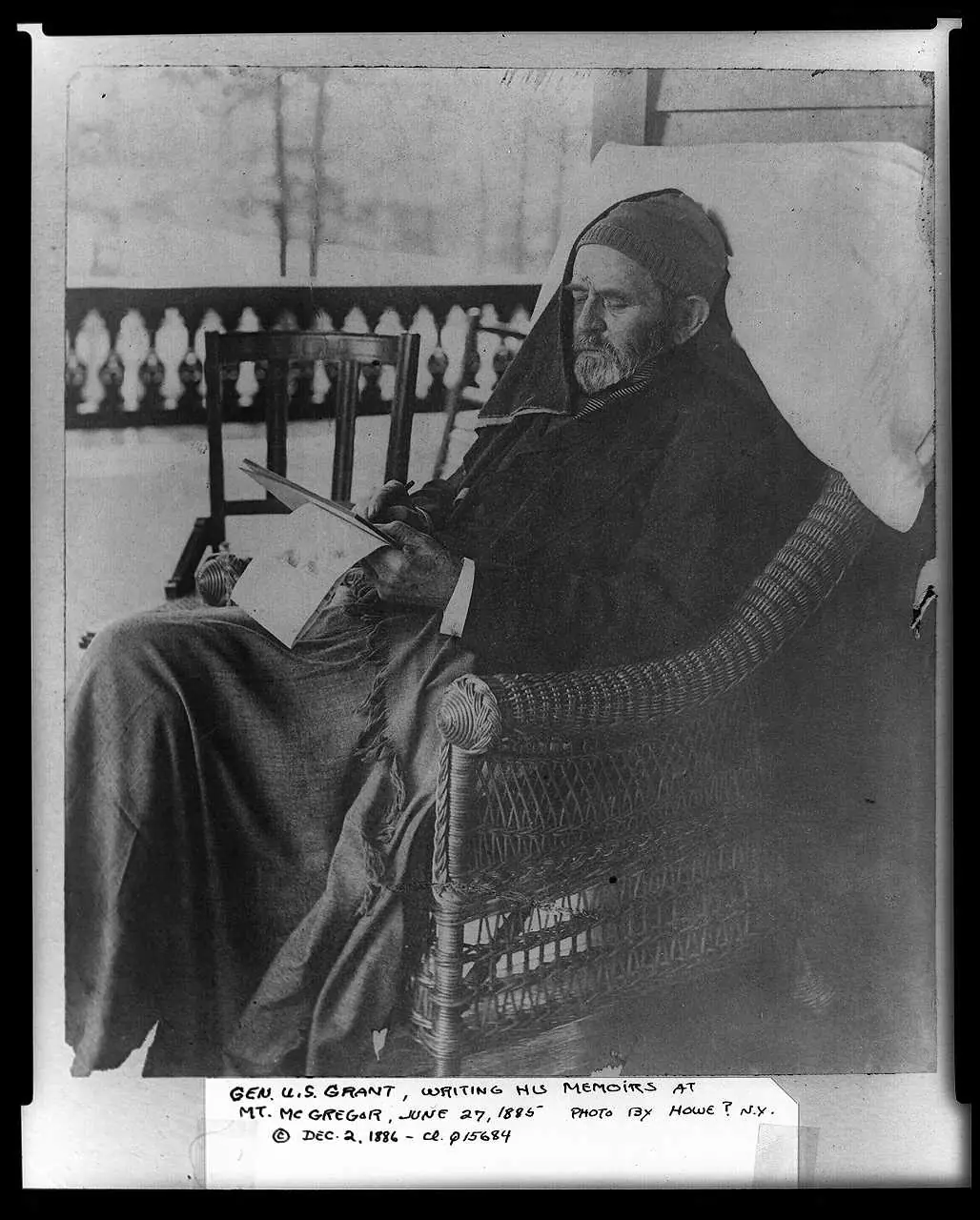
Grant wrote through the last year of his life, in increasing pain, latterly at a cottage on Mount McGregor in the Adirondacks. Accounts of the period record him producing twenty-five to fifty pages in a day. He lost the ability to speak and continued in writing.
He finished the manuscript on July 18, 1885. He died on July 23 — five days later.
Personal Memoirs of U.S. Grant was published by Webster & Company in two volumes. Roughly ten thousand agents, many of them Civil War veterans, sold something on the order of 350,000 two-volume sets by advance subscription. In its first year it outsold Uncle Tom's Cabin.
Julia Grant received about $450,000 in royalties in the first years of publication — one of the largest sums ever paid to an author's estate to that date, and a genuine fortune in 1886.
The book is also, by common consent, one of the finest memoirs written in English. Grant produced a masterpiece under deadline pressure supplied by a tumour, for the specific purpose of leaving his wife an income. Both of those things are true at once, and the second one is the reason the first one exists.
What he actually created
Strip away the drama and Grant did something precise. He converted labour into an asset, and he did it inside the only window he had.
The asset was a copyright and a contract. Neither existed in May 1884. Both existed by July 1885. Neither could be reached by Ward's creditors in any meaningful way, because the manuscript was created after the ruin and the royalty stream ran to Grant and, by the contract's own terms, to his heirs.
That is a legitimate and underused move. Most people think of estate planning as arranging property that already exists. Grant's plan was to create the property. The modern equivalents are ordinary: a life insurance policy bought while still insurable, a retirement account with a named beneficiary, a business built to be sold, a book finished.
- Timing. He priced the asset once, and correctly, because a friend intervened before he signed the first offer.
- Form. The income ran under a contract that named his heirs, not through a general bequest that would have had to survive administration.
- Speed. He had roughly twelve months, and he used all of them.
- Nothing else was left. No property, no trust, no reserve. The plan had a single point of failure, and it happened to hold.
Timeline
- 1880–84Grant invests $100,000 and becomes a full partner in Grant & Ward, the Wall Street firm where his son is a partner. Ferdinand Ward is running a Ponzi scheme built on Grant's name.
- May 4, 1884Grant & Ward collapses, taking the Marine National Bank with it. Grant is left effectively penniless and borrows $150,000 from William H. Vanderbilt.
- Autumn 1884Grant is diagnosed with throat cancer. He begins writing campaign articles for Century Magazine.
- 1884–85Century offers a book contract at a 10 percent royalty. Mark Twain intervenes and offers 70 percent of profits through Charles L. Webster & Company, with a $25,000 advance from his own funds.
- June 1885Grant moves to a cottage on Mount McGregor in the Adirondacks and writes there, latterly unable to speak.
- July 18, 1885Grant completes the manuscript.
- July 23, 1885Grant dies at Mount McGregor, five days after finishing.
- Dec 1885 – 1886Personal Memoirs of U.S. Grant is published in two volumes and sold by subscription through roughly 10,000 agents — on the order of 350,000 sets.
- 1886–88Julia Grant receives about $450,000 in royalties.
What actually went wrong
- Everything, before the memoirs — and it was not his doing. Grant's ruin came from a partner's fraud in a firm that used his name as its principal credential. Lending your reputation to a venture you do not control is a form of unsecured liability.
- Concentration. Grant put essentially his whole net worth into one firm run by one man he did not audit. The estate-planning failure happened years before the estate did.
- No insurance, no reserve, no separate property. When the firm failed there was nothing outside it. The recovery had to be built from zero because nothing had been walled off from the risk.
- A single-asset plan. The memoirs worked. If Grant had died in March 1885 instead of July, they would not have, and there was no second plan.
- Nearly signing the first offer. Ten percent versus seventy percent of the same manuscript. The margin between an adequate outcome and a transformative one was one conversation with someone who knew the market.
Would it have gone that way in Florida?
The book still works — and Florida adds a floor under the widow that Grant did not have.
Two things a modern Florida estate does differently here.
First, the copyright is an estate asset and has to be treated like one. A manuscript finished five days before death produces a copyright, a publishing contract, and a royalty stream. All three pass through the estate. The personal representative must list them in the inventory required by §733.604, value them — which for an unpublished book means a genuine appraisal problem — and then administer them.
§733.612 gives the personal representative the powers to do that: subsection (2) to perform, compromise, or properly refuse to perform the decedent's contracts, which is exactly what a half-negotiated publishing deal requires; subsection (19) to employ attorneys, accountants, appraisers, and agents; and subsection (22) to continue an unincorporated business or venture in which the decedent was engaged at death — for four months, and longer only with court approval. That four-month clock matters if the asset is a working enterprise rather than a finished manuscript.
Federal law then takes over for the duration. Copyright in a work created today runs for the life of the author plus 70 years, so the royalty stream Grant created would outlive not just his widow but his grandchildren. Federal copyright law also gives a deceased author's surviving spouse and children statutory rights to terminate certain grants of copyright after a fixed period — rights that belong to the family by statute and cannot be signed away in advance. If the estate holds literary property, that is a live and valuable asset decades after the death, and it should be named and directed in the plan rather than left to the residuary clause.
Second, and more practically: Florida would not have made Julia Grant depend on a book. A surviving spouse in Florida has a statutory floor. §732.201 gives the surviving spouse of a person who dies domiciled in Florida the right to an elective share, and §732.2065 fixes it at 30 percent of the elective estate. The elective estate under §732.2035 is deliberately broad: it reaches the probate estate plus revocable trusts, pay-on-death and transfer-on-death accounts, joint accounts with survivorship, certain retirement benefits, and property transferred within a year of death. It is very hard to draft around.
The honest caveat: thirty percent of nothing is nothing. In May 1884 Grant's elective estate would have been negative. The elective share protects a spouse against being written out of a solvent estate; it does not protect against ruin. Alongside it, §732.402 exempt property and §732.403 family allowance give a Florida widow a floor of household goods, two vehicles, and up to $18,000 for maintenance during administration — small numbers, but ahead of ordinary creditors. And an election is not automatic: under §732.2135 it must be made within 6 months after service of the notice of administration or 2 years after the death, whichever is earlier. A valid prenuptial or postnuptial waiver under §732.702 defeats it entirely.
The instruction: if any part of your income comes from something you created — a book, a song, a patent, a course, a channel, a licence — say in your documents who owns it, who is authorized to administer it, and who receives the money. Royalty streams do not stop when you do, and a personal representative who has to negotiate a publishing contract without written authority is spending your family's money on lawyers to get permission.
What people ask us about this.
Further reading
Third-party sites. Not ours, not endorsed, not kept current by us — just the places worth going next.
Sources
- Personal Memoirs of Ulysses S. Grant — publication, contract terms, and royalties — Wikipedia
- Ferdinand Ward — the Grant & Ward Ponzi scheme and the May 1884 collapse — Wikipedia
- Charles L. Webster and Company — Wikipedia
- Ulysses S. Grant — Wikipedia
- Fla. Stat. §733.612 — Powers of the personal representative — The Florida Senate
- Fla. Stat. §732.201 — Right to elective share — The Florida Senate
- Fla. Stat. §732.2065 — Amount of the elective share — The Florida Senate
If this is your situation
Free 30-minute consult. Plain English. No pressure.
Nearly every case in this archive turned on something ordinary — an unwitnessed page, a stale beneficiary line, a document nobody could find. Those are cheap to fix while you're alive and expensive to fix afterward.