Bebe Rebozo
Richard Nixon's closest friend left roughly 65% of his estate — about $19 million — to the Nixon Library, on the condition that the spending be approved by Nixon's two daughters and one other friend. The money sat for four years while the approvers disagreed, and a Miami judge finally ordered them into a room together.
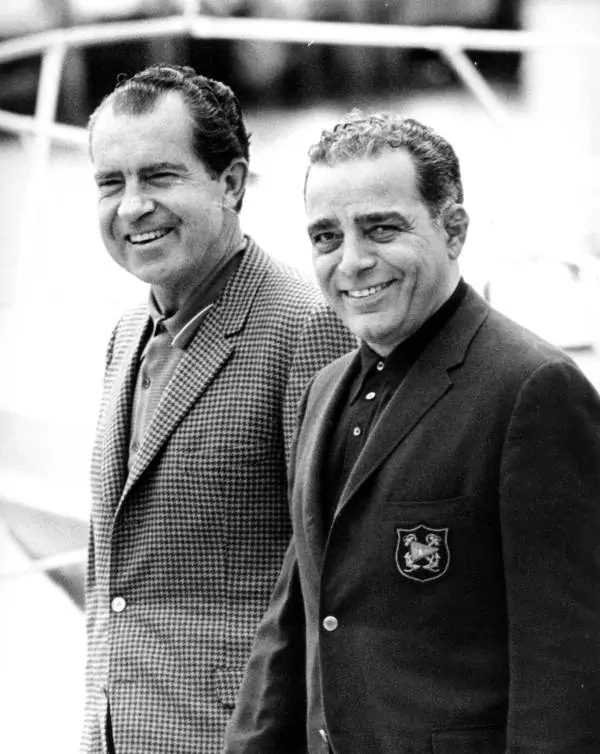
Charles Gregory Rebozo — Bebe to everyone, including three presidents' worth of reporters — was born on November 17, 1912, the son of Cuban immigrants Matias and Carmen Rebozo. He ran a gas station and laundromats, and in 1964 founded the Key Biscayne Bank & Trust.
In 1950, through Florida Representative George Smathers, he met a young congressman named Richard Nixon. The friendship lasted 44 years and made Rebozo one of the most photographed private citizens in American politics — the man beside Nixon on the Key Biscayne compound the press called the Florida White House. He was investigated during and after Watergate in connection with a $100,000 contribution held on Nixon's behalf.
He was married twice — to Claire Gunn, twice, and to Jane Lucke, who survived him. He died on May 8, 1998, at 85, of complications from a brain aneurysm.
And then he did something that looked generous, was generous, and took four years and a Miami-Dade circuit judge to actually accomplish.
Sixty-five percent, and a committee
Rebozo's estate plan directed roughly 65% of his estate to the Richard Nixon Library and Birthplace Foundation in Yorba Linda, California — reported at about $19 million, and described in some accounts as approaching $20 million.
The condition attached to it was short and specific: the money was to be used in accordance with the directions of a three-person group — Nixon's daughters Julie Nixon Eisenhower and Tricia Nixon Cox, together with the Nixon family friend Robert Abplanalp. The trust gave those three ultimate control over how the bequest was spent.
That is not an unusual instinct. A donor who cares about a charity and does not entirely trust its future board will often name people he does trust and give them a veto. It reads as prudence.
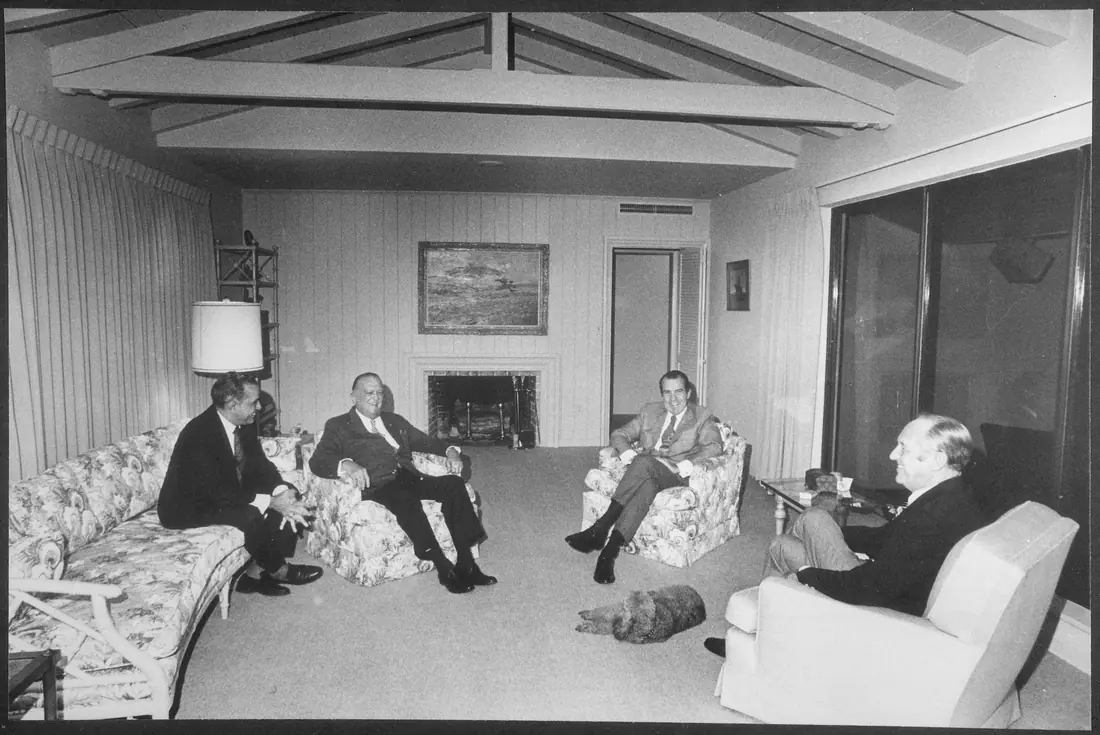
In practice, it created three independent keys to one lock, held by people who were under no obligation to agree with each other about anything — and no mechanism in the document for what to do if they did not.
Four years, one question
The disagreement, as reported, was not about whether the library should get the money. Both sisters wanted it placed in an endowment. The question was who would control that endowment.
Julie Nixon Eisenhower's position, and the foundation's, was that the foundation's 24-member board should control the endowed funds. Tricia Nixon Cox's position was that the three-person group named in Rebozo's trust should. Neither reading is absurd; the document supported an argument in both directions, which is precisely the definition of a drafting failure.
Meanwhile the library did not get the money. The trust distributed $781,000 in 1999. A $1.3 million check intended for taxes was frozen. Contemporary reporting described a bitter five-year feud that starved the library of nearly $20 million in funds it needed.
In February 2002 the foundation filed suit in Florida demanding immediate transfer, with a parallel action in Orange County, California. The Florida case landed in Miami-Dade Circuit Court before Judge Maria Korvick.
A judge orders everyone into a room
Judge Korvick ordered face-to-face mediation. On Wednesday, August 7, 2002, both sisters, Robert Abplanalp, the estate's trustees, and representatives of the library met in a hotel conference room in Miami.
It settled that day. The terms were kept confidential at the parties' request. The library's attorney said it had been amicably resolved; one of Cox's attorneys said everyone was happy and declined to say more. Reporting from the scene described the two sisters embracing outside the conference room.
Four years, two lawsuits in two states, and the outcome was two people in a room agreeing on something the donor could have written into a single sentence in 1998.
Every veto needs a tiebreaker
The structural error is worth naming precisely, because it is one of the most common in charitable and family trust drafting.
Rebozo did not create a badly funded gift, an unclear beneficiary, or an illegal condition. He created a decision-making body with no decision rule. Three people, no majority provision, no chair, no casting vote, no default if they deadlocked, no sunset if the impasse persisted, and no named person or institution empowered to break the tie.
The same problem shows up in family trusts with co-trustee siblings, in business succession plans requiring unanimous consent of the next generation, and in every arrangement where a settlor writes with the approval of and stops. A veto is a power to say no. Three vetoes and no procedure is a power to do nothing, held by everybody.
Timeline
- Nov 17, 1912Charles Gregory Rebozo born to Cuban immigrant parents.
- 1950Introduced to Congressman Richard Nixon by Rep. George Smathers. The friendship lasts 44 years.
- 1964Founds Key Biscayne Bank & Trust.
- 1970sInvestigated during and after Watergate in connection with a $100,000 contribution held on Nixon's behalf.
- May 8, 1998Rebozo dies at 85. His plan leaves roughly 65% of his estate to the Nixon Library and Birthplace Foundation, spendable per the directions of Julie Nixon Eisenhower, Tricia Nixon Cox, and Robert Abplanalp.
- 1999The trust distributes $781,000. A $1.3 million check intended for taxes is frozen as the disagreement hardens.
- Feb 2002The foundation sues in Florida demanding immediate transfer, with a parallel action filed in Orange County, California.
- Apr 2002The Miami-Dade court orders the Nixon daughters joined in the Florida suit over the roughly $20 million.
- Aug 7, 2002Court-ordered mediation before Judge Maria Korvick's case ends in a same-day settlement, terms confidential.
What actually went wrong
- Three approvers, no tiebreaker. The single defect that produced four years of litigation. A majority rule, a chair with a casting vote, or a named neutral would each have cost one sentence.
- “In accordance with the directions of” is not a governance structure. It grants a veto without saying how the veto is exercised, how often, on what standard, or what happens when it is used.
- No sunset and no fallback. Nothing in the arrangement said what to happen if the approvers could not agree within a year, or five. The money simply waited.
- Approvers with a personal history in the subject matter. The condition put the same two people in charge of both a family legacy and an institution's operating budget. Where those two things can diverge, a document has to say which one wins.
- Two states, two courthouses. A Florida trust funding a California foundation produced parallel litigation in Miami-Dade and Orange County. Cross-border charitable gifts need a governing-law and forum clause.
Would it have gone that way in Florida?
Same result — and Florida gives you three tools that would have prevented it, all of which have to be used in the document.
A Florida donor may absolutely condition a charitable gift on someone else's approval. §736.1408 is the enabling provision: where a trust confers on a person a power to direct certain actions of the trustee, the trustee must generally act in accordance with that direction. This is the statutory home of the trust protector, the investment adviser, the distribution committee — and the approval board Rebozo created.
What §736.1408 does not do is supply a decision rule for a group of directing parties. §736.0703(1) does that for co-trustees — they act by majority when there are three or more — but a committee of approvers who are not trustees is governed by whatever the instrument says, and if it says nothing, by nothing. That gap is the whole case. Name three approvers in Florida and you must state, in the document, how they decide: majority, unanimity with a named tiebreaker, or a designated chair.
Florida also supplies exits, but they are litigation, not planning. §736.04113 lets a court modify a trust where compliance with its terms would defeat or substantially impair the accomplishment of a material purpose. §736.0413 applies cy pres where a particular charitable purpose becomes unlawful, impracticable, impossible, or wasteful. And §736.0706(2) permits removal of a trustee where a lack of cooperation among co-trustees substantially impairs administration. Each of these ends a deadlock. Each also requires a petition, a hearing, and attorney fees that, under §736.1004, a court may in its discretion direct be paid from a party's interest in the trust or from the party's other property.
On the charitable side, §736.0405 confirms that a trust may be created for the advancement of arts, sciences, education, or religion, and permits a court to select purposes or beneficiaries consistent with the settlor's intention where the instrument does not. The Florida Attorney General has standing to enforce charitable trusts, which matters when the intended beneficiary is an institution rather than a person who can sue for themselves.
The honest caveat: Rebozo's structure was not defective as a matter of law, and no court held that it was. It was enforceable, valid, and clear about the amount and the recipient. It simply had no answer to the one question that arose. That is an important distinction — most estate-planning failures in this archive are failures of completeness, not of legality.
The practical instruction: if your plan gives anyone a veto — a trust protector, an approval committee, co-trustee children, a business partner — write the next sentence. How is the decision made, who breaks a tie, what is the deadline, and what happens automatically if the deadline passes. Then read it back and ask what happens if the two people you named stop speaking to each other, because that is the scenario the sentence exists for.
What people ask us about this.


Further reading
Third-party sites. Not ours, not endorsed, not kept current by us — just the places worth going next.
Sources
- Bebe Rebozo — biography, Key Biscayne Bank, Watergate investigations, death — Wikipedia
- Nixon's daughters end rift over gift: library gains access to $19 million bequest — San Francisco Chronicle, Aug 2002
- Nixon library dust-up — CBS News, May 2002
- Nixon daughters resolve dispute — Fox News, Aug 2002
- Nixon daughters ordered to join lawsuit over $20-million — Tampa Bay Times, Apr 2002
- Bebe Rebozo — biographical file — Richard Nixon Presidential Library and Museum
- Fla. Stat. §736.1408 — Duty and liability of directed trustee — The Florida Senate
- Fla. Stat. §736.0405 — Charitable purposes; enforcement — The Florida Senate
- Fla. Stat. §736.04113 — Judicial modification of irrevocable trust — The Florida Senate
If this is your situation
Free 30-minute consult. Plain English. No pressure.
Nearly every case in this archive turned on something ordinary — an unwitnessed page, a stale beneficiary line, a document nobody could find. Those are cheap to fix while you're alive and expensive to fix afterward.