Al Capone
The federal government never proved Al Capone did the things he is remembered for. It proved he had not paid his income tax. He died on Palm Island in Miami Beach in 1947 still owing that government money — and the house everyone calls Capone's mansion was bought in his wife's name.
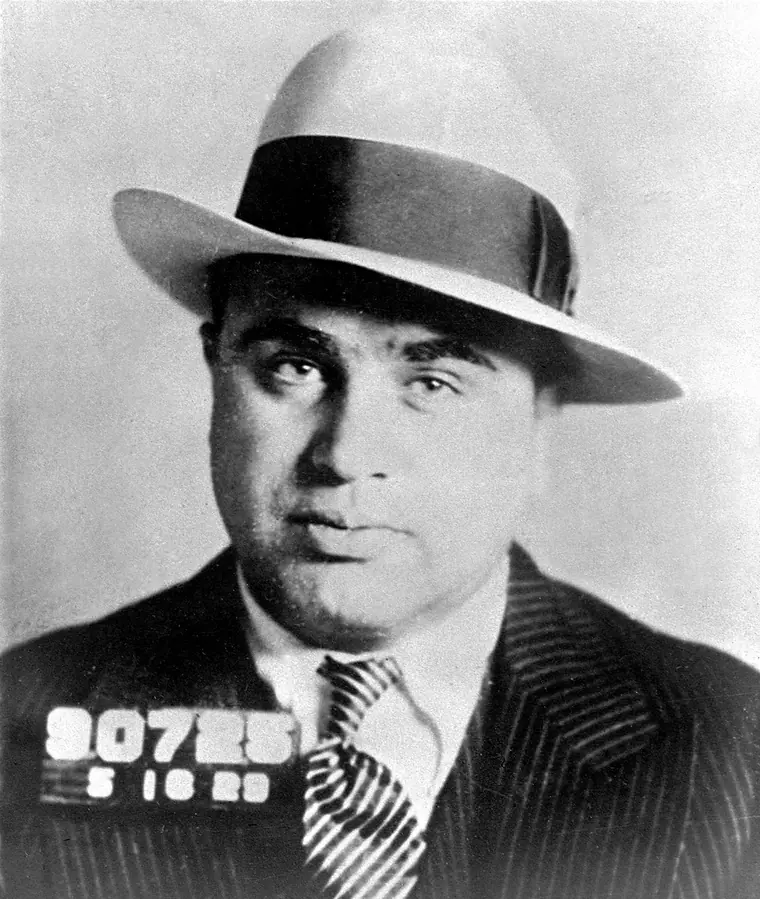
Everything Al Capone is famous for, the government could not prove. What it could prove was that on an income it calculated at $1,038,654 between 1925 and 1929, he had paid essentially no income tax.
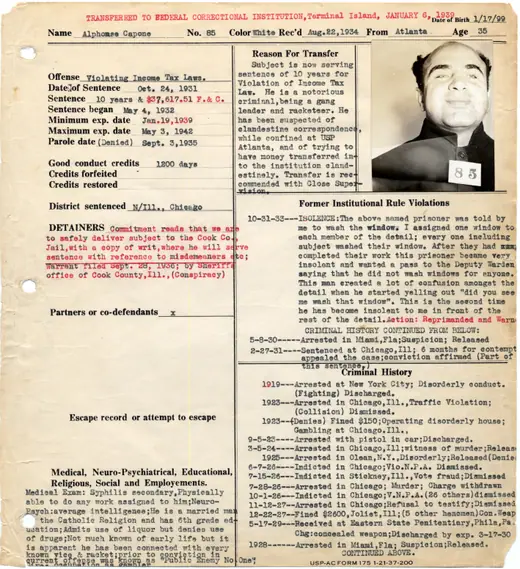
He was indicted on June 5, 1931, on 22 counts of income-tax evasion, and separately on some 5,000 violations of the Volstead Act. On October 17, 1931, a jury convicted him on five of the tax counts. The sentence was 11 years in federal prison, a $50,000 fine, $7,692 in court costs, and liability for roughly $215,000 in back taxes plus interest.
That last item is the one this archive cares about. A fine is a punishment. A tax assessment is a debt — and debts do not die with the debtor. Sixteen years later, when Capone died at 48 in a house on Palm Island, that obligation was still sitting there, and it was sitting in front of everybody else in the queue.
Atlanta, Alcatraz, and a man who could no longer sign anything
Capone entered the federal penitentiary in Atlanta in May 1932, aged 33. On arrival he was diagnosed with syphilis. He was transferred to Alcatraz in August 1934, completed his term there on January 6, 1939, and was paroled on November 16, 1939.
A formal diagnosis of syphilis of the brain had been made in February 1938. He was among the first American patients given penicillin, in 1942, and it was far too late to reverse anything. In 1946, his physician and a Baltimore psychiatrist examined him and concluded he had the mental function of a 12-year-old child.
State that as a legal fact rather than a sad one and it becomes the most important sentence in his estate file. Fla. Stat. §732.501 allows a will to be made by any person “of sound mind” who is 18 or older. Whatever Capone did or did not sign in his last years, a document executed after that examination would have been walking into a capacity contest with the medical record already written by the other side.
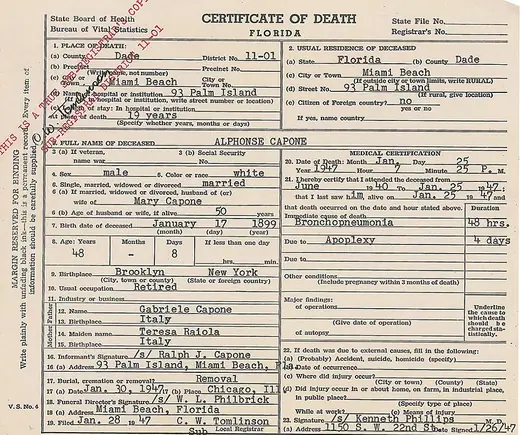
He suffered a stroke on January 21, 1947, contracted bronchopneumonia, went into cardiac arrest the next day, and died on January 25, 1947 at the Palm Island house. He was buried at Mount Olivet Cemetery in Chicago; in 1950 his remains were moved, with his father Gabriele and his brother Frank, to Mount Carmel Cemetery in Hillside, Illinois.
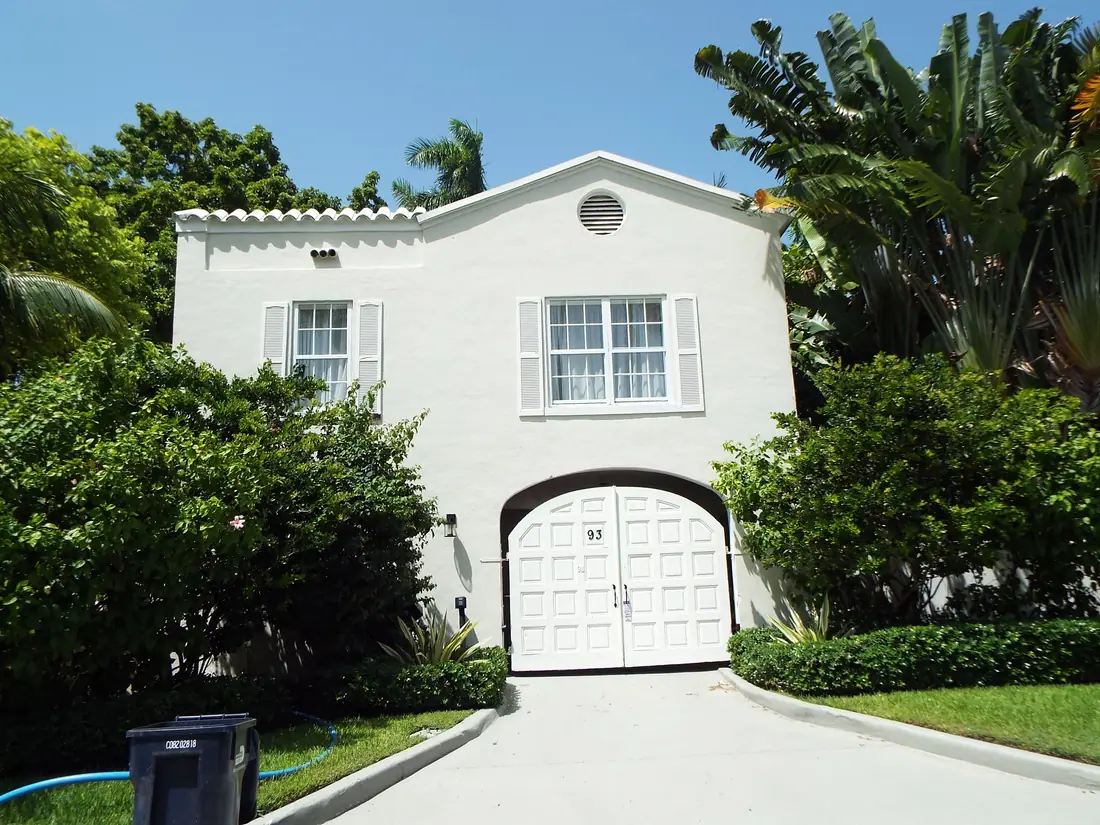
93 Palm Avenue, and what putting it in a spouse's name did not do
Capone bought the Palm Island property in 1928 for $40,000 and reportedly spent another $200,000 on it. After his 1939 release he lived there permanently until he died. It is the single asset anyone associates with him.
It was purchased in Mae Capone's name.
This did not have the effect people generally assume it has. In 1936, while Capone was in Alcatraz, the federal government filed a tax lien of $51,498.08 against the Miami property. In 1937 Mae Capone sued the local Internal Revenue collector seeking a refund of $52,103.30. The claim was denied.
So the most famous house in Florida organised-crime history spent the 1930s under a federal lien, held in the name of a spouse who then had to litigate against the government about it and lost. Titling an asset in someone else's name is not a magic trick; it is a fact pattern, and creditors litigate fact patterns.
The house outlived all of it. In 2021 it sold to a property developer for $10.75 million.
What there was to administer
Here is the honest state of the record: there is no reported Capone probate litigation, no famous will contest, no published inventory. For a man whose name still sells tour tickets in two cities, the estate left almost no trace at all.
That absence is the finding, not a gap in the research. Consider what he actually had at the end.
- Income from cash businesses, which do not title. You cannot bequeath an untitled revenue stream, and you cannot inventory one.
- A federal tax obligation of roughly $215,000 plus interest, assessed in 1931 and never discharged by the passage of time.
- A residence held in his wife's name, already the subject of a federal lien and a lost refund suit.
- Eight years of documented cognitive decline before death, which is the worst possible window in which to sign anything.
Put those four together and you have the outline of every estate that ends with a family discovering there is nothing to administer — just at unusual scale, and with the Bureau of Internal Revenue standing where the credit-card company usually stands.
Timeline
- 1928Capone buys the Palm Island property in Miami Beach for $40,000, in Mae Capone's name, and spends a reported $200,000 more on it.
- Jun 5, 1931Indicted on 22 counts of income-tax evasion for 1925–1929, and separately on some 5,000 Volstead Act counts.
- Oct 17, 1931Convicted on five tax counts. Sentenced to 11 years, a $50,000 fine, $7,692 in costs, and liability for about $215,000 in back taxes plus interest.
- May 1932Enters the federal penitentiary in Atlanta. Diagnosed with syphilis on arrival.
- Aug 1934Transferred to Alcatraz.
- 1936The federal government files a tax lien of $51,498.08 against the Miami property held in Mae Capone's name.
- 1937Mae Capone sues the Internal Revenue collector for a refund of $52,103.30. The claim is denied.
- Nov 16, 1939Paroled, having completed the Alcatraz term in January. Returns to Palm Island.
- Jan 25, 1947Dies at the Palm Island house at 48, of cardiac arrest following a stroke and bronchopneumonia. Buried in Chicago; reinterred at Mount Carmel Cemetery, Hillside, Illinois, in 1950.
What actually went wrong
- A tax judgment does not die with the taxpayer. It becomes a claim against the estate, and under Florida's order of payment it stands near the front of the line rather than the back.
- Titling the house in a spouse's name did not defeat the lien. The federal government recorded against the Miami property anyway, and the resulting refund suit was lost. Nominee ownership is a question of fact that somebody eventually litigates.
- No capacity left to plan with. By 1946 his cognitive function was medically assessed at that of a child. Estate planning is something you do while you still can sign; there is no later.
- Wealth that never touched a title. Cash income from unrecorded businesses cannot be inventoried, cannot be devised, and cannot be inherited. It just stops.
Would it have gone that way in Florida?
This is a Florida estate, and the Florida answer is blunt: when the decedent owed the federal government, the government is paid before nearly everyone else — and the personal representative is personally on the hook if it is not.
Capone died domiciled in Miami Beach, so Chapter 733 governed. The interesting question is not whether he had a will. It is the order in which anything left would have been paid out.
Fla. Stat. §733.707 sets that order in eight classes. Class 1 is costs, administration expenses, and the fees of the personal representative and attorney. Class 2 is reasonable funeral and interment expenses, capped at $6,000. Class 3 is “debts and taxes with preference under federal law” — which is where a federal income-tax assessment lands. Class 4 is medical and hospital expenses of the last 60 days of the last illness. Class 5 is family allowance, Class 6 court-ordered child-support arrearage, Class 7 post-death business debts, and Class 8 is everything else, including judgments against the decedent. Ordinary creditors are last. The Internal Revenue Service is third.
Federal law reinforces this and adds teeth. 31 U.S.C. §3713(a) gives a claim of the United States first payment where the estate of a deceased debtor in the hands of the personal representative is not enough to pay all debts. §3713(b) then makes the representative personally liable, to the extent of the payment, for paying any other debt before the Government's claim. That is not a Florida rule and Florida cannot soften it. A personal representative who pays the funeral home, the lawn service, and a sympathetic beneficiary before checking for a federal tax liability has bought themselves a problem out of their own pocket.
The creditor clocks still run. Under §733.702, claims are barred after the later of 3 months from first publication of the notice to creditors or 30 days from service on a creditor entitled to be served, and §733.710 bars claims against the decedent absolutely at 2 years after death. But note §733.710(3): the two-year rule does not affect mortgage liens, security interests, or other liens on estate property. A federal tax lien recorded before death is a lien, not a claim. It rides with the property, and the nonclaim statute does not wash it off.
Homestead, and the uncomfortable part. Fla. Const. Art. X §4 exempts a Florida homestead from forced sale by creditors, with no dollar cap — only an acreage limit of half an acre inside a municipality or 160 acres outside — and the exemption passes to the heirs the property descends to. It is the strongest such protection in the country and people rely on it deliberately. It has hard edges. It does not stop a mortgage, property taxes, or a construction lien on the home itself, and it does not override a federal tax lien, which attaches under federal law regardless of a state exemption. Palm Island would have been squarely inside that last exception.
Homestead also constrains what you can do with the house. §732.4015 restricts the devise of homestead where there is a surviving spouse or a minor child, and §732.401 supplies what happens instead: the surviving spouse takes a life estate with the remainder to the descendants, or may elect within 6 months to take an undivided one-half interest as a tenant in common. In a house bought in the spouse's own name, none of that arises — the house was simply hers, subject to whatever the government had already recorded against it.
What to actually do. Before a Florida personal representative distributes anything, run a lien search and check for federal tax liability, then pay strictly in §733.707 order. And if you are considering putting an asset in a relative's name to keep it away from a creditor, read Fla. Stat. §726.105 first: a transfer made with actual intent to hinder, delay, or defraud a creditor is voidable, and the person who has to explain it later is usually not you.
What people ask us about this.
Further reading
Third-party sites. Not ours, not endorsed, not kept current by us — just the places worth going next.
Sources
- Al Capone — Wikipedia
- Mae Capone — Wikipedia
- Palm Island (Miami Beach) — Wikipedia
- Al Capone — The Mob Museum
- Al Capone's Alcatraz inmate file, Bureau of Prisons, 1934 — National Archives Catalog, via Wikimedia Commons
- 31 U.S.C. §3713 — Priority of Government claims — Cornell Legal Information Institute
- Fla. Stat. §733.707 — Order of payment of expenses and obligations — The Florida Senate
- Fla. Stat. §732.501 — Who may make a will — The Florida Senate
If this is your situation
Free 30-minute consult. Plain English. No pressure.
Nearly every case in this archive turned on something ordinary — an unwitnessed page, a stale beneficiary line, a document nobody could find. Those are cheap to fix while you're alive and expensive to fix afterward.