Agatha Christie
Her personal estate probated at about £106,000, which tells you nothing. Twenty-one years before she died she put the rights into a company, and along the way she handed individual works to individual relatives outright. Fifty years on it is still trading, and still in the family.
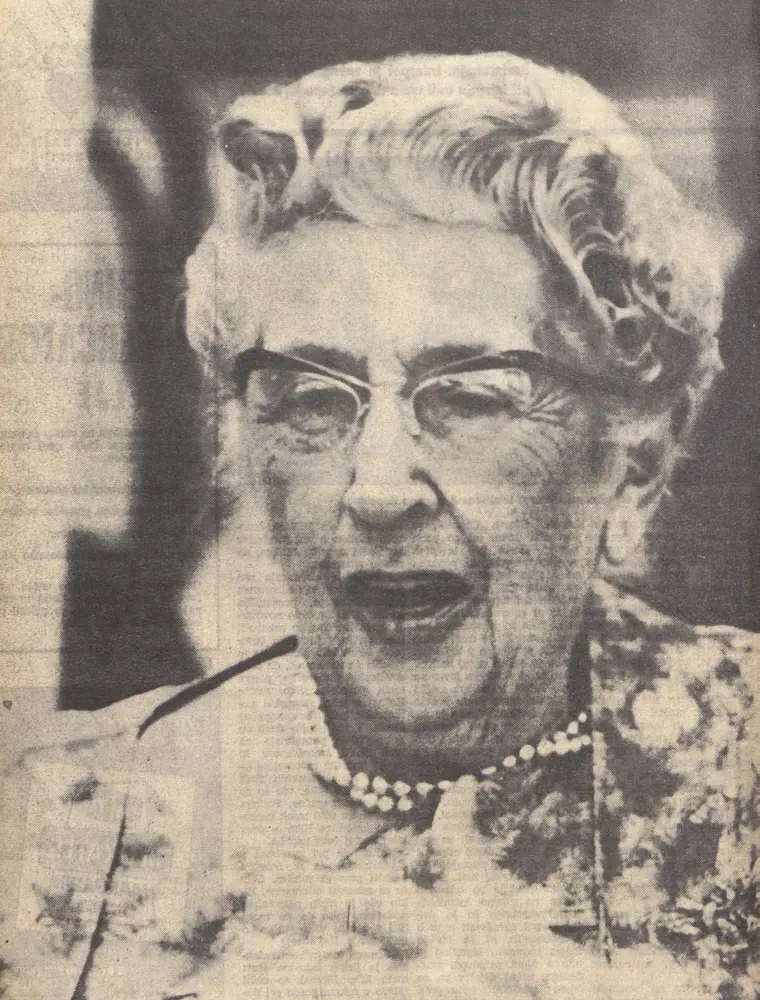
Agatha Christie died on January 12, 1976, at Winterbrook House near Wallingford, aged 85. She had sold, by most estimates, more copies of her books than any novelist in history.
Her personal estate went through probate at a reported £106,683.
That figure is not a mistake, and it is not a scandal. It is the whole point of this page. By the time she died, the valuable thing was not in her name. It was in a company she had incorporated twenty-one years earlier, and in gifts she had made decades before that.
Agatha Christie Limited, incorporated 1955
Agatha Christie Limited was set up in 1955, by Christie herself, to manage the literary and media rights to her work worldwide. It has done so continuously ever since — seventy-one years, across four changes of majority ownership.
In 1968, at nearly 80, she sold a 51% stake to Booker Books, an arm of the Booker McConnell conglomerate; Booker later increased it to 64%. In 1998 Booker sold that stake to Chorion for a reported £10 million. In February 2012 Chorion, in financial difficulty, sold the 64% to Acorn Media, which became part of RLJ Entertainment and then, through RLJ, part of AMC Networks.
Through all four transactions the Christie family retained 36% — and, critically, the shareholder arrangements have been reported to split voting rights 50-50, with the family holding a casting vote on matters relating to the estate. Christie's grandson Mathew Prichard chaired the company for many years; her great-grandson James Prichard now chairs and runs it.
That is the structural trick, and it is available to anyone. Economic ownership and control were separated. She sold most of the value and kept the decisions. Deadline reported ACL revenue of nearly £33 million for 2025, its strongest year on record.

Particular works to particular people, given away while she was alive
The company held the portfolio. Individual works, she handed out personally.
The Mousetrap. In 1952 she gave the rights in the play to her grandson Mathew Prichard as a ninth-birthday present. It opened in the West End on November 25 of that year and has been running more or less ever since — the longest-running play in the world. The gift was complete, outright, and made twenty-four years before her death. It was never part of her estate, was never valued for probate, and required no executor's decision.
Curtain and Sleeping Murder. During the Second World War, uncertain of surviving the London bombing and wanting proper endings for her two detectives, she wrote a last case for each and put the manuscripts in a bank vault. Curtain: Poirot's Last Case was designated for her daughter Rosalind. Sleeping Murder: Miss Marple's Last Case was for her husband Max Mallowan. They stayed in the vault for over thirty years. Curtain was published in September 1975, in her lifetime; Sleeping Murder in October 1976, nine months after her death.
Consider what that arrangement solved. Two of the most commercially significant unpublished manuscripts in English fiction sat in a vault for three decades with their destination already fixed by name. No one had to construe a clause. No one had to appraise a manuscript. Nobody argued, because there was nothing left to decide.
On her death, Rosalind Hicks inherited her mother's remaining stake in the company. Max Mallowan took personal effects and provision from their jointly held assets.
An estate that is still a going concern
Copyright in the United Kingdom runs for the author's life plus seventy years, which puts Christie's works into the public domain progressively from 2046. The estate therefore has a defined, finite, and unusually distant horizon — a fact that shapes every decision the company makes.
Alongside the company sits The Christie Archive Trust, which holds her personal archive: notebooks, letters, photographs, drafts. Rights and records are kept in separate vehicles with separate purposes, which is the arrangement most literary estates arrive at eventually and few set up deliberately.
There is no famous Christie estate litigation. There is no contested will, no removed trustee, no sibling lawsuit, no decade in probate. In an archive largely composed of estates that went wrong, this one is here because it did not.
The reason is not that the family got on better than other families. It is that almost nothing important was left for anyone to decide after she died. The company existed. The shares were allocated. The manuscripts had names attached. The play belonged to a nine-year-old. Her will had comparatively little work to do, and so comparatively little went wrong with it.
Timeline
- Early 1940sChristie writes Curtain and Sleeping Murder and places the manuscripts in a bank vault — one designated for her daughter Rosalind, one for her husband Max Mallowan.
- 1952She gives the rights in The Mousetrap to her grandson Mathew Prichard for his ninth birthday. The play opens in the West End on November 25.
- 1955Christie incorporates Agatha Christie Limited to manage the literary and media rights to her work.
- 1968At nearly 80, she sells a 51% stake in the company to Booker Books, later increased to 64%.
- Jan 12, 1976Christie dies at 85, four months after the publication of Curtain: Poirot's Last Case. Her personal estate is probated at a reported £106,683; the rights are already held in the company. Sleeping Murder follows in October.
- 1998Booker sells its 64% stake to Chorion for a reported £10 million.
- Feb 2012Chorion sells the 64% to Acorn Media, later part of RLJ Entertainment and AMC Networks. The family retains 36%.
- 2025Agatha Christie Limited reports revenue of nearly £33 million, its highest on record, chaired by James Prichard.
What actually went wrong
- Nothing that matters — and that is the reason this page exists. The instructive cases are not always the disasters. This is a working model of what an intellectual-property estate looks like when the structure is built in the owner's lifetime.
- She sold control of the economics at 79. A 51% sale in 1968 monetised the portfolio and reduced the family's share of a business that would grow enormously. Whether that was the right call at 79 is a genuine question, and it is the one decision here that a planner would want to stress-test.
- The value moved outside the reach of the ordinary machinery. That is deliberate and lawful, but it cuts both ways: assets inside a company are not protected by probate supervision either. Governance has to do that work instead — which is why the 50-50 voting split and the family casting vote matter more than the 36%.
- A single individual holding one enormous asset. The Mousetrap gift was clean and complete. It also concentrated a career-scale income stream in one person's hands with no built-in succession, which every subsequent generation then has to solve again.
Would it have gone that way in Florida?
Florida would let her do every bit of it — and would let the structure run for a thousand years.
Christie's plan is, in modern American terms, an entity plus a trust plus completed lifetime gifts. Florida is unusually accommodating to all three.
First, duration — and Florida is close to the most permissive state in the country. A copyright portfolio has to outlive the copyright, and Christie's runs to 2046. The old worry was the Rule Against Perpetuities. Under Fla. Stat. §689.225, Florida's statutory rule now permits a nonvested property interest in a trust to last 1,000 years for trusts created on or after July 1, 2022 (360 years for trusts created after December 31, 2000, through June 30, 2022, and 90 years before that). A Florida dynasty trust can hold a literary estate for the entire life of every copyright in it and then some, with the shares never returning to an individual's estate to be probated, taxed, or fought over.
Second, governance, which is the part everyone skips. Christie's arrangement works because control was engineered separately from ownership. Florida's trust code gives you the same tools by statute. §736.1406 recognises powers to direct — the statutory basis for a trust protector or a family committee that can direct or veto the trustee on defined matters, which is the private-trust version of a casting vote. §736.0703 provides that co-trustees act by majority, so an odd-numbered board breaks its own ties. §736.0706 sets out when a trustee may be removed — serious breach, non-cooperation that substantially impairs administration, unfitness, persistent ineffectiveness — and pointedly not for mere disagreement. And §736.0813 imposes the duty to inform and account, which is what keeps a minority holder from being a spectator.
Third, the lifetime gifts. A completed gift is out of the probate estate entirely — no valuation, no executor discretion, no contest. Florida agrees, with one significant asterisk. The elective estate under §732.2035 reaches back to capture certain transfers, including property transferred within one year of death and property over which the decedent retained rights. A gift made twenty-four years before death, as the Mousetrap gift was, is untouchable. A gift made eleven months before death, to the same person, is not. Timing is the whole doctrine here.
The honest caveat. Putting assets into an entity does not make them disappear. It changes which body of law governs the fight — from probate, which is supervised, public, and has a personal representative with fiduciary duties, to corporate and trust law, which is private and where a minority holder's remedies are narrower. Christie's family kept a casting vote precisely because 36% of the shares would not otherwise have been enough. If you move the assets, you must build the governance, or you have simply moved the argument somewhere with fewer referees.
The instruction: if your estate's value is in something that produces income for decades — a catalogue, a patent, royalties, a family business — do not plan to dispose of it in a will. Put it into an entity or a trust while you are alive, decide who votes as carefully as you decide who owns, and make specific gifts of specific things early, by name, in writing, so that the person who receives them never has to prove anything to anyone.
What people ask us about this.
Further reading
Third-party sites. Not ours, not endorsed, not kept current by us — just the places worth going next.
Sources
- About Agatha Christie Limited — Agatha Christie Limited
- Agatha Christie estate acquired by U.S.-based Acorn Media — Deadline, Feb 2012
- My gran Agatha gave me The Mousetrap as a gift — The Sunday Post
- 65 years of The Mousetrap — Victoria and Albert Museum
- Sleeping Murder — the manuscript in the bank vault — Agatha Christie Limited
- Curtain: Poirot's Last Case — publication history — Wikipedia (publication dates and vault history)
- Rosalind Hicks — inheritance of the Agatha Christie Limited stake — Malevus
- Fla. Stat. §689.225 — Statutory Rule Against Perpetuities — The Florida Senate
If this is your situation
Free 30-minute consult. Plain English. No pressure.
Nearly every case in this archive turned on something ordinary — an unwitnessed page, a stale beneficiary line, a document nobody could find. Those are cheap to fix while you're alive and expensive to fix afterward.