Paul Allen
The Microsoft co-founder died in 2018 holding about $20.3 billion, two professional sports franchises, and a Giving Pledge. His four-page will said almost nothing, because everything ran through a trust he signed in 1993. Eight years on, the liquidation is still going.

Paul Allen co-founded Microsoft with Bill Gates in 1975, left it in 1983 after a first cancer diagnosis, and spent the following thirty-five years turning the proceeds into a portfolio nobody has ever had to administer before: the Seattle Seahawks, the Portland Trail Blazers, a quarter of the Seattle Sounders, a Seattle real-estate development company, research institutes, a superyacht, a museum of computing, and one of the great private art collections in the world.
He died on October 15, 2018, at 65, of complications from non-Hodgkin lymphoma. His holdings were valued at roughly $20.3 billion.
His will was filed in King County Superior Court on October 24, 2018, and it is a genuinely boring document. It names his sister Jody Allen as executor, and it directs the estate into a living trust dated December 17, 1993. That is essentially all it does. The Seattle Times headline at the time was accurate: the will “sheds little light on what will happen to estate.”
Which is the point of a pour-over will. It is a funnel, not a plan. The plan was signed twenty-five years before the death and has never been public.
Signing away the estate before writing it
Allen signed the Giving Pledge in 2010, the year Gates and Warren Buffett launched it. He had given more than $2.65 billion during his lifetime through the Paul G. Allen Family Foundation and directly — to the Allen Institute for Brain Science, the Allen Institute for AI, ocean and conservation work, Ebola response, and a long list of Pacific Northwest institutions.
The pledge is a moral commitment, not a contract, and it has no enforcement mechanism. What makes Allen's case different from most signatories' is that his documents matched it. The 1993 trust and the foundation were already in place; the pledge described what the structures did rather than promising something the paperwork did not support.
That distinction matters more than it sounds. A pledge with no trust behind it is an intention. A trust with a charitable remainder is a plan. In the eight years since Allen's death, the visible consequence has been the systematic conversion of illiquid trophy assets into money for the foundation.
$1.6 billion in two nights, and a basketball team
On November 9–10, 2022, Christie's sold Visionary: The Paul G. Allen Collection. It brought more than $1.6 billion across two days — the most valuable single-owner collection ever sold at auction, and the first auction of any kind to pass a billion dollars.
The individual results reset several artist records:
- Georges Seurat, Les Poseuses, Ensemble (Petite version) — $149.24 million. Nearly five times the previous Seurat record.
- Paul Cézanne, La Montagne Sainte-Victoire — $137.8 million. Roughly double the previous Cézanne record.
- Vincent van Gogh, Verger avec cyprès — $117.2 million. A record for the artist.
- Net proceeds to the Paul G. Allen Family Foundation, in accordance with his wishes as stated by the estate.
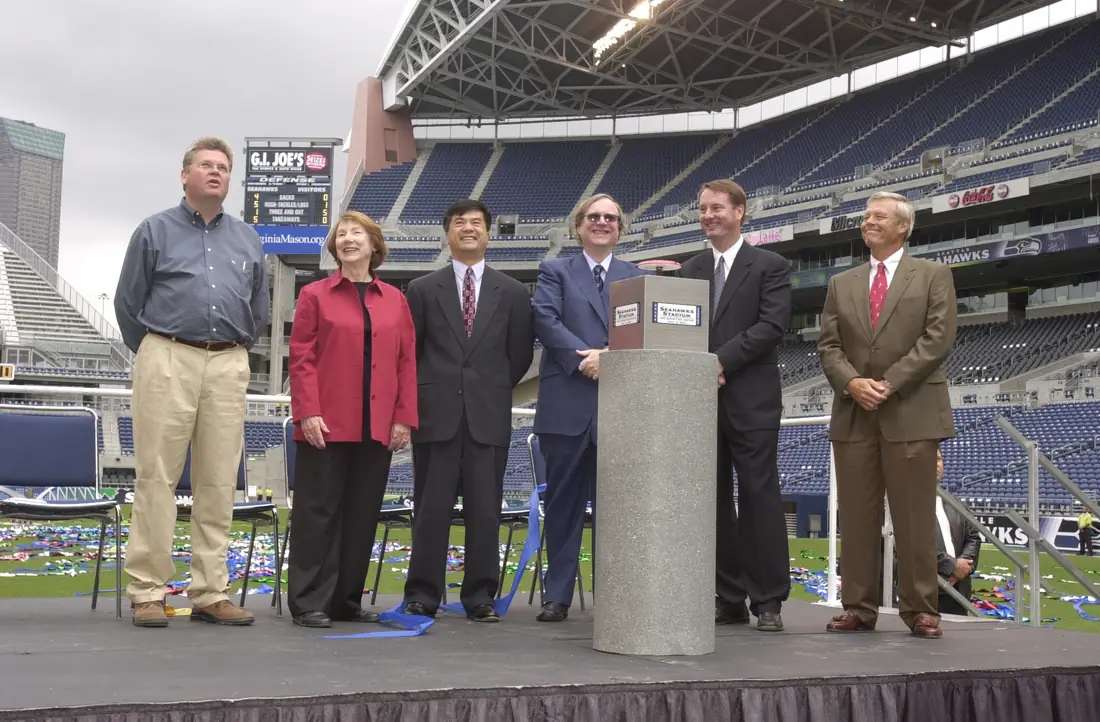
The teams took longer, because sports franchises are the least liquid assets that exist and require league approval to move. Jody Allen served as chair of both the Seahawks and the Trail Blazers while the estate worked through them.
In August 2025 the estate reached a tentative deal to sell the Trail Blazers to a group led by Tom Dundon, followed by a formal sale agreement in September. The NBA Board of Governors approved it on March 30, 2026, and the sale closed on March 31, 2026 — 80.1% of the team at a $4 billion valuation, a reported $4.1 billion price, with the remaining 19.9% to be purchased at a $4.5 billion valuation by September 1, 2028.
As of August 2026 the Seahawks and the Sounders stake have not been sold. Vulcan Inc., Allen's holding company, cut staff in 2019 and had rebranded as the Vale Group by 2024. Eight years after the death, the estate is still working.
The part that draws criticism, stated fairly
Reporting in the years after the death, including by the Seattle Times, noted that the plans for Allen's philanthropy remained largely undisclosed — a consequence of the trust structure rather than any obligation breached. A private trust owes no explanation to the public, and a private foundation's annual Form 990-PF discloses grants after the fact rather than intentions in advance.
That is the honest tension in philanthropy-as-estate-plan, and it applies to every large charitable structure rather than to this family in particular. The tax benefit is immediate and certain; the charitable benefit is deferred and discretionary. A private foundation must distribute roughly 5% of the fair market value of its non-charitable-use assets each year to avoid excise tax. In a year when the portfolio returns more than 5%, the endowment grows while the pledge remains outstanding.
Nothing about that is improper. It is the design of the vehicle, and it is chosen deliberately, because a perpetual endowment funds research programmes that a one-time gift cannot. But it is why “gave it all away” and “put it all into a foundation” describe two different events, sometimes decades apart.
For an ordinary reader the transferable lesson is smaller and more useful. Allen's estate is slow because his assets were slow. Sports teams, private companies, art, and real estate cannot be divided by a spreadsheet. If your estate contains an illiquid asset — a business, a rental portfolio, land — the plan has to say who sells it, on what timetable, and with what money to pay the bills while they do.
The second transferable point is about the fiduciary. Jody Allen has held, simultaneously, the roles of executor, trustee, foundation leader, and chair of two professional sports franchises — a workload no ordinary family member could absorb, performed under public scrutiny for eight years and counting. Naming a family member as fiduciary is a gift you give yourself and a job you give them. Before you do it, ask whether the person has the time, the temperament, and the standing with the rest of the family, and whether a professional co-trustee alongside them would make the work possible rather than merely survivable.
And ask whether they will be paid. Fiduciary compensation is a statutory entitlement in most states, not a favour — but a family member who has never discussed it usually takes nothing for two years, then discovers the work is a full-time job, then raises the subject in a context where every other beneficiary reads it as a grab. Settle the fee question in the document, in advance, in writing.
Timeline
- Dec 17, 1993Allen signs the living trust that will ultimately receive the estate.
- 2010Allen signs the Giving Pledge, alongside Bill Gates and Warren Buffett's initial cohort.
- Oct 15, 2018Allen dies at 65 of complications from non-Hodgkin lymphoma. Holdings valued at roughly $20.3 billion.
- Oct 24, 2018His will is filed in King County Superior Court. It names Jody Allen executor and pours the estate into the 1993 trust. Nothing about the disposition becomes public.
- 2019Vulcan Inc. restructures and cuts staff. Reporting notes the philanthropic plans remain undisclosed.
- Nov 9–10, 2022Christie's sells Visionary: The Paul G. Allen Collection for more than $1.6 billion — the most valuable single-owner art sale in history. Net proceeds to the Paul G. Allen Family Foundation.
- 2024Vulcan Inc. has rebranded as the Vale Group.
- Aug–Sep 2025The estate agrees to sell the Portland Trail Blazers to a group led by Tom Dundon, at a blended valuation reported around $4.25 billion.
- Mar 30–31, 2026The NBA Board of Governors approves the sale; it closes the following day at a reported $4.1 billion. The Seahawks remain unsold as of August 2026.
What actually went wrong
- Very little — but the timetable is the warning. Eight years after the death, the estate is still selling assets. That is not a failure of planning; it is the natural pace of illiquid property. Plan for the pace.
- Trophy assets need named buyers, named sellers, and a clock. A sports franchise requires league approval, a supermajority vote of other owners, and a buyer with several billion dollars. None of that happens on the executor's schedule.
- One fiduciary carrying everything. Jody Allen served simultaneously as executor, trustee, foundation leader, and chair of two professional teams. It worked. It also concentrated every decision — succession, valuation, sale timing, and grantmaking — in a single person, with no co-trustee and no protector to share the load.
- The pledge and the paperwork have to match. Allen's did. A public commitment unsupported by an executed instrument binds nobody, and the people who have to sort it out afterwards are your family.
- A private structure is a private structure. The trust bought total confidentiality, which is exactly what it is for — and it is also why the public conversation about his philanthropy ran on inference for years.
Would it have gone that way in Florida?
Same architecture, and Florida is a good place to build it — but Florida law gives the Attorney General a seat at the table your family does not control.
The structure Allen used works identically in Florida: a revocable trust funded during life, a short pour-over will under §732.513 as backup, and a charitable recipient at the end. Florida imposes no state estate tax under Fla. Const. Art. VII, §5, and the federal charitable deduction for transfers to qualified charities is unlimited, so an estate that gives its residue away pays no federal estate tax on the amount given regardless of size. In 2026 the federal exemption is $15 million per person, indexed — which matters for the part you do not give away.
The Florida wrinkle is enforcement. Fla. Stat. §736.0405 provides that a charitable trust may be created for the relief of poverty, the advancement of arts, sciences, education or religion, and the promotion of health and governmental purposes; that the court may select the purpose or beneficiary if the terms do not; and that the settlor may enforce it. Charitable trusts have no private beneficiary to police them, so the Attorney General is a proper party in proceedings concerning them. If you leave a Florida charitable trust, the State of Florida gets standing to ask what the trustee is doing with it.
§736.0413 is the release valve. If a particular charitable purpose becomes unlawful, impracticable, impossible to achieve, or wasteful, the court may apply cy pres — redirecting the assets to a purpose as near as possible to the settlor's original intent. A settlor, a trustee, or any qualified beneficiary may bring the proceeding. This is the statute that saves a gift to a cause that has been cured, a hospital that has merged, or a college that has closed, and it is the reason a charitable bequest should describe a purpose as well as a named institution.
On fees, Florida gives two different answers depending on which hat the fiduciary is wearing, and a family fiduciary in Allen's position would wear both. A personal representative is compensated under §733.617 — presumptively reasonable at 3% of the first $1 million of the inventory value plus income, sliding down through 2.5%, 2%, and 1.5% on higher tranches, with extra allowed for extraordinary services such as selling a business or conducting litigation. A trustee is compensated under §736.0708 at a rate that is simply “reasonable under the circumstances,” with the court empowered to adjust it, guided by the factors in West Coast Hospital Ass'n v. Florida National Bank, 100 So. 2d 807 (Fla. 1958) and, for the analysis of what a trustee's work is worth, Robert Rauschenberg Foundation v. Grutman, 198 So. 3d 685 (Fla. 2d DCA 2016). On a multi-year liquidation of illiquid assets those two numbers can diverge sharply, and the instrument should say which governs.
§736.0813 then supplies the discipline. A Florida trustee must notify qualified beneficiaries of the trust's existence within 60 days of accepting the trusteeship, tell them they may request the trust instrument and accountings, and provide an annual accounting of receipts, disbursements, assets, and compensation. A charitable remainder does not remove that duty toward the non-charitable beneficiaries who come before it.
The practical instruction. If you intend to give the bulk of your estate to charity, write the purpose and not only the payee, so that §736.0413 has something to work with if the payee changes. If your estate holds anything illiquid, name the person authorised to sell it, set an outer timetable, and fund the carrying costs — insurance, taxes, and professional fees — so your fiduciary is never forced to sell at a discount to pay a bill. And decide, in writing, whether your fiduciary is paid as personal representative, as trustee, or both. That single sentence prevents most of the fee fights in this archive.
What people ask us about this.


Further reading
Third-party sites. Not ours, not endorsed, not kept current by us — just the places worth going next.
Sources
- Read Microsoft co-founder Paul Allen's last will and testament — GeekWire, Oct 2018
- Paul Allen's will sheds little light on what will happen to estate — The Seattle Times, Oct 2018
- Paul Allen's sister Jody named executor, trustee of late billionaire's estate — The Seattle Times, Oct 2018
- What's happening to Paul Allen's billions? A year after his death, it's complicated — The Seattle Times, 2019
- Microsoft co-founder Paul Allen's art collection smashes record with $1.6 billion auction — CNBC, Nov 10 2022
- Paul Allen's collection brings record-smashing $1.5bn at Christie's evening sale — The Art Newspaper, Nov 2022
- Tom Dundon to buy Trail Blazers from Paul Allen's estate for $4.25B — Sportico, Sep 2025
- NBA approves Trail Blazers' sale to group led by Tom Dundon — ESPN, Mar 2026
- Fla. Stat. §736.0405 — Charitable purposes; enforcement — The Florida Senate
If this is your situation
Free 30-minute consult. Plain English. No pressure.
Nearly every case in this archive turned on something ordinary — an unwitnessed page, a stale beneficiary line, a document nobody could find. Those are cheap to fix while you're alive and expensive to fix afterward.