Frozen embryo disputes
Cryopreservation created a category of property, or person, or neither, that outlasts the relationship that made it. Three decisions — Tennessee 1992, New York 1998, Alabama 2024 — answer the question three different ways. Florida answered it by statute in 1993.
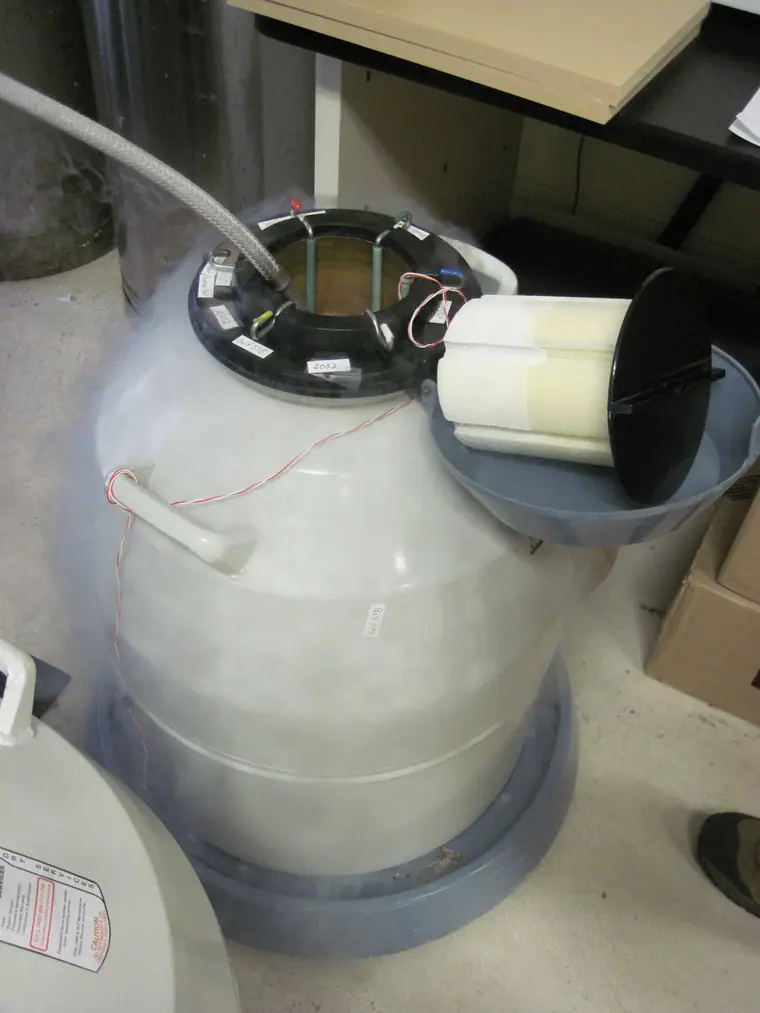
Cryopreservation solved a medical problem and created a legal one. An embryo frozen in 1988 is still frozen. The marriage that produced it may not be. The clinic that stores it may have changed hands twice. And the two people whose consent created it may now want opposite things, or one of them may be dead.
American law had no ready category for this. Property law assumes a thing that can be divided or sold. Family law assumes a person whose interests a court can consider. An embryo in liquid nitrogen is treated by different courts as one, the other, or something in between — and the answer determines everything downstream, including whether a probate court has anything to administer.
The archive's position here is narrow and deliberate: report what each court actually held, precisely, and stop. These are among the most politically contested decisions in American law. What follows is the holdings and the statutes, not a view about them.
One number for scale, from the Tennessee court itself. When Davis v. Davis was decided in 1992, it was noted that at least 20,000 cryopreserved preembryos already existed in the United States. The dispute in that case concerned seven.
Davis v. Davis, and the framework nearly everyone borrowed
Junior Lewis Davis filed for divorce from Mary Sue Davis. The parties agreed on everything except seven cryopreserved preembryos held at a fertility clinic. Junior Davis wanted them not to be used. Mary Sue Davis wanted them donated to a childless couple.
The trial court held that the preembryos were human beings from the moment of fertilisation and awarded them to Mary Sue Davis. The Court of Appeals reversed, holding that Junior Davis had a protected right not to beget an unwanted child, and that no compelling state interest justified ordering implantation against a party's wishes.
The Tennessee Supreme Court, in Davis v. Davis, 842 S.W.2d 588 (Tenn. 1992), declined both of the available simple answers. It held that preembryos are neither persons nor strictly property, but occupy an interim category entitled to special respect because of their potential for human life. Then it built a decision procedure, and that procedure is what spread.
- First, the parties' own prior agreement controls. Where the gamete providers have agreed in advance what should happen, courts should enforce it.
- Second, absent an agreement, the court balances the parties' interests. Not the embryo's — the parties'.
- Third, in that balance, the party wishing to avoid procreation ordinarily prevails — provided the other party has a reasonable possibility of achieving parenthood by other means.
- Fourth, the result in Davis itself: Junior Davis prevailed.
The framework is elegant and it has an obvious pressure point. The tiebreaker favours the party who wants not to proceed, which means the person for whom these embryos are the last realistic chance at a genetic child is the person most likely to lose. Courts applying Davis have wrestled with the “reasonable possibility” proviso ever since, because it is doing an enormous amount of work in a single clause.

Kass v. Kass, and the consent form as the whole answer
Maureen Kass and Steven Kass underwent IVF at John T. Mather Memorial Hospital, producing five cryopreserved pre-zygotes. As part of the process they signed consent forms stating what should happen to any unused material, including in the event of a dispute. Weeks later, with divorce imminent, they signed a further document on June 7, 1993 confirming that the pre-zygotes should be disposed of in the manner set out in the consent form, and that neither of them nor anyone else would lay claim to custody of them.
Maureen Kass then changed her position and sought the pre-zygotes for an implantation procedure.
The New York Court of Appeals, in Kass v. Kass, 91 N.Y.2d 554 (1998), decided May 7, 1998, held that IVF consent agreements should generally be presumed valid, binding, and enforceable, and that the disposition directions they contain should be upheld in a subsequent dispute. On the record before it, the court found that the forms had clearly expressed the couple's mutual intent to donate the material to research if a dispute arose. Steven Kass prevailed.
Kass is, in effect, the first Davis step taken seriously. It says that people can settle this in advance, that the settlement will be honoured, and that the moment to think carefully is the moment the clinic hands you a form — not the moment the relationship ends.
Not every state agrees that an advance agreement should be enforced against a party who has changed their mind, particularly where enforcement would compel someone to become a genetic parent. Several courts have adopted a contemporaneous mutual consent approach instead, under which neither party can be held to a prior direction and nothing happens without agreement at the time. The result of that approach, in practice, is indefinite storage.
LePage, and what the legislature did three weeks later
In LePage v. Center for Reproductive Medicine, P.C., decided February 16, 2024, the Supreme Court of Alabama held 7–2 that parents of frozen embryos destroyed at an IVF clinic could proceed with claims under Alabama's Wrongful Death of a Minor Act, a statute enacted in 1872.
The holding, stated precisely: under the plain language of the Act, the term “child” includes an unborn child regardless of location — inside or outside a biological uterus. The court further held that even if the Act's language were ambiguous, the Sanctity of Unborn Life Amendment to the Alabama Constitution, ratified by voters in 2018, would require an interpretation favouring protection of the unborn.
It is a statutory-construction holding about who counts as a “child” under one nineteenth-century wrongful death statute in one state. It is not a holding about probate, inheritance, or the constitutional status of embryos generally. It was nevertheless read by IVF providers in Alabama as creating potential liability for the ordinary attrition of the IVF process, and several clinics suspended services.
The legislature responded within three weeks. On March 6, 2024, Governor Kay Ivey signed SB 159, granting broad civil and criminal immunity to IVF providers in Alabama. Clinics subsequently resumed operations.
Whatever one thinks of the decision or the statute — and people think a great deal, in both directions — the sequence is the useful part for anyone with material in storage: a court can change the classification of your embryos in a single morning, and a legislature can change it back. The one thing that does not depend on either is a written agreement you signed yourself.
Timeline
- 1872Alabama enacts the Wrongful Death of a Minor Act, the statute construed 152 years later in LePage.
- 1992Davis v. Davis, 842 S.W.2d 588 (Tenn.): preembryos occupy an interim category entitled to special respect; prior agreement controls, then a balancing test that ordinarily favours the party wishing to avoid procreation. Junior Davis prevails.
- 1993Florida enacts §742.17 (ch. 93-237), requiring a written disposition agreement between a commissioning couple and the treating physician.
- Jun 7, 1993Maureen and Steven Kass sign the document confirming that their five cryopreserved pre-zygotes be disposed of as set out in their IVF consent forms.
- May 7, 1998Kass v. Kass, 91 N.Y.2d 554: IVF consent agreements are generally presumed valid, binding, and enforceable. Steven Kass prevails.
- 2018Alabama voters ratify the Sanctity of Unborn Life Amendment to the state constitution.
- Feb 16, 2024LePage v. Center for Reproductive Medicine: the Alabama Supreme Court holds 7–2 that “child” under the Wrongful Death of a Minor Act includes an unborn child regardless of location. Several Alabama clinics pause IVF services.
- Mar 6, 2024Governor Kay Ivey signs SB 159, granting broad civil and criminal immunity to IVF providers in Alabama. Clinics resume operations.
What actually went wrong
- The form was signed without being read. In both Davis and Kass the decisive question was what the parties had agreed in advance. In Kass the agreement was enforced; in Davis there was none, and a court balanced the interests instead.
- The agreement did not cover death. Divorce is the scenario everyone anticipates. Death of one party, incapacity, separation without divorce, and the closure or sale of the clinic are the ones that get left out.
- Nobody said what happens to the material itself. Discard, donate to another couple, donate to research, continue storage and at whose expense — an agreement that omits the options is an agreement that will be litigated.
- The classification changed underneath the parties. LePage construed an 1872 statute in 2024 and the legislature responded in three weeks. The legal category of stored embryos is not a fixed background fact.
- The storage contract and the disposition agreement were treated as the same document. They are usually not. One is with the clinic about fees and liability; the other is between the parties about what happens next.
Would it have gone that way in Florida?
Florida decided this by statute in 1993, and it is unusually direct: you must have a written agreement, and if you do not, the statute supplies the default.
Fla. Stat. §742.17 is titled “Disposition of eggs, sperm, or preembryos; rights of inheritance.” Its first command is a requirement rather than a permission: “A commissioning couple and the treating physician shall enter into a written agreement that provides for the disposition of the commissioning couple's eggs, sperm, and preembryos in the event of a divorce, the death of a spouse, or any other unforeseen circumstance.” Florida does not wait for the dispute. It puts the document at the front.
Then it supplies defaults, for the case where no written agreement exists. Under §742.17, absent an agreement: remaining eggs or sperm stay under the control of the party who provided them; decision-making authority over preembryos rests jointly with the commissioning couple; and upon the death of one member of the couple, the surviving spouse retains control of the eggs, sperm, or preembryos.
And it answers the estate question in one sentence. §742.17(4): “A child conceived from the eggs or sperm of a person or persons who died before the transfer of their eggs, sperm, or preembryos to a woman's body shall not be eligible for a claim against the decedent's estate unless the child has been provided for by the decedent's will.” In Florida the posthumously conceived child does not inherit by default — but is provided for if the decedent's will provides for them. That is a drafting instruction, not a prohibition.
How Florida compares. The Florida default of joint decision-making over preembryos means that, absent agreement, neither party can act unilaterally — functionally the contemporaneous-consent approach, with indefinite storage as the practical consequence of deadlock. The Florida rule on death, by contrast, is decisive: control passes to the surviving spouse. And because §742.17 mandates a written agreement in the first place, the Davis balancing test is much less likely to be reached in a Florida clinic than in a state with no statute.
The honest caveats. §742.17 speaks of a “commissioning couple” and the treating physician, and does not by its terms address every arrangement now in use — a single person, an unmarried couple, donor gametes, a clinic in another state, or material moved across state lines. It does not say what happens if the written agreement is silent on the specific event that occurs. And the surviving-spouse default operates whether or not that is what the deceased spouse would have chosen, which is precisely why the statute asks for the agreement first.
What to actually do, and it is three documents rather than one. (1) Get a copy of the written disposition agreement required by §742.17 and read it — it should name what happens on divorce, on death of either party, on incapacity, and on failure to pay storage fees, and should choose among discard, donation to another family, donation to research, and continued storage. (2) Address the material in your will or revocable trust, because §742.17(4) makes the will the only route by which a posthumously conceived child can claim against a Florida estate — and if you do not want that result, say so expressly. (3) Tell the person holding your health care surrogate designation and your personal representative that the material exists and where. An agreement nobody can find is not much better than no agreement at all.
What people ask us about this.
Further reading
Third-party sites. Not ours, not endorsed, not kept current by us — just the places worth going next.
Sources
- Fla. Stat. §742.17 — Disposition of eggs, sperm, or preembryos; rights of inheritance — The Florida Senate
- Davis v. Davis, 842 S.W.2d 588 (Tenn. 1992) — Justia — Tennessee Supreme Court
- Davis v. Davis (1992) — Embryo Project Encyclopedia, Arizona State University
- Kass v. Kass, 91 N.Y.2d 554 (1998) — Justia — New York Court of Appeals
- Kass v. Kass (1998) — Embryo Project Encyclopedia, Arizona State University
- LePage v. Center for Reproductive Medicine, P.C. (Ala. Feb. 16, 2024) — Justia — Supreme Court of Alabama
- The real impact of the Alabama Supreme Court decision in LePage v. Center for Reproductive Medicine — JAMA, 2024
- Alabama IVF case memo — ASU Center for Public Health Law and Policy, Jul 2024
If this is your situation
Free 30-minute consult. Plain English. No pressure.
Nearly every case in this archive turned on something ordinary — an unwitnessed page, a stale beneficiary line, a document nobody could find. Those are cheap to fix while you're alive and expensive to fix afterward.